My sister unwrapped the painting I gave her as a wedding gift and laughed. “We wanted cash, not a painting.” She shoved it into the garage. Five years later, during her divorce, a liquidator spotted it, stopped, and called an appraiser. That night, my sister called me, her voice shaking. “Who are you?”
The Second Door
Brooke brought the painting back to me on a Tuesday afternoon, five years after she had asked a wedding venue employee to hide it in a garage.
She arrived at my studio without calling first. The canvas was wrapped in a gray moving blanket, its corners protected with cardboard, and she carried it with both hands as if the weight had changed since the last time she touched it.
Maybe it had.
I stood in the doorway while she rested it carefully against the wall.
“You need to take this,” she said.
My sister had spent most of her life filling silence before anyone else could. That afternoon she kept creating it.
Her thumb moved over the little brass key attached to the back of the frame.
I looked at the canvas, then at her.
“It’s yours.”
“I know.”
“You know what people say it’s worth.”
“I know that too.”
There was a small water stain along the bottom of the old wooden frame. I had stared at that stain so many times that it had become more important to me than the number attached to the painting.
Brooke swallowed.
“That’s why I’m giving it back.”
I didn’t understand until she added, very quietly, “I don’t want the first good thing I do with it to happen because somebody finally told me the price.”
Five years earlier, she had torn the brown paper from the same painting in front of sixty-three wedding guests.
I remember the sound more clearly than I remember the music.
Paper ripping.
Glasses touching.
A chair scraping behind me.
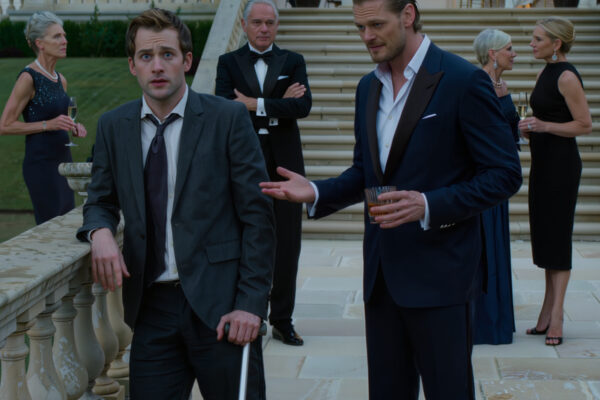
Brooke stood beside Ryan under a ceiling full of suspended flowers and tiny warm lights. Her wedding had been planned with the precision of a presidential summit. She had a floral designer, a lighting consultant, a champagne wall, and a woman whose actual job title included the phrase guest experience.
Then there was me, her older sister, holding a glass of champagne I had barely touched and watching her unwrap eleven weeks of my life.
The painting was thirty inches wide and slightly taller than that, a field of layered blue and smoke-gray color surrounding a pale doorway. I had built it slowly, using translucent paint so that different shapes appeared depending on where you stood. Beneath the surface were dozens of tiny silver marks. From straight on, they looked almost decorative. From the side, they formed another image inside the doorway.
Brooke stared at it.
Three seconds, maybe four.
Then she laughed.
“Oh, Stella.”
Ryan leaned closer. “You made that?”
I nodded.
Brooke looked toward the gift table, where envelopes had been stacked beside crystal bowls and boxes from expensive stores.
“We were kind of hoping people would stick to cash or the registry.”
She said it lightly enough that people could pretend it was a joke.
Ryan laughed first.
A few guests followed.
My mother brought her napkin to her mouth, disguising either a cough or embarrassment. I never asked which.
Brooke turned the canvas around and saw the small brass key attached to the back.
“What’s this?”
“It belonged to our old desk.”
She frowned.
When we were children, our father had brought home a battered wooden writing desk from a yard sale. It had two narrow drawers and one tiny lock neither of us could open because the key had been lost.
Years later, Dad found the key inside a coffee tin in the garage and gave it to me.
I had attached it to Brooke’s painting because of a game we used to play at that desk. We would draw doors on printer paper and invent whatever existed behind them. Brooke always drew castles, mansions, ballrooms, swimming pools.
I drew another door.
She used to make fun of me for it.
“You’re supposed to get somewhere eventually,” she would say.
At her wedding, she flicked the brass key with one finger.
“Cute.”
Then she waved at a young man from the venue staff.
“Can somebody put this somewhere safe? Maybe the garage?”
Safe.
That was the word she used.
The man looked at me before taking it, as though I might object.
I didn’t.
That was one of my worst habits at thirty-one. I could turn pain into politeness before anyone else had to notice what they had done.
“No problem,” I said.
The painting disappeared through a service door.
For the rest of the reception, I smiled in photographs. I helped my mother fix the clasp on her bracelet. I found Brooke’s phone when she misplaced it under a linen napkin. I even danced once with Ryan when he dragged me onto the floor and told me I took life too seriously.
Nobody mentioned the painting again.
That was how things worked in our family.
Brooke was three years younger than me and had been the center of attention almost from birth. It wasn’t because our parents consciously loved her more. Families are rarely that simple.
Brooke simply had a talent for making herself impossible to overlook.
She was funny, social, beautiful in the effortless way that made strangers remember her after meeting her once. When she walked into a room, she behaved as if something had begun.
I was different.
I noticed when the dog’s medication was running low. I remembered where people put their passports. I checked the locks before bed. If my parents went away, I made sure the mail came in and the freezer didn’t stop working.
Brooke created stories.
I prevented problems.
Guess which one people applauded.
The frustrating part was that I loved her.
That detail matters.
It would be easier to tell this story if Brooke had always been cruel. She wasn’t.
When I was twenty-four, I had my first small gallery show in a space above a furniture store. I was terrified no one would come. Brooke arrived early carrying supermarket flowers wrapped in plastic and spent the evening telling strangers, with embarrassing enthusiasm, “That’s my sister. She made all of this.”
I remembered that night for years.
One generous memory can buy forgiveness for a surprising amount of selfishness.
So when Brooke became engaged to Ryan, I wanted to give her something personal.
I had already designed her invitations after she fired the first designer for failing to understand what she called her “emotional palette.” I had helped her compare venues, corrected the seating chart, and talked our mother through three separate emergencies involving the color of table linens.
But the wedding gift was mine.
Not useful.
Not requested.
Not practical.
Mine.
I called it Second Door.
I painted it at night in my rented studio while an ancient wall heater rattled so hard that brushes rolled off the worktable. I layered translucent pigments until the center doorway appeared almost flat from one position and strangely deep from another. The hidden silver marks were deliberate, although no one in my family would have understood why.
By then I had already been living another professional life for several years.
My relatives thought I made digital art.
That was technically correct in the same way saying a surgeon worked with sharp objects would have been technically correct.
Under the name Aster Veil, I created generative digital work, large-scale visual installations, and limited blockchain-authenticated pieces. I had chosen the pseudonym when hardly anyone knew my work. At first anonymity had been practical. Later it became protection.
One project gained attention.
Then another.
A small museum acquired a piece. A touring musician licensed one of my visual sequences. Collectors started trading my early works, and internet forums began arguing about who Aster Veil actually was.
They guessed I was a man in Berlin.
A design collective in Toronto.
An artificial-intelligence lab.
A retired Japanese mathematician.
For a while, one very determined group believed Aster Veil was seventy-two years old and lived outside Kyoto.
I never corrected anyone.
I loved making the work.
I had no desire to become content myself.
The first time an article tried to identify me, strangers started analyzing blurry photographs of people leaving an exhibition and debating whether any of them “looked like Aster.”
That was enough.
I stayed Stella Mercer everywhere else.
My family made that surprisingly easy because none of them asked enough questions.
At Christmas one year, my uncle explained digital art markets to me for nearly half an hour.
Brooke finally said, “Stella does some computer art too.”
My uncle waved a hand.
“I mean the serious collector stuff.”
I looked down at my cranberry sauce so nobody would see me laugh.
Second Door was the only physical painting I made during that period.
That made it unusual.
Inside the brass key attached to the frame, I had engraved a short sequence tied to the authentication history of my earliest verified Aster Veil work. It wasn’t a password. It didn’t unlock money. It couldn’t give anyone access to an account.
It was provenance.
A bridge between the physical painting and my established digital history.
I had designed it that way because I thought one day, when the noise around Aster Veil faded, I might tell Brooke what I had given her.
I imagined the conversation happening in her living room.
Maybe she would laugh.
Maybe she would say she always knew I was strange.
Maybe she would finally understand why I had spent eleven weeks making a blue doorway instead of writing a check.
Instead, the painting went into her garage.
For five years, I pretended that did not matter.
My career changed during those years.
My family’s opinion of it did not.
Brooke occasionally asked whether I was “still doing the art thing.” My mother suggested I design logos for one of her friends. My father once offered me an old desktop monitor because he assumed computer artists needed as many screens as possible.
Ryan was slightly more interested, but only when money entered the conversation.
He worked in commercial real estate and had a complicated relationship with wealth. He didn’t merely enjoy expensive things. He liked them to be observed.
He positioned his watch on restaurant tables.
He turned wine labels outward.
He chose hotels partly based on how recognizable the lobby would look in photographs.
But Ryan was not always unbearable.
Once, when my car died on the freeway late at night, he drove almost two hours to get me because Brooke was sick and couldn’t come. Another time he spent half a Saturday helping Dad repair a fence after a storm.
That history mattered later.
Betrayal from someone who has never done anything kind is easy to categorize.
Betrayal from someone who once showed up for you at midnight creates a different wound.
By the fourth year of Brooke and Ryan’s marriage, the atmosphere around them changed.
Their jokes sharpened.
They corrected each other in front of people.
Brooke complained that Ryan monitored every purchase. Ryan complained that Brooke treated credit limits as personal insults.
When they came to family dinners, they increasingly arrived in separate cars.
Then, in year five, they filed for divorce.
The financial disclosures became combative almost immediately.
Ryan accused Brooke of reckless spending.
Brooke accused Ryan of concealing assets.
From what I later learned, neither accusation was entirely wrong.
Because both sides disputed the household inventory and values, an independent specialist was brought in to document and assess property before anything could be divided or sold.
His name was Franklin Moss.
I had never met him.
He had spent more than twenty years handling estate inventories, business liquidations, collections, and high-conflict divorces. He had learned, apparently, that people stored valuable objects in places no reasonable person would choose.
That was how, one afternoon, he ended up in Brooke and Ryan’s garage.
The room had become a graveyard of postponed decisions.
A treadmill with one broken display.
Two folding chairs.
Holiday decorations in cloudy plastic tubs.
Half-empty containers of automotive fluid.
Old lamps.
A box labeled KITCHEN even though they had lived in the house for years.
Second Door stood behind the treadmill, facing the wall.
Franklin moved one chair.
Then another.
He saw the edge of blue canvas.
Brooke was nearby with one of the attorneys.
According to her, Franklin stopped so abruptly that the attorney almost walked into him.
He pulled the painting forward several inches but didn’t lift it.
“What is this?”
Brooke barely looked.
“My sister made it.”
Franklin crouched.
He studied the lower right corner first. Then the surface. Then he moved to the back.
When he noticed the brass key, he stopped touching anything.
“Your sister’s name?”
“Stella.”
“Stella what?”
“Mercer.”
Brooke sounded annoyed.
“She makes internet art. Why?”
Franklin took out his phone.
“What?”
“Please don’t move this.”
Brooke laughed once.
“You can put it in the junk inventory if you want.”
Franklin looked at her.
“I wouldn’t.”
Two months earlier, he had attended an exhibition that included a digital work called Second Door Open, one of the later variations from an Aster Veil retrospective.
He recognized the composition.
Not exactly.
Enough.
Forty minutes later, an appraiser named Celia Ward was driving across Los Angeles.
At 9:17 that night, my phone rang.
I was standing over my kitchen sink eating noodles from the pot because I had forgotten to run the dishwasher.
That same week, one of my installations was being shown in Tokyo.
Professional success does not necessarily improve domestic discipline.
Brooke’s name appeared on the screen.
I answered.
“Hey.”
Nothing.
“Brooke?”
I heard breathing.
Then she said, “Who are you?”
I lowered the fork.
“What happened?”
“The painting.”
Across my apartment, above the bookshelf, was an empty nail.
I had hammered it there years earlier after finishing Second Door. For a few weeks, the painting had hung in that spot while the final layers cured.
After the wedding, I never put anything else there.
“What about it?”
“There are people in my garage wearing gloves.”
That was when I understood.
Not the value.
Not yet.
The key.
“They found the engraving?”
Another silence.
Brooke whispered, “You know about that?”
I closed my eyes.
Of course I knew.
I had put it there.
The next morning I drove to her house.
I expected Brooke, Franklin, and the appraiser.
Instead, I arrived at something between a legal meeting and a family emergency.
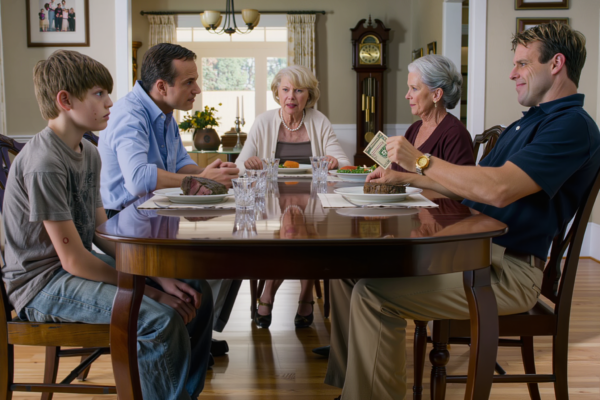
Franklin Moss was in the living room. Celia Ward had arranged her equipment on the dining table. Brooke’s attorney was there. Ryan’s attorney was there. Ryan was pacing between the fireplace and the windows.
My mother had somehow arrived without being invited.
She stood beside the kitchen island clutching coffee and watching everyone as if she had been denied the first ten minutes of a television show.
Dad appeared fifteen minutes later carrying nothing and offering no explanation.
Families have information systems more efficient than governments when embarrassment is involved.
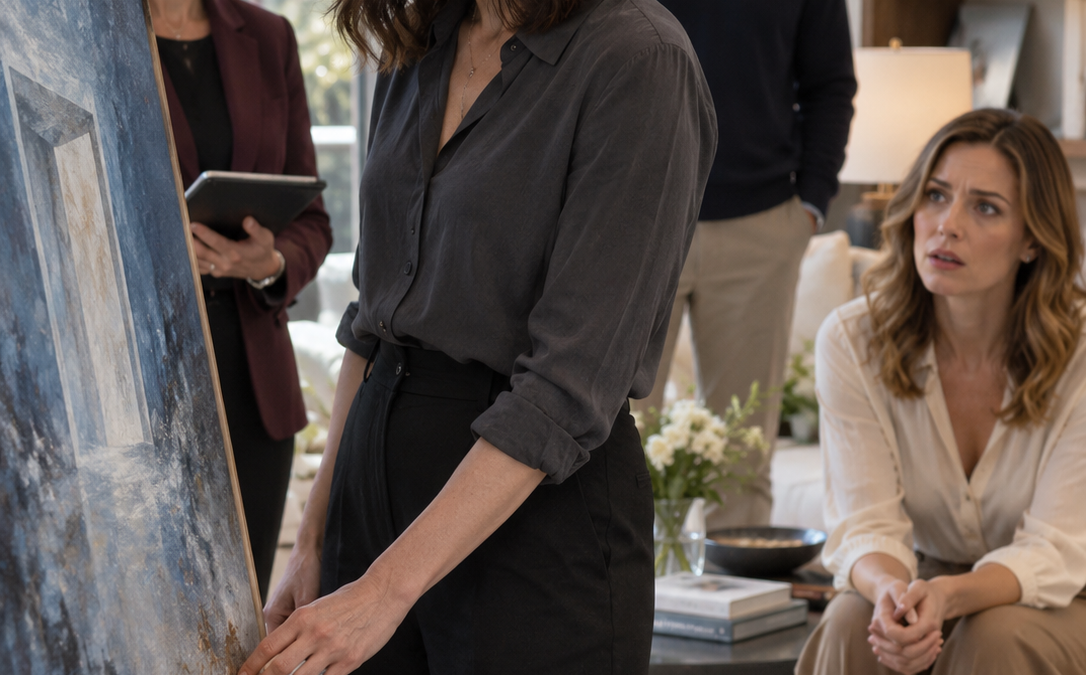
Second Door stood on a padded easel beneath the living room windows.
For the first time in five years, it was under good light.
I went straight to it.
The blue had survived.
The silver marks were intact.
The canvas itself looked surprisingly stable.
Then I noticed the brown discoloration along the lower frame.
Moisture.
Not enough to destroy the painting.
Enough to tell me exactly where it had lived.
Brooke watched my face.
“Tell them they’re wrong.”
I looked at her.
“About what?”
Celia spoke before Brooke could.
“We believe this painting predates the first major Aster Veil digital cycle and may be directly connected to the authenticated work.”
My mother frowned.
“Is that good?”
Celia looked at her, unsure whether the question was serious.
“Yes.”
“How good?”
Ryan stopped pacing.
Celia hesitated.
“Comparable works are difficult because this is a physical piece, but an authenticated digital work from the same broader period reportedly sold privately last year for around one-point-eight million dollars.”
My mother’s coffee cup stopped halfway to her mouth.
Brooke sat down.
Ryan said, “One-point-eight?”
Celia raised a hand.
“That is not a valuation of this painting. It’s context.”
My father stepped closer to the canvas.
“I always liked this one.”
Every person in the room turned toward him.
I stared.
“Dad, you called it blue lasagna.”
He considered that.
“I like lasagna.”
I laughed.
I couldn’t help it.
Brooke didn’t.
She was looking at me in a way I had never seen before.
Not because I had become different overnight.
Because the information around me had changed.
“Stella.”
I waited.
Her voice dropped.
“Are you Aster Veil?”
Five years after she had laughed while someone carried my work into a garage, my sister finally asked me what I did.
“Yes.”
My mother put one hand against her chest.
Dad looked at me, then at the painting, then back at me.
Ryan asked the first question I should have expected from him.
“So what is it worth?”
Celia began explaining that value would depend on condition, provenance, authentication, market demand, documentation, and whether I formally acknowledged the work.
Ryan’s attention moved to me.
Brooke stood.
“It’s authenticated, right? Stella, tell them.”
I didn’t answer immediately.
Ryan and Brooke began arguing over whether the painting had been a gift to Brooke individually or a wedding gift to both of them.
I stepped closer to the frame.
My thumb stopped near the water stain.
That mark hurt more than Brooke’s laughter had.
At the wedding, I could pretend she had been distracted, overwhelmed, thoughtless.
The stain represented five years.
Five summers.
Five damp winters.
Five years when the painting had been worth exactly what it was worth that morning, except nobody in the house knew the number.
Now everyone was standing around it carefully.
Gloves.
Padding.
Professional lights.
Measured voices.
Nobody wanted to breathe too close to it.
I authenticated Second Door.
I did not do it for Brooke.
I did not do it for Ryan.
I did it because the painting was mine when I created it, even if ownership had later transferred with the gift, and I refused to make truth conditional on whether the people holding it had treated me well.
The formal appraisal took time.
Research was done.
Condition was documented.
The provenance link was verified.
The final figure was not $1.8 million.
It was $640,000.
A serious amount of money, but not a magical lottery ticket and not enough to make the divorce simple.
If anything, it complicated it.
The painting entered the broader property dispute, and questions over whether it had been intended for Brooke alone or for the couple became another issue for lawyers to argue about.
I thought that would be the strangest consequence.
I was wrong.
Three days after my identity became formally connected to the painting, an arts publication confirmed that Stella Mercer and Aster Veil were the same person.
My family transformed.
My mother called first.
“I need better pictures.”
“Of what?”
“Me.”
“Why?”
“For my profile.”
“What profile?”
A pause.
“Mother of Aster Official.”
I closed my eyes.
“How many followers do you have?”
“Eleven.”
Four were relatives.
One became me because she refused to end the call until I followed her.
Dad joined social media two days later and posted a photograph of himself holding a screwdriver.
Creativity runs in the family, the caption said.
Dad sold insurance.
The screwdriver was not his.
Aunt Diane updated her biography to describe herself as related to an internationally collected digital artist.
My cousin Mason launched a podcast about creative families. It lasted two episodes.
At first I found it funny.
After a lifetime of being the relative people interrupted, I suddenly had a family determined to document my every breath.
My mother invited me to lunch and seated me beneath a ring light.
Aunt Diane asked me to hold one of her homemade candles “just naturally.”
Mason positioned his protein powder beside my coffee cup and then pretended it had happened by accident.
Even the animals became part of it.
My parents’ cocker spaniel, Winston, acquired his own account.
His profile described him as an “art dog” and “brother to genius.”
He was not my brother.
He was a cocker spaniel.
Brooke posted an old photograph of me petting her cat, Clementine, and wrote something about reconnecting with my roots.
Clementine had met me twice and disliked me both times.
By Thanksgiving, I walked into my parents’ house and found three relatives, two dogs, one cat, and a rabbit arranged around the living room.
I stopped in the doorway.
“Why is there a rabbit?”
Mom clapped once.
“Everybody just act normal.”
“Whose rabbit is that?”
“Diane’s friend’s.”
Aunt Diane looked offended by my tone.
“He has twelve thousand followers.”
“The rabbit?”
“Yes.”
The rabbit, I later learned, had representation.
That Thanksgiving was when amusement began turning into exhaustion.
Dad photographed me opening the refrigerator.
Aunt Diane tried to film me seasoning potatoes.
Mason crouched behind a ficus and whispered, “Just be organic,” while pointing a phone at me.
Brooke began posting childhood photographs with captions describing how she had watched my talent develop.
One of the photographs was of her.
I commented, “That’s you.”
She deleted my comment.
I laughed about it for a while.
Then people outside the family noticed.
Collectors contacted relatives.
Reporters asked questions.
Brands sent messages.
My family had spent years not understanding what I did and approximately ten days deciding they were qualified to represent it.
I started saying no.
No, Mom, I wasn’t doing a family interview.
No, Diane, I wasn’t promoting candles.
No, Mason, I wasn’t appearing on the podcast.
No, Brooke, you could not tell a publication you had “guided my early aesthetic development” because you once owned a box of markers.
Most of them complained.
None of it felt dangerous.
Then Ryan decided access to me had market value.
His divorce was worsening.
Legal bills were rising. One of his commercial investments had performed badly. He had fewer options than he wanted anyone to know.
The $640,000 painting was not going to rescue him. Its treatment in the divorce remained contested, and even a valuable object is not the same thing as cash in a bank account.
Ryan started approaching entertainment pages and gossip accounts.
He told people he had exclusive insight into the private life of Aster Veil.
I called him once.
“Stop using my name.”
He gave a short laugh.
“We’re family.”
“You’re divorcing my sister.”
“Temporarily.”
I remember staring at the phone after he said it.
Not because I found it funny.
Because it revealed how he thought.
People were permanent when they were useful.
Rules were temporary when they were inconvenient.
I told him again to stop.
He said I was overreacting.
About two weeks later, Maya Chen called me.
Maya had represented me on intellectual-property and business matters for years. She rarely sounded surprised by anything.
That evening she did.
“Stella, I need to ask you a strange question.”
“Okay.”
“Did you ever stay overnight at Brooke and Ryan’s Palm Springs place?”
“Yes.”
“Did you ever use the guest bathroom?”
I laughed because the question was so unexpected.
Then I remembered a birthday weekend two years earlier.
A crowded house.
Too many relatives.
Me borrowing the guest shower before dinner.
“Yes.”
Maya paused.
“Did you know there was an indoor security camera covering part of the hallway outside that bathroom?”
The apartment seemed to change temperature.
“No.”
“There’s more.”
I sat down.
The images were not explicit.
That distinction mattered legally and practically, but emotionally it offered almost no comfort.
The camera had captured still frames of me leaving the bathroom wrapped in a towel. At least two images appeared to have been taken while the bathroom door was partly open, at an angle where I had believed I was completely private.
Ryan had kept them.
After my identity became public, he had tried to sell them.
The proposed price was $85,000 if the buyer could confirm that the woman in the images was Aster Veil.
I listened to Maya explain that a gossip broker had requested verification. Ryan, through an intermediary, had sent enough material to demonstrate what he possessed.
The deal did not happen.
Someone on the buyer’s side had enough legal sense to walk away.
The communications eventually reached Maya.
For a long time after she finished, I said nothing.
In my head, every ridiculous moment from the previous weeks rearranged itself.
The rabbit.
Dad at the refrigerator.
Brooke posting childhood photographs.
Mason behind the ficus.
Those had been irritating. Invasive, sometimes. But mostly absurd.
Ryan had looked at the same sudden attention and seen a product.
Then he had crossed a line the rest of them had not.
“Do you still have the communications?” I asked.
“Yes.”
“Keep everything.”
“I already am.”
I did not call Ryan.
I did not threaten him.
I did not post his name.
Maya contacted his attorney and sent formal demands concerning the images, the devices on which they had been stored, any cloud backups, copies, and communications connected to the attempted sale.
The process that followed was not dramatic.
That surprised some members of my family.
Real consequences often arrive through boring documents.
Preservation notices.
Inventories.
Device examinations.
Statements.
Emails between lawyers.
Dates.
Signatures.
Ryan called me once from a number I didn’t recognize.
I answered because I was expecting a delivery.
“Stella.”
I knew his voice immediately.
“You shouldn’t be calling me.”
“You’re destroying my life over pictures nobody even saw.”
I stood beside my studio worktable.
The brass key from Second Door had become the image I kept seeing in my mind.
“You priced them.”
Silence.
“It was eighty-five grand.”
“I know.”
“Do you understand what eighty-five grand would do for me right now?”
“Yes.”
“What?”
“Pay your lawyer.”
I hung up.
It was the last joke I made about the situation.
As accounts and devices were reviewed, more material surfaced.
Ryan had kept recordings of private arguments between himself and Brooke as well.
Some had been made without her understanding the extent of what he was saving.
That discovery affected their divorce negotiations.
Not magically.
Not overnight.
No judge appeared and solved their marriage in a five-minute speech.
But Ryan’s credibility changed.
So did Brooke’s understanding of whom she had been married to.
For years, they had accused each other of secrecy.
Ryan had created an archive.
Eventually, the issues involving my images were resolved through enforceable restrictions governing possession and distribution, financial consequences, and sworn confirmation concerning surrendered copies and deletion.
Other legal questions remained with attorneys.
The $85,000 Ryan had imagined never existed beyond an offer he tried to secure.
For some reason, that made the whole thing seem smaller and uglier.
He had risked relationships, reputation, money, and legal exposure for cash he never received.
Brooke called me after one of the final mediation sessions.
Her voice was exhausted.
“I didn’t know.”
I was in my studio, looking at the blank section of wall where Second Door had once hung before her wedding.
“I know.”
“No. I mean I didn’t know he was capable of that.”
I almost told her she should have known.
It would have been satisfying for about five seconds.
Then I remembered Ryan coming to get me when my car died.
People reveal themselves in pieces.
Sometimes the worst piece arrives late.
“I believe you,” I said.
Brooke began crying, quietly enough that I almost missed it.
For once, I didn’t try to solve anything.
After the divorce settlement, Second Door ended up with Brooke as part of her share.
I assumed she would sell it.
She had every legal right to do so, as far as I understood the final arrangement.
Collectors had already expressed interest.
I told myself I didn’t care.
That old habit again.
Convert hurt into maturity.
Call detachment growth.
Then, several weeks later, Brooke appeared at my studio with the painting wrapped in a moving blanket.
That was the Tuesday afternoon when she rested it against my wall and told me to take it.
“You could sell this,” I said.
“I know.”
“You could keep it.”
“I know.”
“Then why bring it here?”
She stared at the back of the frame.
Her thumb touched the brass key.
“Because I put it in a garage before I knew anybody wanted it.”
I waited.
“And now if I keep it because it’s valuable, what does that say?”
“That depends on why you keep it.”
She looked at me.
“I don’t trust my reason anymore.”
It was one of the most honest things Brooke had ever said.
No performance.
No dramatic apology.
No explanation about how stressed she had been at the wedding.
No attempt to remind me of all the good things she had done.
Just doubt.
I still didn’t take the painting that day.
Not immediately.
I told her to leave it.
For almost a week, Second Door remained wrapped beside my worktable.
Every morning I arrived, saw the gray blanket, and felt something different.
Anger.
Grief.
Embarrassment over how much I still cared.
Relief that Brooke had finally understood something.
Suspicion that she had understood it too late.
Then guilt for resenting someone who was trying.
Relationships are rarely repaired in a clean emotional sequence.
One Friday night I stayed late.
The building had gone quiet. Traffic moved below the windows. I made coffee I didn’t need and finally unwrapped the painting.
Under the studio lights, the hidden second image appeared inside the pale doorway.
Five years earlier, I had painted it for Brooke.
Now I was seeing it again as something I had made before any of us knew what would happen.
Before $640,000.
Before Aster Veil became a headline.
Before Ryan’s attempted sale.
Before lawyers.
Before boundaries became necessary.
The frame was damaged, so I had it replaced professionally.
I kept the original brass key exactly where it had always been.
Brooke came by several weeks later.
She stood in front of the painting for a long time.
“Do you hate me for the garage?”
“No.”
Relief moved across her face too quickly.
“So we’re okay?”
“I didn’t say that.”
She looked at me.
For most of our lives, that would have been the moment when I softened the sentence.
I would have laughed.
Changed the subject.
Told her it was fine.
This time I didn’t.
“I loved you enough to spend eleven weeks making that.”
Her eyes dropped toward the floor.
“You opened it in front of everyone, laughed because it wasn’t money, and sent it away because you thought it had no value.”
“I know.”
“No. Listen.”
She did.
“That painting was the same painting in your garage that it was when Franklin found it. Nothing about the work changed when Celia arrived with gloves. Nothing about me changed when the articles came out.”
Brooke pressed her lips together.
“I was stupid.”
“This isn’t about whether you knew I was Aster Veil.”
She looked up.
“That isn’t the part that hurt.”
Her eyes filled.
“The part that hurt was that Stella should have been enough.”
Neither of us spoke for a while.
I had imagined saying something like that to her for years.
In the imaginary versions, I was always calm and Brooke always understood immediately.
Real life was messier.
My hands shook.
She cried.
I wanted to comfort her and was still angry with her.
I loved my sister and did not trust her in the same way I once had.
Both things were true.
Finally Brooke nodded.
“You were enough.”
I looked at her.
“You just didn’t act like it.”
“No.”
It was not a beautiful reconciliation.
It was better.
It was accurate.
Afterward, I made rules for my family.
Actual written rules.
No photographs of me without asking.
No using my professional name to promote a product, service, account, podcast, candle, supplement, pet, or personal brand.
No selling family stories to media.
No filming in my home.
No surprise interviews.
No “accidental” livestreams.
No placing animals in my lap because someone believed engagement numbers would improve.
The animal rule existed because experience had taught me that my family required specificity.
Mom read the list at my kitchen table.
“What if Winston walks into a picture on his own?”
“Then Winston may retain counsel.”
Dad laughed so hard he had to remove his glasses.
Brooke smiled but didn’t laugh.
She understood why the list existed.
That mattered.
Things did not become perfect afterward.
Mom still occasionally asks whether I can “casually” tag her.
Dad finally stopped pretending to understand blockchain technology, which may be his greatest act of personal growth.
Aunt Diane’s experiment with animal-based promotion ended after the borrowed dachshund objected during a livestream.
The rabbit somehow became more popular.
Nobody understands why.
Mason abandoned the podcast.
Brooke still talks over me sometimes.
I still disappear emotionally when I am hurt instead of telling people immediately.
We are improving unevenly.
That is what most families do.
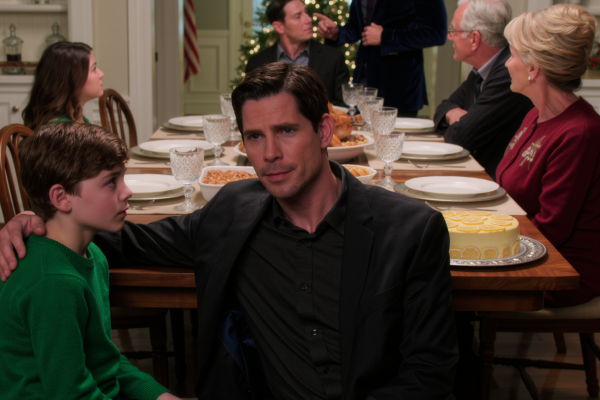
A few months after Second Door returned to my studio, we had dinner at my parents’ house.
No cameras were visible.
No one had arranged the food near branded products.
There were no borrowed animals.
Winston slept under the table, secure in the knowledge that he did not have to produce content.
After dessert, Mom reached for her phone.
Every person at the table looked at her.
She froze.
“What?”
Dad lifted an eyebrow.
“I’m checking the weather.”
Nobody moved.
Mom stared at us, offended.
“I am allowed to know whether it’s going to rain.”
Dad leaned toward me.
“Should we get that in writing?”
Brooke laughed.
A real laugh.
Not the one from the wedding.
For a moment I looked around the table and realized that the most important change had not happened to them.
It had happened to me.
For years, I had been waiting for my family to correctly identify my value before I allowed myself to believe I had any.
I thought recognition would fix old injuries.
Then recognition came.
It arrived with appraisers, articles, followers, collectors, reporters, and numbers large enough to make relatives suddenly remember every drawing I had ever made.
And none of it fixed the original wound.
Because the wound had never been caused by the price of the painting.
It had been caused by the belief that something from me could be dismissed because no one important had approved it yet.
Second Door still hangs in my studio.
I have never sold it.
Collectors occasionally ask.
I always say no.
One evening, a conservator needed to work on the backing, so I temporarily removed the little brass key.
I slipped it into my pocket before dinner at my parents’ house and forgot it was there.
Later, while everyone argued about whether the weather app was accurate, I rolled the key between my fingers beneath the table.
I thought about the desk Brooke and I shared as children.
Her paper castles.
My endless doors.
She used to tell me I never let myself arrive anywhere.
Maybe she was right then.
Maybe I was always waiting for the next room, the next version of myself, the next chance to become someone other people would finally recognize.
But sitting at that table, I understood the drawing differently.
A door did not always mean escape.
Sometimes it meant choice.
You could open one.
You could leave one open.
You could decide who was allowed through it.
And sometimes, after spending years holding it for everyone else, you could finally close it without apologizing.