A billionaire mother hid cameras because she wanted to protect her daughter. She expected the footage to give her answers. Instead, what she saw the ex-SEAL single dad do left her stunned—and made her realize there was far more to him than she had understood.
The Blind Spot in the Garden
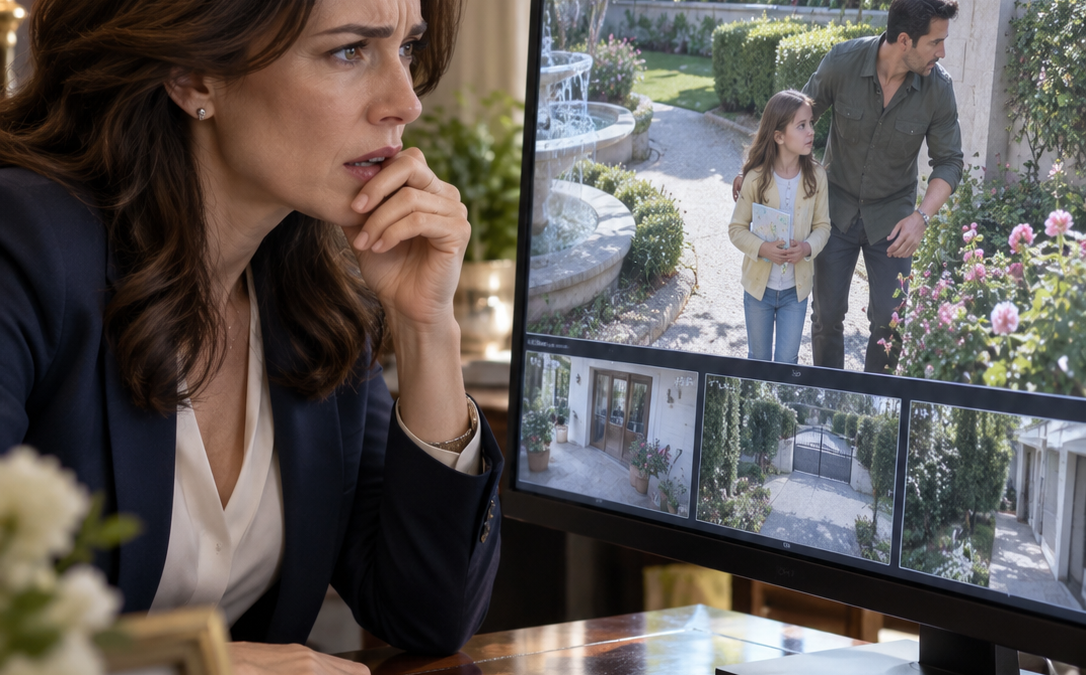
At 10:17 on a bright Tuesday morning, Saraphina Vale watched her daughter disappear from one camera and reappear in another.
That alone was not unusual.
The garden behind the house covered nearly two acres, and the security system divided it into overlapping views: rose beds, limestone paths, the greenhouse, the old oak tree, the south lawn, the stone wall along the eastern edge.
What made Saraphina lean toward the monitor was the man walking behind her eight-year-old daughter.
Caleb Rowan.
He was thirty-eight, quiet, broad-shouldered without looking imposing, and still new enough to the household that Saraphina had not decided whether she trusted him.
On the monitor, Marabel sat cross-legged beside a low fountain with a notebook balanced on her knees. She was coloring butterflies with blue and yellow pencils.
Caleb approached from behind the roses.
Saraphina’s hand tightened around the edge of her desk.
She had installed the hidden cameras because someone had been frightening her daughter.
Nobody on the household staff knew where all of them were.
Not the gardeners.
Not the cleaning crew.
Not even the security team.
She had told herself that secrecy was necessary because whoever had been watching Marabel might already be inside the estate.
Now Caleb stopped six feet from the child.
He didn’t call her name.
He didn’t touch her.
He looked toward the high garden wall.
Then toward the windows on the second floor.
His entire posture changed.
Marabel noticed.
She tipped her head up.
Caleb smiled at her and pointed toward the house as though he had remembered something ordinary.
Lunch, maybe.
A forgotten book.
Something harmless.
Then he stepped between Marabel and the eastern wall.
Saraphina sat straighter.
“What are you doing?”
Her voice sounded too loud in the empty office.
Caleb bent and said something to Marabel that the camera could not pick up. The little girl closed her notebook and reached for him.
He lifted her.
That was when Saraphina stood.
Her first thought was not reasonable.
It was not measured.
It came from six months of waking in the middle of the night because Marabel had appeared beside her bed without speaking.
It came from the anonymous photograph that had arrived on Saraphina’s phone three weeks earlier.
It came from the knowledge that the picture had been taken inside the property.
Caleb turned with Marabel in his arms.
Instead of taking the shortest path toward the kitchen, he walked directly across the open section of lawn.
Directly beneath one of the cameras nobody was supposed to know existed.
Then he looked up at it.
Not approximately.
Not past it.
At it.
Saraphina stopped breathing.
Caleb held her gaze through the lens for perhaps half a second.
Then he carried Marabel inside.
Saraphina reached for the phone on her desk.
Before she touched it, Caleb appeared again.
Alone this time.
He walked back into the garden.
Not toward the house.
Toward the rose bushes beside the eastern wall.
Saraphina sat back down.
She watched him crouch.
He moved two branches aside without touching the leaves more than necessary.
Then he stopped.
His face lost whatever softness it had carried with Marabel.
Saraphina zoomed the camera.
There, hidden among the dark leaves, was a small black object.
Too small for a landscape light.
Too angular for part of the irrigation system.
Caleb did not pick it up.
He took out his phone and photographed it.
Then he covered it carefully with a folded gardening cloth.
Saraphina stared at the monitor.
It wasn’t one of her cameras.
For the first time in weeks, the fear inside her became something more useful.
Specific.
Someone else had been watching the house.
And Caleb had found them watching.
Six months earlier, Marabel had still slept with her bedroom door open.
She had been the kind of child who ran ahead on hiking trails and had to be reminded that not every animal wanted to be her friend. She climbed trees in dresses, argued with adults who said butterflies were insects as though that made butterflies less important, and once brought a muddy stray dog through the formal dining room because it “looked lonely.”
Saraphina had spent most of Marabel’s childhood trying to balance two contradictory desires.
She wanted her daughter to understand that their life was unusual.
She also wanted her never to feel unusual.
The Vale estate made the first goal difficult.
The house stood behind iron gates on nearly twelve acres outside the city. Glass walls faced manicured gardens. There was a pool house, a greenhouse, a detached guest cottage, staff entrances, service corridors, and enough security equipment to make visitors uncomfortable if they looked too closely.
Saraphina had not built the place to impress anyone.
Most people assumed she had.
They saw her photograph in business magazines and her company’s name across the top floors of a downtown tower and concluded that everything in her life was an extension of ambition.
The truth was less flattering.
Saraphina liked control.
Control had made her wealthy.
Control had also gotten her through a bitter divorce, years of corporate disputes, and the slow realization that people often behaved differently around money.
She had spent a decade learning to verify before trusting.
Then Marabel became afraid.
At first it was small.
She stopped going downstairs alone after dark.
Saraphina assumed she had watched something frightening.
Then Marabel began checking her closet before bed.
Not once.
Every night.
She started closing curtains that had never bothered her.
She would freeze in the upstairs hallway and ask whether anyone was at the end of it.
Twice, Saraphina woke to find her daughter standing silently beside her bed, clutching the sleeve of her pajamas.
“What happened?”
Marabel shook her head.
“Bad dream?”
Another shake.
“Did you hear something?”
“I don’t know.”
The answer frightened Saraphina more than if Marabel had screamed.
Security found nothing.
The alarm system worked.
The gates were monitored.
The dogs never reacted to anyone unfamiliar.
The household staff had been screened.
Saraphina replaced two guards anyway.
Then she changed the entrance codes.
Then she restricted deliveries.
Then she stopped allowing repair contractors into the house unless someone from security remained with them.
Marabel became more frightened.
Saraphina responded by making the property safer.
At least that was what she believed she was doing.
More locks.
More cameras.
More rules.
One night, while tucking Marabel into bed, Saraphina noticed her daughter watching the red light on the hallway security sensor.
“You don’t have to worry,” Saraphina told her. “Nobody gets near this house without us knowing.”
Marabel looked at her.
“That means somebody might try.”
Saraphina had no answer.
Three days later, the photograph arrived.
No message.
No demand.
Just a picture.
Marabel in the garden.
Her yellow sweater visible through the branches.
The angle was wrong for any of Saraphina’s cameras.
The picture had been taken low and close from inside the estate.
Saraphina stared at it until her coffee went cold.
Then she stopped trusting the system she had built.
She ordered additional surveillance installed without telling the security team exactly where each device went.
She reviewed staff records herself.
She changed passwords.
She questioned people discreetly.
One housekeeper resigned after deciding the atmosphere had become unbearable.
Saraphina understood.
She did not ask her to reconsider.
Fear made efficiency easier.
You stopped worrying whether people thought you were unreasonable.
Caleb Rowan entered the estate during that period.
He had not applied to become Marabel’s caregiver.
The original position was temporary grounds and household support.
A longtime employee recommended him.
“He needs steady work,” the man told Saraphina. “And he notices things.”
“What does that mean?”
“He notices what other people walk past.”
Saraphina nearly rejected him because the recommendation sounded vague.
Then Caleb arrived for the interview wearing a clean work shirt, worn boots, and the expression of someone more interested in understanding the job than impressing the employer.
His résumé was ordinary.
Maintenance work.
Property care.
Tutoring.
A few years spent taking whatever work fit around raising his son, Tobias, alone.
There were gaps.
Saraphina noticed.
“What happened here?”
Caleb glanced at the dates.
“Life.”
“That’s not an answer.”
“It’s the honest one.”
She almost ended the interview there.
Instead, she asked, “Why this job?”
“The hours work with my son’s school.”
“That’s all?”
“That’s enough.”
Saraphina was accustomed to applicants pretending her company, house, or reputation had inspired them.
Caleb seemed unimpressed by all three.
She hired him for six weeks.
The first person in the household to trust him was Marabel.
Not immediately.
She watched him for days.
Caleb never tried to win her over.
That was probably why he did.
One afternoon, he repaired a loose wooden gate near the herb garden while Marabel sat on the path ten feet away.
“What are you doing?”
“Fixing the hinge.”
“It wasn’t broken.”
“It was becoming broken.”
“That’s different.”
“Not for long.”
She considered that.
“Can I help?”
“You can hand me the screwdriver.”
“Which one?”
He held out his hand.
“The one that looks like it has disappointed its parents.”
Marabel laughed.
Saraphina heard it from the terrace.
She could not remember the last time the sound had surprised her.
After that, Marabel started following Caleb.
He helped her water flowers.
She showed him where lizards hid between the stones.
He repaired a toy birdhouse she had abandoned months earlier.
When she became nervous, he did not ask why she was afraid.
He sat nearby.
Sometimes they said nothing.
Saraphina watched all of it through cameras.
She hated herself a little for that.
Not enough to stop.
Caleb arrived early most mornings.
He repaired small things nobody had asked him to repair.
Once he noticed a gate sitting slightly open and stood staring at the latch for nearly a minute before closing it.
Another morning, he paused beside a muddy patch near the service road.
Saraphina later checked the recording.
There was a partial footprint.
He never mentioned it to her.
He began paying attention to the same things she was.
That made him either useful or dangerous.
Saraphina had learned not to confuse the two.
She watched harder.
She saw him carry groceries for an older housekeeper.
She saw him leave part of his lunch near the rear gate for a stray dog.
She saw him sit beneath the oak tree while Marabel read aloud from a children’s book.
He never checked his phone.
Never hurried her.
Never acted as though listening to an eight-year-old struggle through a long paragraph was less important than anything else he might have been doing.
Marabel’s shoulders relaxed around him.
She began sleeping better.
Then came Tuesday morning.
The second camera changed the rules.
Saraphina met Caleb in the security office fifteen minutes after he found it.
The head of security had already arrived.
The device sat untouched in the garden while two guards blocked access to the area.
Caleb stood beside the monitors with his arms folded.
Saraphina entered quickly.
“You knew where my camera was.”
It was not the first question she had planned.
It was the one that came out.
Caleb looked at her.
“Yes.”
“How?”
“You hide them well.”
“That wasn’t my question.”
“No.”
“Then answer it.”
The head of security shifted uncomfortably.
Caleb remained still.
“Reflections,” he said. “Lens placement. Coverage angles. Where you leave blind spots.”
Saraphina stared at him.
“My own security staff doesn’t know where half those cameras are.”
“I’m not your security staff.”
“That answer is becoming increasingly obvious.”
Caleb looked toward the monitor showing the rose bushes.
“The device outside isn’t yours.”
“I know.”
“It isn’t pointed at the garden.”
Saraphina stopped.
“What?”
Caleb tapped the monitor.
“Look at the angle.”
She leaned closer.
The tiny camera faced diagonally past the fountain.
Not toward the place Marabel usually sat.
Toward the rear entrance.
Saraphina felt cold.
“It’s watching the door.”
“It’s watching movement through the door.”
“Why?”
“I don’t know.”
“You seem to know quite a lot today.”
Caleb looked at her for a long moment.
Then he said, “I used to do work where noticing surveillance kept people alive.”
The security chief glanced at him.
Saraphina did not.
“What kind of work?”
“Military reconnaissance.”
The room became very quiet.
“How long?”
“Long enough.”
“Why isn’t that on your résumé?”
“Because I wasn’t applying to do that job.”
“You were standing in my garden identifying hidden cameras.”
“Yes.”
“While caring for my daughter.”
“Yes.”
She disliked how calm he was.
It left nowhere for her anger to go.
“What happened?”
“To what?”
“Your career.”
“Injury.”
The answer was flat.
Closed.
Saraphina recognized the boundary.
She also recognized that pushing past it would be about satisfying her suspicion, not protecting Marabel.
She exhaled.
“You should have told me.”
“Maybe.”
“Maybe?”
“You would have hired me for the wrong reason.”
“And what reason did I hire you for?”
“You needed someone to fix things.”
That almost made her laugh.
Almost.
Instead, she asked, “Why did you move Marabel before checking the bushes?”
Caleb’s expression changed.
Because now they were discussing the part that mattered.
“I saw a reflection from across the garden.”
“You knew it was a camera?”
“I knew it could be glass.”
“That’s not enough to pick up my daughter and carry her away.”
“It was enough to move her.”
“Why?”
“Because being wrong would cost me embarrassment.”
He looked toward the monitor.
“Being right could cost more.”
Saraphina looked at the garden feed.
Marabel was now inside with a housekeeper, coloring at the breakfast table.
Safe.
Caleb continued.
“I didn’t tell her there was danger.”
“I noticed.”
“Kids borrow fear from adults.”
Saraphina turned toward him.
“Are you criticizing me?”
“Yes.”
The security chief suddenly became fascinated by another screen.
Saraphina’s voice dropped.
“You should be careful.”
“I am.”
“That didn’t sound careful.”
“It was.”
She waited.
Caleb’s expression stayed tired rather than confrontational.
“You’ve built a very secure house,” he said. “But your daughter knows you’re afraid inside it.”
Saraphina felt the words like an insult because part of her already believed them.
“You know nothing about my daughter.”
“I know she checks doors when adults talk about security.”
Saraphina said nothing.
“I know she looks at windows before she sits with her back to them.”
Nothing.
“I know when the gardeners start the leaf blower unexpectedly, she watches you before deciding whether she should be scared.”
He stopped.
“That’s not because she’s weak.”
Saraphina’s jaw tightened.
“I never said she was.”
“I know.”
“Then what are you saying?”
“She trusts you more than she trusts the locks.”
That silenced her.
Caleb looked back at the camera feed.
“You can teach her there are dangerous people in the world without teaching her the whole world is dangerous.”
Saraphina left before she said something she would regret.
For three days, security examined the unauthorized camera.
It had no identifying markings.
Its transmission method suggested somebody had expected to retrieve data without remaining near the property.
The device itself answered less than Saraphina wanted.
But it confirmed one thing.
Her fear had not been imagined.
Somebody had entered the estate.
Somebody had installed surveillance.
Someone had been studying access to the house.
Security traced an old gate code to a contractor who had worked on the property the previous year.
The contractor denied involvement.
Eventually, records showed that an access credential had been copied and passed through several hands.
A former employee surfaced in the chain.
He had been selling information about the Vale household to a business rival who seemed more interested in leverage than physical harm.
Saraphina wanted immediate answers.
Names.
Motives.
Every person involved.
The investigation moved more slowly than her fear.
Caleb, meanwhile, returned to work.
That irritated her.
“How are you acting normal?”
They were standing in the greenhouse while Marabel repotted basil.
Caleb handed the girl a small scoop of soil.
“Normal helps.”
“For who?”
He nodded toward Marabel.
Saraphina watched her daughter press dirt around the plant.
“Do you think the danger is over?”
“No.”
“Then why aren’t you worried?”
“I am.”
“You don’t look worried.”
“I’m not eight.”
Saraphina looked at him.
Caleb’s eyes remained on Marabel.
That was the difference, she realized.
Saraphina believed protection meant making danger visible to herself.
Caleb believed protection sometimes meant making safety visible to the child.
Marabel spilled dirt onto the floor.
She gasped.
Caleb looked down.
“Tragic.”
Marabel grinned.
“I’ll clean it.”
“I was going to frame it.”
Saraphina laughed before she could stop herself.
Marabel looked up, pleased.
The sound embarrassed Saraphina.
She had forgotten how rarely anyone joked in the house anymore.
The alarm went off nine days later.
Thursday afternoon.
Saraphina was downtown in a conference room twenty-two floors above the city when her phone vibrated.
The estate security application opened automatically.
Rear perimeter alert.
Then interior service access.
Then camera interruption.
Three alerts in less than fifteen seconds.
Saraphina stood so abruptly her chair rolled backward.
Everyone at the table stopped talking.
“I have to go.”
Her assistant followed her into the hallway.
“What happened?”
“Call the house.”
“I’ll call security.”
“Call the house first.”
Marabel was upstairs.
Saraphina knew because she had spoken with her twenty minutes earlier.
Art room.
Caleb with her.
The elevator took too long.
Everything took too long.
At the estate, Caleb heard the alarm from the upstairs hallway.
Marabel was kneeling on the art-room floor cutting yellow paper.
She looked toward the ceiling.
“What’s that?”
Caleb crossed to the window but did not stand directly in front of it.
“Probably something security needs to check.”
“Is it bad?”
“I don’t know yet.”
Her eyes widened.
He held out his hand.
“Come with me.”
“Where?”
“Somewhere quieter.”
He did not run.
Running would tell her the wrong thing.
They moved into the hallway.
One of the house guards appeared at the far end, speaking into a radio.
“Rear gate?”
Caleb asked.
The guard shook his head.
“Panel says internal.”
Caleb stopped.
“Internal where?”
“Service corridor.”
The old passage ran behind the kitchen and connected staff areas to the mechanical rooms and rear stairwell.
Someone could move through part of the ground floor without crossing the formal rooms.
Caleb looked down at Marabel.
She had heard enough to know something was wrong.
Her hand tightened around his.
“Mom?”
“She knows the alarm went off.”
“Is she coming?”
“Yes.”
“How do you know?”
“Because she’s your mother.”
That answer worked better than a promise.
He took Marabel toward the interior safe room.
The estate had several reinforced rooms, though Saraphina had always hated the name.
Safe room sounded like an admission that the rest of the house wasn’t.
Caleb opened the door.
Marabel stopped at the threshold.
“I don’t want to go in.”
“I’m going in too.”
“Promise?”
“Yes.”
The word came easily because it was one promise he could control.
They entered.
Caleb secured the door.
Marabel sat on the bench.
Her knees shook.
Caleb crouched several feet away.
“Look at me.”
She did.
“What color was the butterfly you were making?”
“What?”
“The paper one.”
“Yellow.”
“And?”
“Blue.”
“How many wings?”
She frowned.
“Four.”
“Good.”
She understood what he was doing.
That annoyed her.
“I’m not a baby.”
“I know.”
“Then stop distracting me.”
“Fair.”
He sat beside the door.
“What do you want to talk about?”
“What’s happening?”
“We have an alarm inside the house. Security is checking it.”
“Is somebody here?”
“Maybe.”
“Someone bad?”
“I don’t know.”
She swallowed.
Caleb did not say everything was fine.
Children remembered false promises.
Instead, he said, “The door is locked. Security knows where we are. I’m staying here.”
Marabel looked at him.
“You’re scared.”
“Yes.”
That surprised her.
“You don’t look scared.”
“People can be scared and still know what to do.”
She nodded slowly.
Outside the room, guards moved through the service corridor.
The intruder had entered wearing a maintenance uniform.
That almost worked.
The estate regularly saw contractors.
But the access credential was outdated.
A guard noticed.
The man tried to retreat.
He never reached the upper floor.
Security detained him near the mechanical room and recovered equipment tied to the copied access system.
By the time Saraphina’s car reached the gates, the threat was contained.
Nobody told her that soon enough.
She ran through the front entrance.
Her shoes struck the marble too hard.
A guard tried to update her while she was still moving.
“Marabel is safe.”
“Where?”
“Interior room.”
“Where?”
“Second floor east—”
Saraphina was already on the stairs.
Caleb heard her before Marabel did.
Footsteps.
Fast.
Then Saraphina’s voice beyond the door.
“Marabel?”
Caleb opened it.
Saraphina stepped inside.
Her daughter stood.
For one strange second, neither moved.
Then Marabel looked at Caleb.
Not because she preferred him.
Not because Saraphina had failed.
She looked at him because he had been the steady thing in the room for the last twelve minutes.
Saraphina understood that instantly.
And instead of feeling jealous, something inside her broke open.
Marabel ran to her.
Saraphina dropped to her knees.
She held her daughter so tightly Marabel complained.
“Mom.”
“I know.”
“You’re squishing me.”
“I know.”
“Caleb said people can be scared and still know what to do.”
Saraphina looked over her shoulder.
Caleb stood near the door.
He looked exhausted now.
For the first time, she could see what his calm cost him.
She loosened her hold.
“What happened?”
Marabel began talking.
Not about the intruder.
About the alarm.
The paper butterfly.
The safe room.
How Caleb had admitted he was scared.
How they had waited.
Saraphina listened.
Later that evening, after Marabel finally slept, Saraphina walked alone into the garden.
The estate was full of security personnel again.
Temporary lights illuminated the service entrance.
People checked gates and reviewed footage.
The roses looked ordinary.
That felt impossible.
Saraphina stood beneath the camera Caleb had looked into nine days earlier.
She stared up at it.
For months, she had believed seeing more would make her safer.
More footage.
More passwords.
More people reporting to her.
The cameras had helped.
One had exposed the unauthorized device.
Another had shown her Caleb moving Marabel to safety.
Surveillance had value.
But she had asked it to do something it could not.
Tell her who deserved trust.
Cameras could record behavior.
They could not create safety inside a frightened child.
She ordered most of the hidden cameras removed the next morning.
Her security chief stared at her.
“Most?”
“Keep the coverage we actually need.”
“And the interior monitoring?”
“Reduce it.”
“We just had an intrusion.”
“I know.”
“That seems like the wrong time to reduce surveillance.”
“It’s the right time to stop confusing surveillance with judgment.”
He hesitated.
Saraphina almost smiled.
“That sounded annoyingly philosophical, didn’t it?”
“A little.”
“Blame Caleb.”
A week later, Saraphina invited Caleb and Tobias to lunch.
Not a formal lunch.
No dining room.
No staff arranging plates.
They ate beneath the garden pergola.
Tobias was nine, thin, serious for approximately thirty seconds at a time, and immediately accepted Marabel’s challenge to build a paper airplane that could clear the fountain.
It could not.
The first landed in a rose bush.
The second struck a chair.
The third went backward.
Marabel laughed so hard she had to sit down.
Caleb watched from across the table.
Saraphina noticed something she had spent years failing to buy.
Ease.
The mansion had expensive furniture.
Original art.
Rooms designed by people whose names appeared in magazines.
None of them had ever made the place feel the way it did with two children arguing about folded paper.
Caleb caught Saraphina watching him.
“What?”
“Nothing.”
“That usually means something.”
“I’m reconsidering my hiring practices.”
“That sounds dangerous.”
“You were hired to fix a gate.”
“I fixed the gate.”
“You also identified surveillance equipment, protected my daughter during a security breach, and insulted my parenting.”
“I didn’t insult your parenting.”
“You implied I was teaching my daughter to fear the world.”
“I said you were teaching her to watch you to decide whether the world was dangerous.”
“That’s worse.”
Caleb considered it.
“Maybe.”
She expected defensiveness.
Instead, he looked toward the children.
“My son used to do the same thing.”
Saraphina waited.
Caleb rarely volunteered anything personal.
“After you left the military?”
He nodded.
“What happened?”
He took a drink of water.
“When I got injured, everything I thought I was good at disappeared at once.”
“Tobias’s mother?”
“Gone before that.”
Saraphina understood the answer did not invite another question.
Caleb continued anyway.
“I was angry for a while.”
“At who?”
“Everyone. Mostly myself.”
Tobias shouted when his airplane finally cleared the fountain.
Caleb smiled.
“There were mornings when I didn’t know how I was going to buy groceries and still managed to worry more about whether he knew.”
Saraphina looked at him.
“He didn’t?”
“He knew we didn’t have much.”
“That’s different?”
“Yes.”
Caleb watched his son.
“I never wanted him thinking money was proof that his father had failed him.”
Saraphina thought of all the ways she had used money to solve fear.
Guards.
Gates.
Cameras.
Experts.
“I suppose we made opposite mistakes.”
Caleb looked at her.
“You tried to buy certainty.”
“And you?”
“I tried to pretend uncertainty couldn’t hurt me.”
“Did it?”
“Yes.”
Neither of them said anything for a while.
Across the garden, Marabel helped Tobias retrieve a blue paper airplane from beneath a hedge.
Months passed.
The investigation into the unauthorized surveillance moved through proper channels.
Saraphina learned exactly enough to understand how the estate had been compromised.
An old contractor’s credentials.
A former employee willing to sell information.
A rival business interest that had wanted leverage and access more than confrontation.
The facts mattered.
But after the immediate danger ended, Saraphina discovered that knowing who had done it did not automatically undo what fear had done to the household.
That part took longer.
Marabel stopped checking the closet first.
Then she began walking to the kitchen alone again.
One evening she left her bedroom door open.
Saraphina noticed from the hallway and stood there for several seconds.
She almost mentioned it.
Then she decided not to turn progress into a performance.
She simply kept walking.
Caleb stayed after the temporary contract ended.
The title changed eventually.
Not bodyguard.
Saraphina disliked that word.
Not tutor either.
He managed parts of the property and helped coordinate practical security changes, but Marabel still treated him as the man who knew which screwdriver had disappointed its parents.
Tobias became a regular visitor.
Saraphina learned that children could transform a formal home faster than any decorator.
Shoes appeared by the wrong door.
Paper airplanes collected on windowsills.
Once, she found a half-eaten peanut butter sandwich on a side table worth more than her first car.
She left it there until dinner.
Mostly because it made her laugh.
The strangest change happened to Saraphina herself.
She stopped watching the monitors every morning.
At first she reduced it to thirty minutes.
Then fifteen.
Then some days she forgot completely.
The first time that happened, she realized at lunch.
Panic rose automatically.
She almost returned to her office.
Then she looked through the window.
Marabel sat beneath the oak tree with Caleb and Tobias.
She was reading.
Caleb was repairing the binding of an old garden book.
Tobias was upside down on the grass for reasons known only to Tobias.
Nobody looked afraid.
Saraphina stayed where she was.
Late that fall, Marabel appeared in Saraphina’s office holding a paper butterfly.
Blue and gold.
“Is that for me?”
“No.”
Saraphina pretended offense.
Marabel smiled.
“It’s for Caleb.”
“Why?”
“Because.”
“Excellent explanation.”
“I wrote something on the back.”
Saraphina looked at the butterfly.
“What?”
“You’re not supposed to read it.”
“Then why tell me?”
“So you know there’s something you’re not allowed to read.”
“You’re becoming difficult.”
“I’m eight.”
“Fair.”
Marabel carried the butterfly down the hall.
Saraphina followed several minutes later, not because she wanted to spy.
At least that was what she told herself.
Caleb’s small office was near the rear entrance.
Marabel placed the butterfly on his desk.
He looked up.
“What’s this?”
“For you.”
“That seems suspicious.”
“It’s not.”
“Most suspicious things start that way.”
She rolled her eyes.
“Read the back.”
He turned it over.
Saraphina could not see the words from the doorway.
She saw Caleb read them twice.
His thumb moved carefully along the edge of the paper.
For several seconds, he said nothing.
Marabel shifted.
“Do you like it?”
Caleb cleared his throat.
“Yes.”
“You look sad.”
“I’m not sad.”
“You are a little.”
He smiled.
“Maybe a little.”
“Why?”
“Good things can do that sometimes.”
Marabel seemed to accept the explanation.
She hugged him quickly, then ran out.
Saraphina moved aside before her daughter reached the doorway.
Marabel rushed past without noticing her.
Caleb remained seated.
The blue-and-gold butterfly rested between his hands.
Saraphina stepped into the doorway.
“What did she write?”
Caleb looked at her.
“You’re not allowed to know.”
Saraphina narrowed her eyes.
“She told you that?”
“Very clearly.”
“She enjoys abusing authority.”
“I wonder where she learned that.”
Saraphina ignored the insult.
Caleb placed the butterfly carefully beside his notebook.
For a moment neither spoke.
Through the open window, they could hear Marabel and Tobias arguing in the garden.
Saraphina glanced toward the ceiling.
Months earlier there had been a hidden camera in the corner.
Now there was only a faint patch of newer paint where it had been removed.
Caleb followed her gaze.
“You miss it?”
“No.”
“Not even a little?”
Saraphina considered lying.
“A little.”
He nodded.
“Trust is uncomfortable.”
“That sounds like something printed on a terrible coffee mug.”
“It probably is.”
“I hate terrible coffee mugs.”
“I’ve noticed.”
Saraphina looked back at the butterfly.
She still had guards.
Locks.
Alarms.
Passwords.
She had not become careless.
Danger had not disappeared because she had learned a lesson.
That was not how life worked.
But the house no longer behaved as though danger was the only thing worth preparing for.
There were doors left open now.
Children laughing in rooms that had once stayed quiet.
People who sometimes made mistakes without being treated as suspects.
Saraphina had spent years believing the safest person was the one who required the least trust.
Caleb had shown her the opposite.
Safety did not come from never needing anyone.
Sometimes it came from knowing exactly who would stay when fear entered the room.
She turned to leave.
Behind her, Caleb picked up the butterfly again.
Saraphina stopped at the doorway.
“You know,” she said, “there’s one thing I still don’t understand.”
“What?”
“That morning in the garden.”
Caleb waited.
“You looked directly into my hidden camera.”
“Yes.”
“You knew I was watching.”
“I suspected.”
“Why step into view?”
Caleb glanced toward the window where Marabel’s laughter carried in from outside.
“So you’d know she wasn’t alone.”
Saraphina did not answer immediately.
Months earlier, that gesture had frightened her.
Now she understood it.
He had not been showing the camera that he knew where it was.
He had been showing a frightened mother exactly where her daughter was.
Safe.
Held.
Not alone.
Saraphina nodded once.
Then she walked back through the house, past the quiet security panel, past the windows she no longer checked before entering a room, and out toward the garden where Marabel was waiting.