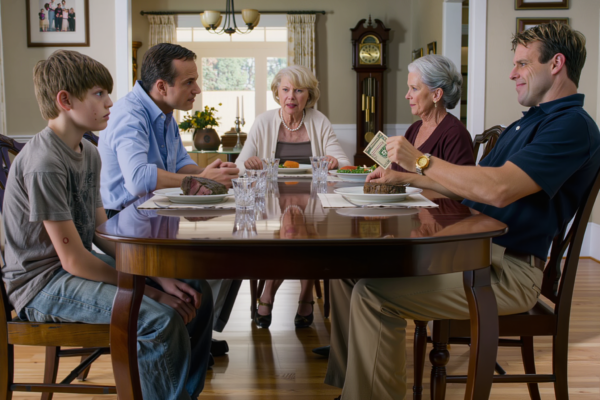
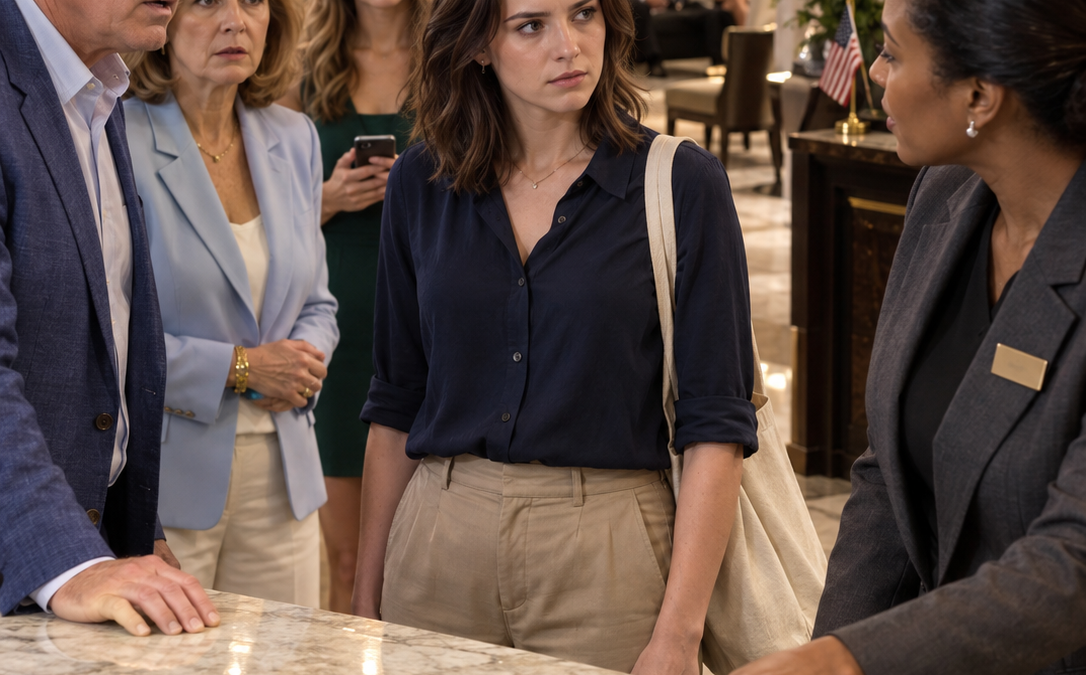
“Get us the manager right now,” Dad yelled in the hotel lobby. “She doesn’t belong in this suite.” Mom added, “Have her removed immediately.” I stood quietly until the front desk director smiled at me and asked, “Ma’am, how would you like to handle your family’s reservation?” That was when their faces dropped.
The Room on the Fourth Floor
My mother was standing at the marble front desk of the Charleston Harbor Grand when she said, in a voice meant to carry, “She does not need a suite.”
She did not look at me when she said it.
My father did.
He had one palm flat against the counter and the expression he used whenever he believed a situation could still be corrected by finding someone more important to complain to.
“Move her,” he told the young woman behind the desk. “Put her in our room, downgrade her, whatever you need to do. This is ridiculous.”
A few feet away, my younger sister, Khloe, held her phone at chest level. I could see the tiny red recording indicator reflected in the polished case.
The front desk associate glanced toward the office behind her.
I already knew who was going to walk through that door.
What I did not know was what my parents would do when she recognized me.
Eighteen hours earlier, I had still been hoping for a normal birthday weekend.
That hope had survived the flight from Denver, a weather delay over Atlanta, and the discovery that my checked suitcase had decided to spend the evening somewhere other than Charleston.
By the time I reached the hotel, I had one battered carry-on, a canvas tote holding my laptop, and the same sandals I had worn onto the plane that morning.
The Charleston Harbor Grand rose at the end of a quiet downtown block a few streets from the water, its restored brick facade washed gold beneath exterior lights. The property had been renovated to look as though it had existed effortlessly for a century, which was one of hospitality’s more expensive illusions.
Inside, the lobby smelled faintly of magnolia, polished wood, and new paint.
A pianist played something soft near the fireplace.
My family had already claimed the seating area opposite the harbor windows.
My mother sat in the middle of a leather sofa wearing cream slacks and a pale blue blazer. On her wrist was the bracelet Khloe had given her for her sixtieth birthday, a delicate gold piece my mother had photographed from three different angles before we had even arrived.
My father was beside her.
Khloe occupied an armchair, scrolling through her phone.
They looked comfortable enough that, for one irrational second, I felt like I had entered someone else’s family photograph.
My father noticed me first.
His gaze went from my sandals to my tote and then to the carry-on.
“That’s all you brought?”
“My suitcase got held up at security. They’re sending it over.”
He gave a small shake of his head.
It was not an accusation exactly. My father had perfected a category of reaction that carried disappointment without requiring him to say what he was disappointed by.
My mother adjusted her bracelet.
“We already checked in.”
“Good.”
“Room 412. They only gave us two keys.”
“I have my own reservation.”
That made her look at me.
“You booked separately?”
“I always do.”
There was a pause.
Not dramatic. Just long enough to remind me that independent decisions were still treated in my family as information I should have cleared through someone first.
Khloe looked up.
“I told Mom the weekend was handled.”
“It is handled.”
“I meant I handled it.”
“You handled the family block. I booked my own room.”
My father leaned back.
“Why?”
“Because I’m twenty-nine.”
Khloe smiled despite herself.
My mother did not.
“This weekend is supposed to be about family.”
“It still is.”
She looked toward the windows again.
“Front desk is over there.”
There had been a time when that would have hurt more.
At nineteen, I had been almost entirely built out of my parents’ reactions to me. Approval could carry me for days. A dismissive comment could sit in my chest for weeks.
That year, I had told my father I wanted to study hotel finance.
He had been cutting steak at the kitchen table.
“Hotel finance?”
“Real estate, operations, acquisitions. Hospitality assets.”
He had stared at me.
“So accounting for hotels.”
“Not exactly.”
“What kind of job does that turn into?”
I had tried to explain debt structures, property performance, investment underwriting, revenue models, and how a hotel was not just a building full of rooms but a business with dozens of moving pieces that could fail independently or rescue one another if managed well.
I had barely finished before he waved his fork.
“You’re smart. Pick something people understand.”
Khloe had been sixteen then.
She had not said anything.
My mother had asked whether I had considered marketing.
I eventually stopped trying to translate my ambitions into a language they respected.
The front desk associate found my reservation in less than a minute.
“Welcome, Ms. Colby. We have you in a junior suite on the fourth floor.”
“Perfect.”
“And there’s a note that your checked bag may arrive by courier. We’ll send it up as soon as it does.”
“Thank you.”
She passed me a key sleeve.
Behind her, the brass doors to the staff corridor gleamed beneath a row of recessed lights. The placement of the check-in stations had been changed during the renovation because the old layout created a bottleneck every time a conference group arrived together.
I knew that because I had approved the revised lobby plan.
I knew why the sconces near the elevators were warmer than the overhead fixtures.
I knew which section of flooring had been replaced after water intrusion was discovered beneath the old concierge desk.
I knew that the chandelier overhead had gone nearly twenty percent over budget because the original replacement looked cheap once the sample was installed.
No one in my family knew any of that.
More importantly, no one had ever asked.
Eighteen months earlier, the Charleston Harbor Grand had appeared on my desk in Denver as one line in a distressed-property review.
Occupancy was below forty percent.
The previous ownership group had defaulted.
The food-and-beverage operation was losing money.
Deferred maintenance had piled up behind cosmetic repairs, and the capital plan was optimistic enough to border on fiction.
Several people at Anchor Point Hospitality Partners wanted to walk away.
I did not.
There was nothing romantic about the decision. I had not fallen in love with the building from a photograph.
I liked the numbers.
More accurately, I liked the possibility hiding behind the bad numbers.
The property had location, bones, meeting space, and a staff that had somehow maintained strong guest scores even while the business around them deteriorated.
Bad hotels were often obvious.
This one looked tired, not broken.
For eleven months, it became the first thing I thought about in the morning and the last spreadsheet I closed at night.
I rebuilt revenue assumptions.
I argued for a different debt structure.
I renegotiated vendor terms with our operating partners.
I spent dawn walkthroughs with engineers, housekeeping supervisors, food-and-beverage managers, and Marcus Yud, the general manager who had kept the place functioning through foreclosure and receivership.
Some mornings Marcus and I walked silent hallways at six o’clock while guests slept behind numbered doors and electricians worked around us.
He knew every leaking valve, every underperforming banquet room, every employee who had stayed when leaving would have been easier.
I knew every variance between projected and actual revenue.
Between the two of us, we knew what the hotel was capable of becoming.
Anchor Point eventually acquired a thirty-eight percent beneficial interest through one of its holding vehicles.
Because I had led the restructuring and continued chairing the asset committee overseeing the property, my name appeared on documents that mattered very much inside the industry and almost not at all anywhere else.
I had never told my family.
Not because it was secret.
Because work had become the one part of my life I did not offer up for review.
For years, Sunday calls with my parents followed a reliable pattern.
My mother asked whether I was seeing anyone.
My father asked if I was still traveling so much.
Khloe talked about whatever was happening in her life.
Then someone asked a version of the same question.
“So what exactly are you doing these days?”
I would begin answering.
Within a minute, the subject would change.
Eventually I shortened the answer.
“Hospitality investments.”
That was apparently vague enough to become “something with hotels.”
My father once told an uncle that I worked in “corporate travel.”
I corrected him the first time.
Not the second.
Not the fifth.
By the time I walked away from the Charleston Harbor Grand’s front desk with my key sleeve in hand, I had no intention of changing that habit.
I was almost at the elevators when my father called out.
“Excuse me.”
I stopped.
The front desk associate turned toward him.
He crossed the lobby quickly, my mother following with Khloe several steps behind.
“We need to fix something,” he said.
“Of course, sir. What can I help you with?”
He pointed toward me.
“My daughter was just given a junior suite.”
The associate waited.
“Our room is a standard king.”
“Yes, sir.”
“So clearly there’s been some mix-up.”
“There hasn’t.”
His expression tightened.
“I’m sorry?”
“Ms. Colby has a separate reservation.”
“I understand that. I’m saying it doesn’t make sense that she has a better room.”
The associate’s professional smile became more careful.
“Room types are based on the reservation booked, sir.”
My mother stepped closer.
“Then change it.”
The associate looked at her.
“Change which reservation?”
“Hers.”
I could feel people beginning to notice us.
Not everyone. Most travelers are skilled at ignoring other people’s problems.
But a couple near the fireplace had gone quiet.
Khloe stood slightly behind our parents with her phone in her hand.
“Mom,” I said, “leave it alone.”
She looked at me as if I had interrupted.
“This is my birthday weekend.”
“I know.”
“You don’t need a suite.”
“I booked one.”
“You booked it with what?”
There it was.
Not quite an insult.
Worse, in some ways.
A genuine question built on a belief she had never bothered to test.
“With money.”
Khloe covered a smile by touching her mouth.
My father did not find it funny.
“You know what she means.”
“I really don’t.”
He turned back to the associate.
“Can you move her into our room?”
“No, sir, not without Ms. Colby’s authorization.”
“Then downgrade her.”
“I can’t alter another guest’s reservation without permission.”
My mother exhaled through her nose.
“This is getting absurd.”
I set my canvas tote on a chair.
A pulse had started beating just beneath my jaw.
I knew that sensation.
I had felt it in conference rooms when older men repeated my own analysis back to me five minutes after dismissing it.
I had felt it the first time a lender asked my male colleague a question about a model I had built.
Years earlier, I would have rushed to explain myself.
These days, I let silence do some of the work.
My father interpreted that silence as surrender.
“Get the manager.”
The associate nodded once.
“I can ask our director of guest services to come out.”
“Please do.”
My mother glanced around the lobby.
People were definitely watching now.
“Richard, keep your voice down.”
“I am keeping my voice down.”
He was not.
Khloe had raised her phone slightly.
I looked at her.
“Are you recording this?”
Her eyes flicked to the screen.
“I was filming the lobby.”
“Of course you were.”
She lowered it an inch but did not stop recording.
My father continued.
“I want to know why someone thought putting her in a suite made sense when the rest of the family is in standard rooms.”
The associate tapped something on her computer.
“Your daughter booked and paid for a junior suite.”
“That isn’t the point.”
“What is the point?” I asked.
He turned.
“The point is that your mother planned this weekend.”
“Khloe planned it.”
My mother stiffened.
“I am standing right here.”
“Then tell me what the point is.”
She folded her arms.
“Tomorrow twelve relatives are arriving. We are all here together. You walking around in a nicer room makes it look like you’re trying to separate yourself.”
I stared at her.
For a few seconds, the lobby sounds seemed to sharpen around us.
Glasses touching at the bar.
The piano.
A suitcase rolling over tile.
A child laughing near the elevators.
That was when I understood the room category had almost nothing to do with the argument.
My mother was not worried about square footage.
She was worried about hierarchy.
Our family had always had one.
My father was the authority.
My mother managed the emotional weather.
Khloe, younger and easier to understand, occupied the warm center.
I was the difficult one.
The daughter who left.
The daughter who chose an unfamiliar career.
The daughter who came home twice a year with airport exhaustion and vague answers about work.
The daughter whose life made more sense if everyone agreed it had not become particularly impressive.
A junior suite threatened a story they had been telling about me for a decade.
“I’m not trying to separate myself,” I said.
“Then switch with us,” Khloe said.
She meant it as a solution.
That was the problem.
My mother immediately shook her head.
“No. It’s the principle.”
I almost laughed.
“What principle?”
“That family members don’t make themselves look important at everyone else’s expense.”
I felt something old move inside me.
Not rage.
Recognition.
At nineteen, I had come home from my first semester carrying a borrowed laptop and a scholarship renewal form.
My father had asked why I could not study something closer to home.
At twenty-two, when I accepted my first analyst job, he had asked whether it came with “real benefits.”
At twenty-five, after I had been promoted, my mother spent an entire dinner talking about Khloe’s new apartment before turning to me and asking whether I was still “doing the hotel thing.”
None of those moments had seemed large enough to justify a confrontation.
Stacked together, they had built an entire architecture.
I finally saw it.
The office door behind the desk opened.
Ranata Voss stepped into the lobby.
She wore the hotel’s charcoal director blazer, a white blouse, and the small gold badge I remembered approving during the rebranding package.
DIRECTOR OF GUEST SERVICES.
My father straightened.
His whole posture changed in the presence of someone he perceived as an authority.
“Finally,” he said.
Ranata’s eyes passed over him, then my mother, then Khloe.
They reached me last.
She did not smile.
That would have made the moment worse.
Instead, a fraction of professional distance disappeared from her expression.
“Good evening.”
My father spoke before she could ask anything else.
“There’s been an issue with our rooms.”
“I’m Ranata Voss. Tell me what happened.”
“My daughter has somehow been placed in a junior suite while my wife and I are in a standard king. We asked for it to be corrected.”
Ranata looked at the associate.
“Separate reservations?”
“Yes.”
“My daughter’s reservation can be changed,” my father said.
Ranata returned her attention to him.
“Only by your daughter.”
He frowned.
“I’m her father.”
I saw the moment Ranata decided not to respond to that.
Instead, she asked, “And you are?”
“Richard Colby.”
He said his name with the confidence of a man who had lived for decades in rooms where it carried weight.
Ranata gave a polite nod.
Then she looked at my mother.
“And your daughter’s name?”
My mother waved one hand.
“That is not the issue.”
Ranata waited.
“My point,” my mother continued, “is that she should not be in a suite when the rest of the family is staying modestly. She can’t possibly need it, and I don’t want the relatives arriving tomorrow getting the wrong idea.”
Ranata’s gaze returned to me.
I had sat through enough meetings with her to recognize what she was doing.
Evaluating.
Not the argument.
Me.
She knew my role.
She also knew I had arrived for a private family weekend, not an inspection.
Hospitality professionals learn quickly that there are facts which may be true and still not belong in the lobby unless someone with standing invites them there.
I could have ended it myself.
I could have said, This property is part of our portfolio.
I could have told my father exactly how many hours I had spent deciding whether the room he was complaining about should exist at all.
I could have explained that his “standard” reservation was in a hotel his daughter had helped keep from becoming another failed asset in a restructuring deck.
But explaining myself to my parents had become an old addiction.
I had stopped feeding it.
Ranata turned fully toward me.
“Ms. Colby, how would you like us to handle your family’s reservations?”
No one spoke.
Khloe’s phone lowered until it pointed toward the carpet.
My father looked from Ranata to me.
My mother’s bracelet clicked softly against the marble counter when she rested her hand on it.
“What does that mean?” she asked.
Ranata did not answer immediately.
The associate behind the desk had become very interested in keeping her hands folded.
I looked at the slim leather folio tucked beneath Ranata’s arm.
Every property in the portfolio maintained an owner-representative file.
Not because investors enjoyed ceremony, but because hotels were twenty-four-hour operations and people arrived at strange hours.
Access mattered.
Authority mattered.
Identity mattered.
The folio existed so employees did not have to guess.
Ranata noticed me looking at it.
She set it on the counter.
My mother watched the movement.
“What is that?”
Ranata opened the cover.
Inside was an owner-access sheet bearing the Anchor Point Hospitality Partners name and a current list of designated representatives.
Mine was near the top.
She turned the page so I could see it.
My father leaned forward before I said anything.
His lips moved once as he read.
Then he read it again.
My mother bent closer.
Khloe stopped recording altogether.
“Owner representative?” my father said.
The words came out slowly.
Ranata closed the folio halfway.
“Ms. Colby represents one of the ownership groups associated with this property.”
My mother looked at me.
“No.”
It was not an accusation.
It was reflex.
I almost felt sorry for her.
Almost.
My father pointed at the page.
“What is Anchor Point?”
“The firm I work for.”
“You said you worked in hotel investments.”
“I do.”
“That says owner representative.”
“Yes.”
“How much of this hotel do you own?”
“I don’t personally own the hotel.”
That clarification seemed to give him a second of relief.
Then I continued.
“My firm’s holding vehicle has a thirty-eight percent beneficial interest. I chair the asset committee for this property.”
The relief disappeared.
Khloe stared at me.
“You’re serious.”
“Yes.”
“You never said that.”
“I’ve said what I do plenty of times.”
“No, you said investments.”
“That is what this is.”
My father looked at Ranata, perhaps hoping she would translate my life into something he could dismiss.
Before she could, the door beside the elevators opened and Marcus Yud came through at a pace that made it obvious he had taken the stairs.
He was still wearing the navy suit he had worn to an afternoon function, although his tie was loosened.
“Ms. Colby.”
He came around the desk instead of offering his hand across it.
“I heard you were downstairs.”
“I was trying not to make a thing of being here.”
“You picked the wrong family for that.”
Khloe made a sound that might have been a laugh before realizing no one else was laughing.
Marcus glanced at my parents.
His professionalism returned immediately.
“Mr. and Mrs. Colby. Welcome to the Harbor Grand.”
My mother looked at him.
“You know her?”
Marcus and I exchanged a glance.
“Yes, ma’am.”
“How?”
He seemed genuinely uncertain how much explanation the question required.
“We worked together through the restructuring and renovation.”
My father turned to me.
“You worked on the renovation?”
“I led the asset side.”
Marcus nodded toward the far end of the lobby.
“The rooftop terrace she approved opens tomorrow morning.”
The sentence landed harder than the owner-access sheet had.
I saw it in my father’s face.
A document could still be misunderstood.
A job title could still be exaggerated.
But the general manager of a hotel standing in front of him and casually referring to a renovation decision I had made was harder to place inside the old family story.
My mother looked toward the ceiling, as though she might somehow see the terrace through several floors of plaster and concrete.
“You approved it?”
“I signed the capital authorization in March.”
Marcus smiled slightly.
“And argued us into keeping the original brick parapet.”
“It was worth keeping.”
“It was expensive to keep.”
“It was still worth keeping.”
That exchange was normal for us.
Technical.
Almost boring.
For my family, it seemed to be the first evidence that I had an entire professional identity existing beyond anything they had imagined.
Ranata’s radio crackled.
She touched it.
A security voice asked her to confirm my presence against the owner-access register.
She answered quietly.
A moment later came the response.
“Confirmed. Owner-level access active.”
My father looked at the black key card Marcus had taken from his pocket.
It was different from guest keys—unmarked except for a narrow embossed line and encoded for access to secured operational areas when needed.
Marcus placed it on the counter.
“For your stay.”
“I won’t need most of that.”
“You always say that.”
“I’m here for my mother.”
Marcus gave my mother a courteous nod.
“Then happy birthday.”
She managed, “Thank you.”
Her voice was much smaller.
I wished the moment felt better.
That is the part people rarely understand about vindication.
From the outside, it looks clean.
Someone underestimates you.
Truth appears.
The balance shifts.
You win.
But standing in that lobby, I did not feel victorious.
I felt twenty-nine and nineteen at the same time.
I wanted my parents to know they had been wrong.
I also wanted them never to have needed proof.
Those two desires could not be reconciled.
My mother recovered first.
She always did.
“Well,” she said, “no one tells us anything.”
I looked at her.
“You could have asked.”
“We ask you things.”
“You ask whether I’m dating someone.”
“That is not fair.”
“It’s accurate.”
My father’s jaw tightened.
“We’re still your parents.”
“I know.”
“This doesn’t change that.”
“No.”
He seemed relieved again.
Then I said, “But what happened in the last ten minutes should probably change something.”
His eyes narrowed.
“Meaning?”
“You walked up to a hotel employee and demanded that my room be downgraded because you didn’t think I belonged in it.”
“That was before we knew—”
“Before you knew what?”
He stopped.
I let the silence remain between us.
Before you knew I mattered here?
Before you knew I could afford it?
Before you knew someone else in the room might respect me?
He did not say any of those things.
He did not need to.
My mother looked down at her bracelet.
“I was trying to keep the weekend equal.”
“No, you were trying to keep me where you expected me to be.”
“That’s not what I meant.”
“It may not be what you meant. It’s what you did.”
Khloe shifted beside us.
“Can we not do this in the lobby?”
I looked at her.
“You were filming it in the lobby.”
She lowered her eyes.
“Yeah.”
A strange tenderness came over me then.
Khloe had spent most of her life protected by the very system that had worn me down.
She was not cruel.
She was accustomed.
There is a difference.
Not always in outcome, but in possibility.
Cruelty enjoys the wound.
Habit barely notices it exists.
Marcus stepped back, giving us the kind of space that hotel managers learn to create without physically leaving.
Ranata did the same.
My father looked around at the people who had been watching.
Most had already turned away.
The woman near the fireplace reopened her magazine.
A couple collected their drinks and headed toward the elevators.
The scene was shrinking back into what it had always been: a family problem that happened to occur in public.
I picked up my tote.
“My room is fine.”
My mother swallowed.
“So you’re just going upstairs?”
“That was the original plan.”
“What about our reservation?”
I looked at the associate.
“Do we still have the two connecting junior suites on owner hold?”
She checked her screen.
“Yes, ma’am.”
My parents both stared at me.
I almost smiled, but I was too tired.
“Move them into one.”
My mother blinked.
“You had suites available?”
“I keep two rooms on hold when family visits. I wasn’t sure who might need them this weekend.”
Khloe’s expression changed.
That hurt her.
I could tell.
“You did that for us?”
“For all of you.”
My father rubbed one hand across his mouth.
“Then why didn’t you say anything?”
“Because until five minutes ago nobody cared where the rooms came from.”
No one had an answer.
I nodded to the associate.
“Put any room charges for the family block through owner relations this weekend. Nothing extravagant. Just the rooms.”
Marcus understood immediately.
“I’ll handle it.”
My mother looked almost offended.
“You don’t need to pay for everyone.”
“I know.”
“Then why are you?”
“Because I want Grandma and the cousins to enjoy the weekend without wondering what happened down here.”
That, more than anything, seemed to disarm her.
I was not punishing them.
I was refusing to become them.
There is a difference in that, too.
Marcus slid the black access card toward me.
I picked it up.
It was heavier than a normal hotel key, though not by much.
My father watched it disappear into my palm.
Earlier, he had wanted someone with authority to remove me.
Now the building itself had just confirmed that I had more access to it than he did.
I could have said something sharp.
For once, I did not need to.
“Good night,” I said.
I thanked Ranata.
I thanked Marcus.
Then I walked to the elevators.
The brass doors opened.
I stepped inside with my battered carry-on, my canvas tote, a guest key in one hand and the black access card in the other.
My family remained by the desk.
The doors closed without ceremony.
Upstairs, my suite faced the harbor.
I left the lights off at first.
The city glow was enough.
Beyond the glass, black water held broken reflections from waterfront buildings, and farther out, a container ship moved slowly toward open water.
My delayed suitcase arrived twenty minutes later.
A bellman brought it up.
I tipped him, unpacked just enough for the next morning, and hung the black access card on the small brass hook beside the door.
For eleven months, I had spent more waking hours thinking about that hotel than almost anything else in my life.
Now I was finally inside one of its finished rooms with nothing to review.
No spreadsheet.
No renovation schedule.
No operating report.
Just silence.
I sat on the edge of the bed.
For the first time that night, my hands shook.
Not badly.
Enough.
I pressed them together.
The worst part had not been my father demanding a manager.
It had not been my mother saying I did not belong in the suite.
It was the speed with which they had believed their own assumptions.
No hesitation.
No possibility that I might have booked exactly what I wanted.
No curiosity about whether I had changed during the years they were not looking.
I thought of all the Sunday calls.
All the times I had almost told them more.
The promotion.
The first major deal.
The morning I received the email confirming I would chair the Charleston asset committee.
I had imagined telling my father that one.
I could still remember sitting at my desk in Denver, reading the message twice.
For a few minutes, I had felt seventeen again, holding a good grade and wanting to bring it home.
Then I remembered what home did with achievements it could not categorize.
I closed the email.
That had been the moment I stopped trying.
There was a knock at my door a little after nine.
I expected my mother.
It was Khloe.
She was still wearing the dark green dress she had arrived in. Her shoes were gone. She carried two glasses of water.
“I didn’t know what people bring when they come to apologize,” she said.
I stepped aside.
“Apparently hydration.”
She gave me the smallest smile.
The room had a sitting area with two armchairs near the window.
Khloe chose one.
I sat opposite her.
For a minute she studied the water glass in her hands.
“I deleted the video.”
“You didn’t have to.”
“Yes, I did.”
“Why?”
“Because I started filming because Dad was making a scene and I thought it would be funny later.”
“That tracks.”
She winced.
“I know.”
I waited.
“I didn’t know, either.”
“About the hotel?”
“About any of it.”
“You knew what I did.”
“No. I knew the words you used.”
I looked at her.
She continued.
“Investments. Hospitality. Assets. Whatever. I heard the words. I just never pictured anything.”
“That is remarkably close to the problem.”
“I know that now.”
There was no defense in her voice.
That made it easier to listen.
She glanced toward the black card hanging by the door.
“So you really helped save this place?”
“I helped restructure the investment. Marcus saved plenty of it before we ever showed up.”
“But the renovation?”
“I worked on it.”
“And you come here for meetings?”
“Sometimes.”
“How often?”
“Enough.”
She leaned back.
“Mom and Dad honestly thought you had some kind of middle-management travel job.”
I laughed once.
“Corporate travel. Dad’s phrase.”
“I never corrected him.”
“No.”
“I’m sorry.”
The apology surprised me because Khloe was not normally comfortable saying the words without wrapping them in explanation.
I looked at her.
“You don’t need to take responsibility for everything they think.”
“I’m taking responsibility for what I think.”
That was different.
I nodded.
She picked at the paper sleeve around the water glass.
“Do you hate us?”
“No.”
“Do you like us?”
I laughed again, more softly.
“Some days.”
“That’s fair.”
She looked out at the harbor.
“When we were younger, I thought you wanted to get away from us because you thought you were better.”
“I wanted to get away because I was tired of explaining myself.”
“I thought those were the same thing.”
“I know.”
She was quiet for a while.
Then she said, “Do you remember driving three hours back from school when I broke up with Jordan?”
“I remember paying for the gas.”
“You also bought me fries.”
“I was a very generous college student.”
“You had like forty dollars.”
“Thirty-eight.”
She smiled.
Then her face changed.
“I think that’s what bothers me.”
“What?”
“You always showed up for me. And I don’t think I ever learned how to show up for you because everyone acted like you didn’t need it.”
I had not expected that.
The words found a softer place than the argument downstairs had.
I looked toward the window.
“Being capable and being fine aren’t the same thing.”
“I know.”
“You know now.”
She accepted the correction.
“Yeah.”
Before she left, Khloe stood by the door and looked at the two keys hanging there.
My normal guest key.
The black one.
“Which one opens this room?”
“The guest key.”
She frowned.
“What does the other one open?”
“Almost everything else.”
For some reason, that made her laugh.
The sound followed her into the hallway.
I slept badly.
Not because I was replaying the confrontation.
Because the hotel had become too quiet.
When a crisis ends, the body does not always get the message.
I woke before sunrise and finally gave up around six.
Old habits took over.
I pulled on workout clothes, clipped the black card to the inside of my jacket, and went downstairs.
The lobby looked completely different without my family in it.
Night staff were finishing their shift.
Fresh flowers had been replaced near the entrance.
Someone was polishing fingerprints from the elevator brass.
Ranata stood behind the front desk reviewing something on a screen.
She saw me.
“You’re awake early.”
“Occupational damage.”
“You’re not doing a walkthrough.”
“I promised everyone I wasn’t.”
“Good.”
She handed me coffee without asking.
I took it.
“Was last night awful for your staff?”
“We’ve seen worse.”
“I’m sure.”
She hesitated.
“Your father apologized to the associate.”
That surprised me.
“When?”
“Before he went upstairs.”
“What did he say?”
“That he was frustrated and spoke to her disrespectfully.”
I absorbed that.
“For him, that’s practically a confession under oath.”
Ranata smiled.
“He also tipped the bellman.”
“Now I know you’re lying.”
She laughed.
Then her expression softened.
“You okay?”
It was a dangerous question.
Not because I might cry.
Because I might answer honestly.
“I will be.”
She nodded as though that was enough.
Marcus had already opened the rooftop terrace for final inspection, so I went up before breakfast.
The renovated space stretched along the harbor side of the building, framed by the original brick parapet we had fought to preserve. New planters softened the edges. Tables were spaced beneath canvas umbrellas. The bar still smelled faintly of fresh millwork.
The sky was pale over the water.
For months I had seen the terrace in plans, budget revisions, photographs, and progress reports.
Standing inside the finished version was different.
A hotel is one of the few assets where financial decisions eventually become physical space.
A number becomes a lamp.
A line item becomes a chair.
A capital authorization becomes a place where strangers drink coffee on vacation.
Marcus joined me near the railing.
“Opening breakfast starts in twenty minutes.”
“It looks good.”
“That is the nicest thing you’ve ever said about one of my projects.”
“I said the lobby looked good.”
“You said the lobby looked ‘operationally improved.’”
“That was high praise.”
He leaned on the parapet.
“You know your family is going to be up here soon.”
“I know.”
“You want me to disappear?”
“No.”
“Want me to stay?”
“No.”
“Excellent. Very clear direction.”
I smiled.
He started to walk away, then stopped.
“For what it’s worth, no one here thinks less of you because of what happened last night.”
“That isn’t what bothers me.”
“I know.”
He left me alone.
At eight, the cousins began arriving.
The normal volume of my family returned all at once.
Suitcases rolled through the lobby.
Someone complained about parking.
My aunt hugged everyone twice.
One cousin had brought two children who immediately discovered the decorative fountain outside and had to be retrieved before breakfast.
Nobody knew what had happened the night before.
Khloe did not tell them.
Neither did I.
My mother arrived on the terrace wearing the gold bracelet again.
My father followed carrying two coffees.
He said good morning to Marcus.
Not casually.
Deliberately.
I noticed.
So did Marcus.
Neither of us commented.
Breakfast was almost normal.
That was more difficult than hostility would have been.
My mother discussed dinner reservations.
My father asked one cousin about his new job.
Khloe passed me a basket of pastries without saying anything meaningful with the gesture, which was precisely why it meant something.
The hotel staff moved around us.
Every once in a while, one of them greeted me by name.
My relatives noticed but were too polite to ask why.
My mother noticed every time.
Around ten, I walked to the coffee station alone.
She followed.
For several seconds she pretended to examine the tea selection.
Then she said, “I didn’t know how much responsibility you had.”
I added cream to my coffee.
“No.”
“You never made it clear.”
I looked at her.
She stopped herself.
It was visible.
An old argument forming, then being reconsidered before it became words.
Finally she said, “That isn’t entirely fair.”
I waited.
She touched the bracelet.
“I probably didn’t make it easy for you to tell me.”
That was closer to an apology than my mother usually got on the first attempt.
I could have demanded more.
Part of me wanted to.
Another part understood that people rarely cross ten years of habit in one sentence.
“No,” I said. “You didn’t.”
She nodded.
“I’m sorry about the lobby.”
This time the words were clear.
I looked down at my coffee.
“For asking them to move me?”
“For deciding what you deserved before I knew anything.”
There it was.
The real thing.
Small.
Late.
Costly.
I looked at her.
“Thank you.”
Her eyes became wet, though she did not cry.
“I thought you were struggling.”
“I struggled for years.”
“Why didn’t you tell us?”
“I did.”
She looked away.
Across the terrace, my father was laughing at something one of my cousins had said.
I continued.
“I told you when the job was hard. You said all jobs are hard. I told Dad when I got promoted. He asked whether that meant I would finally stop traveling. I tried to explain the Charleston deal last year and you changed the subject because Khloe was thinking about buying a condo.”
My mother’s fingers tightened around her cup.
“I don’t remember that.”
“I do.”
That ended the argument.
Not because she agreed with every detail.
Because memory is not democratic.
The person who was hurt often remembers what the person speaking casually never had reason to store.
She nodded.
“I don’t know how to fix that.”
“You don’t have to fix ten years today.”
“What do I do?”
“Ask me something real.”
She looked at me.
“What?”
“Anything.”
She thought.
Then, awkwardly, like someone learning a new language, she asked, “What was the hardest part of saving this hotel?”
I almost laughed.
Instead I looked across the terrace.
“The debt.”
“That sounds boring.”
“It was.”
She smiled.
I explained anyway.
Not all of it.
Enough.
How lenders lose patience.
How distressed assets become expensive before they become healthy.
How every renovation dollar has to earn its place.
How people assume hospitality is about beautiful rooms when much of it is actually labor costs, revenue management, financing terms, and hundreds of operational decisions guests never see.
My mother listened for almost seven minutes.
She only interrupted once.
That may have been the most meaningful part of the weekend.
My father took longer.
Saturday passed without any private conversation between us.
At dinner he was polite.
On Sunday morning, he found me in the lobby near the windows.
The fireplace was unlit because the weather had warmed.
He stood beside me without speaking at first.
I had inherited that habit from him.
“I was out of line,” he said.
“Yes.”
He looked irritated.
Not at me.
At the fact that I had not helped him soften the sentence.
“I thought you might say it wasn’t that bad.”
“It was that bad.”
His mouth twitched.
“Your mother says you’ve become very direct.”
“I’ve always been direct.”
“That’s true.”
Another silence.
He looked around the lobby.
“Thirty-eight percent.”
“The firm. Not me.”
“I understand.”
“I wasn’t sure.”
He gave me a look.
Then, unexpectedly, he laughed.
It was brief.
Tired.
“I deserved that.”
I said nothing.
He studied the chandelier.
“How long did you know this place would work?”
“I didn’t.”
He turned.
“You didn’t?”
“No one knows. That’s the point.”
“But you convinced everyone to buy it.”
“I convinced them the risk was worth taking.”
“That sounds like knowing.”
“It isn’t.”
He considered that.
My father liked certainty.
Perhaps that was why he had struggled with my career.
I had chosen a profession where judgment mattered precisely because certainty did not exist.
“You were good at this before Charleston,” he said.
It was a statement.
“Yes.”
“How good?”
I looked at him.
“Do you really want the answer?”
He hesitated.
Then nodded.
So I told him.
Not my résumé.
Not every promotion.
Just enough.
The portfolio work.
The acquisitions.
The committees.
The travel.
The decisions.
His face changed slowly.
Not because any one fact overwhelmed him.
Because he was realizing the missing decade was larger than he had thought.
When I finished, he rubbed a thumb over the edge of his coffee cup.
“I told Uncle Dan you worked in corporate travel.”
“I know.”
“He probably thinks you book conventions.”
“He does.”
“I should correct that.”
“You can if it comes up.”
“You don’t want me to tell everybody?”
“No.”
He looked genuinely confused.
“Why not?”
“Because I don’t need a family announcement.”
He absorbed that.
Then he nodded.
We stood there quietly until the elevator opened and several cousins emerged arguing about brunch.
My father started toward them.
After two steps, he turned.
“For what it’s worth, I’m proud of you.”
The sentence should have landed harder.
I had wanted it for years.
Instead, it settled gently.
That surprised me.
“Thank you.”
He seemed to expect more.
There wasn’t more.
Not yet.
He walked away.
By Sunday evening, the birthday weekend had become what it was supposed to be.
People ate too much.
Someone ordered a second cake because the first was smaller than expected.
My aunt complained about the air-conditioning.
Two cousins stayed on the rooftop terrace until closing.
My mother took dozens of photographs.
In most of them I was simply another daughter beside her.
No one announced who controlled what percentage of anything.
No one mentioned owner access.
The black key card stayed in my pocket.
Monday morning, I checked out before most of the family came downstairs.
My flight to Denver left early.
Marcus met me near the entrance with coffee.
“Terrace beat opening-weekend projection.”
“By how much?”
He told me.
I smiled.
“There. That’s your version of happiness.”
“It’s a good number.”
“It is.”
Ranata came around the desk.
“Safe flight.”
“Thank you for Friday.”
“I didn’t do anything.”
“You knew exactly what not to do.”
“That’s most of hotel management.”
I handed her the black access card.
She looked at it.
“You can keep it.”
“I have enough keys.”
She accepted it.
For a second, the card lay between us on the marble counter where it had first changed the temperature of the room.
Then Ranata picked it up and returned it to the leather folio.
My father had once believed authority would arrive in the form of a manager and restore the order he expected.
Instead, authority had turned out to be quieter.
A file.
A name.
A record.
Years of decisions no one in my family had seen me make.
Outside, the morning air was already warm.
I rolled my battered carry-on toward the waiting car.
My suitcase had survived the weekend.
So had we.
At the airport, my mother texted.
No birthday photographs.
No dramatic apology.
Just: Call me when you land.
I stared at the message for a moment.
Then I typed: I will.
Back in Denver, work swallowed the week quickly.
On Wednesday afternoon, Marcus sent the final weekend numbers.
The terrace had outperformed forecast.
Food-and-beverage revenue was stronger than expected.
Guest satisfaction had held.
I read the report twice, made two notes in the margin, and forwarded it to the asset team.
I did not send it to my parents.
Not out of resentment.
Because for the first time, I understood that I did not need every part of my life witnessed by them to make it real.
My mother called that evening.
There was no agenda.
That was unusual enough that I spent the first five minutes waiting for one.
None arrived.
She asked about my flight.
I asked whether she liked the photographs.
Then she surprised me.
“How are the terrace numbers?”
I leaned back in my chair.
“Better than projection.”
“Is that good?”
“That is literally what it means.”
She laughed.
“I’m trying.”
“I know.”
We talked for another fifteen minutes.
Before she hung up, she asked what city I was traveling to next.
Not why I still traveled.
Not whether my company really needed me there.
Just where.
It was a small change.
I had learned not to distrust small changes simply because they were small.
Hotels are rebuilt that way.
Relationships probably are, too.
One honest correction.
One repaired assumption.
One door that opens differently than it did before.
The next month, I received the Charleston property report while sitting in another airport.
Occupancy had climbed again.
The rooftop terrace was becoming one of the hotel’s strongest food-and-beverage spaces.
Marcus added one line beneath the usual numbers.
Your family suites are still blocked in the owner inventory. Want us to release them?
I stared at the question.
For years I had kept two rooms available whenever family might visit one of our properties, a habit no one knew about because generosity felt safer when it remained invisible.
I thought about releasing them.
I thought about Friday night in the lobby.
My mother’s voice.
My father’s hand on the counter.
Khloe’s red recording light.
The black key card.
Then I thought about Saturday morning, when my mother asked about hotel debt and listened long enough to understand the answer.
I typed back.
Keep them for now.
A few weeks later, Khloe called me from her car.
She had been offered a promotion and wanted advice.
Normally she would have called Dad first.
She did not say that.
Neither did I.
We spent forty minutes talking through salary, responsibilities, and the difference between a title that looks good and a job that actually moves a career forward.
Before hanging up, she said, “You’re annoyingly good at this.”
“At what?”
“Knowing what questions to ask.”
I smiled.
“That is most of my job.”
Months later, I returned to Charleston for a quarterly review.
I arrived alone.
No birthday weekend.
No relatives.
No argument.
The front desk associate from that Friday was working when I walked in.
She recognized me.
“Welcome back, Ms. Colby.”
“Good to see you.”
Behind her, the lobby looked exactly as it should have.
Travelers at the sofas.
Soft piano music.
Late afternoon light across the marble.
The same chandelier.
The same elevators.
The same desk where my father had once insisted I did not belong upstairs.
Ranata came out of her office carrying the familiar leather folio.
She lifted it slightly when she saw me.
“Need the dramatic version of check-in?”
“Absolutely not.”
“Normal guest key?”
“Please.”
The associate slid a plain white key sleeve across the counter.
Room 417.
The same junior suite.
I took the key.
No one in the lobby looked up.
No one needed to.
I rode the elevator to the fourth floor, unlocked the door, and set my tote on the bed.
The harbor stretched beyond the windows, afternoon light breaking across the water.
Near the door was the same small brass hook where I had once hung the black access card.
This time I placed an ordinary room key there.
Then I opened the curtains all the way.