During New Year’s dinner, my father-in-law threw red wine in my face. My wife’s brother laughed and said, “Thanks, Dad. Maybe that’ll teach him some respect.” I felt my hands tighten around the chair, then stood up and stepped away from the table. I made one phone call. Whatever they expected me to do after that humiliation, it wasn’t what came next.

The Glass at Midnight
The wine hit me before I saw Richard Preston lift his hand.
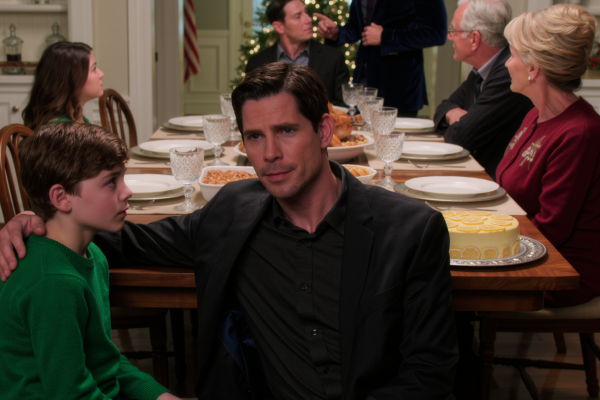
One second I was sitting beside my wife at the long mahogany table in her parents’ Highland Park dining room, listening to Richard explain why his next Fort Worth development would “reset the market.” The next, cold red wine covered my face, collar, and the front of my white shirt.
The crystal glass remained in his hand.
Nobody moved.
Thirteen people were seated around the table beneath a chandelier bright enough to make every expression visible.
Jordan sat beside me.
Her fingers tightened around the edge of her napkin, but she did not look at her father.
Across from us, her younger brother Tyler leaned back and laughed.
“That ought to teach you some respect.”
Richard placed the empty glass beside his plate as calmly as if he had just finished a toast.
Four years earlier, I might have argued.
Two years earlier, I might have tried to shame him.
Six months earlier, I might have looked to Jordan and waited for her to choose between us.
That night, I did none of those things.
I stood.
I picked up my napkin and placed it beside my plate.
Red wine ran from my jaw onto the tablecloth.
Richard watched me with the patient confidence of a man waiting for the reaction he had already written for me.
He wanted anger.
He wanted shouting.
More than anything, he wanted me to prove that beneath the law degree, the tailored suit, and the respectable career, I was still the poor boy from Fort Worth he had decided I was the first time we met.
I looked at Jordan.
Her eyes finally found mine.
There was fear in them.
But there was something else too.
Exhaustion.
I turned and walked out.
The grandfather clock in the hallway sounded louder than the dining room behind me.
I passed framed photographs of Preston charity galas, Preston vacation homes, Preston children graduating from private schools, and Richard shaking hands with people whose names appeared on hospital buildings.
At the front entrance, I stopped beside the coat closet.
My hands were trembling.
Not from fear.
From the effort of keeping them still.
I took out my phone.
For weeks, one name had been sitting near the top of my recent calls.
Marcus Warren.
I called him.
He answered on the third ring.
“Logan?”
“It’s me.”
A pause.
He must have heard something in my voice.
“What happened?”
I looked at myself in the antique hallway mirror.
Wine had soaked through my shirt.
Behind my reflection, at the far end of the hallway, the dining-room doorway glowed gold.
“Richard crossed the line.”
Marcus was silent.
We had discussed this possibility more than once.
Not the wine.
Everything beneath it.
“Are you sure?” he asked.
I understood the question.
He was not asking whether Richard had behaved badly.
He was asking whether I was finally prepared to stop protecting a family that had never protected me.
“Yes.”
“Then tomorrow morning we move.”
I ended the call.
Behind me, footsteps crossed the hallway.
Jordan.
She had followed me out.
Her face looked gray beneath the makeup she had put on for the party.
“Logan.”
I put the phone away.
She looked at my shirt.
“I’m sorry.”
That sentence nearly broke me.
Not because it was insufficient.
Because I knew how much it cost her to say anything against her father.
I reached for my coat.
“We’re leaving.”
She looked toward the dining room.
Then back at me.
For several seconds, she did not move.
Richard had spent thirty years teaching his daughter that leaving him always had a price.
Money.
Approval.
Family.
Belonging.
Eventually, Jordan walked to the coat closet and took down her coat.
That was the first decision of the night that mattered.
We left together.
Four years earlier, when I met Jordan, I believed people like the Prestons existed mostly in magazines.
My mother raised me in a two-bedroom apartment in Fort Worth. She was a registered nurse who worked extra shifts whenever the electric bill, car insurance, or school expenses arrived at the same time.
We were never destitute.
But money was something we noticed.
When the air conditioner ran too long in July, my mother noticed.
When I needed new shoes halfway through a school year, she noticed.
When college applications began, I noticed.
I attended the University of Texas and worked nights to cover what scholarships and loans did not. Law school at SMU meant more debt, more work, and more mornings when I arrived in class having slept less than anyone around me could guess.
I never considered that tragic.
It was simply how my life worked.
By thirty-one, I had built a solid corporate-law practice in Dallas. I handled partnership disputes, commercial transactions, internal investigations, and cases involving financial misconduct.
I was not famous.
I was not rich by Preston standards.
I was good at my job, financially independent, and proud that nothing I had came attached to someone else’s permission.
Then I met Jordan at a charity gala.
She was wearing a dark green dress and standing near an architectural rendering displayed beside the ballroom entrance.
I assumed she was studying it because she liked the building.
She was studying it because she disliked the building.
“The west side is going to cook all afternoon,” she said.
I looked at the rendering.
“I’m sorry?”
“Those windows.”
She pointed.
“They’re beautiful in the rendering. They’ll be miserable in August.”
“You’re an architect.”
She turned.
“Was it that obvious?”
“You insulted the windows before introducing yourself.”
She laughed.
Jordan worked in architectural design and occasionally did freelance projects connected to her father’s real-estate company, though she hated when people described her as working “for her father.”
She was talented, careful, observant, and funnier than anyone in her family appeared to know.
We dated for eleven months before she introduced me to Richard and Sandra Preston.
The house in Highland Park was enormous without being gaudy in the obvious way. Nothing had labels. Nothing needed them.
The first conversation I had with Richard lasted eleven minutes.
He asked where I went to college.
Where I went to law school.
Which firm employed me.
What my billable rate was.
Whether I planned to move to a larger firm.
Whether my father had practiced law.
When I told him my father had not been part of my life and my mother was a nurse, something subtle settled behind his eyes.
He had placed me.
Not as a bad person.
As a category.
Jordan squeezed my hand under the table that night.
I squeezed back.
At first, Richard’s disapproval came in small packages.
A question about whether my firm handled “serious corporate work.”
A recommendation for a tailor after I wore a suit he did not recognize.
A remark about student loans made in front of guests.
Tyler was less subtle.
Tyler was thirty-three, held a vice-president title at Preston Real Estate, drove a Porsche, and treated employment as something that happened around him rather than something he personally performed.
At our first Thanksgiving as a married couple, he spent half the dinner talking about investments.
Then he looked at me.
“Do you even bother investing while you’re still paying law-school debt?”
Jordan stiffened.
I said, “Yes.”
He laughed.
“I guess everybody needs a hobby.”
Richard cut into his turkey.
“Leave Logan alone. Building from nothing develops character.”
The sentence sounded charitable.
It was not.
I knew it.
Richard knew I knew it.
That was how he preferred things.
The insult mattered less if he could claim you misunderstood the compliment.
For years, I tolerated it because Jordan asked me to.
Not directly.
She rarely said, “Let them humiliate you.”
Instead, her hand would find my knee beneath the table.
Later, in the car, she would apologize.
“He’s threatened by people he can’t control.”
“That’s not an excuse.”
“I know.”
“He talks to you the same way.”
“I know.”
“Then why do we keep going?”
She would look through the windshield.
“Because they’re my family.”
That answer can keep people trapped for decades.
Richard’s control over Jordan was not merely emotional.
He had designed the family around dependence.
Tyler’s title came from him.
Sandra’s financial life ran through accounts Richard managed.
Jordan’s expected inheritance was discussed whenever she made a decision he disliked.
When Jordan and I began looking for a house, we deliberately refused his money.
That should have made the process simpler.
It did not.
We found a neighborhood we loved.
Three days after we toured a property there, our real-estate agent began steering us elsewhere.
At first, I assumed inventory had changed.
Then she finally admitted Richard was one of her brokerage’s most important commercial clients.
He did not want his daughter buying in that neighborhood without his involvement.
He had not legally prevented the transaction.
He had done something more typical of him.
He had made resistance expensive.
We changed agents.
We bought elsewhere.
Richard called the house “a starter compromise.”
Jordan cried after he left.
Still, she kept going back.
So did I.
Then my mother died.
It happened suddenly.
A heart attack.
I called Jordan first.
Then, eventually, her parents.
Sandra came to the funeral.
Richard did not.
There was a golf event in Florida connected to one of his charities.
He sent flowers.
My mother’s name was misspelled on the card.
I stood beside the arrangement after the service and stared at the wrong name.
That was the first time I stopped asking myself whether I was being too sensitive.
Two months before the New Year’s Eve dinner, I found the documents.
It happened in Jordan’s home office.
We needed a tax document connected to one of her older freelance projects. She was on a deadline and asked me to check the bottom filing drawer.
I found the tax file.
Behind it sat a thick manila folder beneath several old blueprints.
I pulled it forward because the label on the tab carried the name of a Preston property entity I recognized from public filings.
Inside were internal accounting pages.
I should have closed it immediately.
Instead, I read enough to recognize a pattern.
The work I did professionally made certain inconsistencies difficult to unsee.
Management fees did not reconcile cleanly.
Money moved through an entity whose purpose was unclear.
Several property distributions appeared to have been redirected before reaching partnership accounts.
I did not photograph the documents.
I did not remove them.
I returned the folder to the exact place I found it.
Then I sat alone in Jordan’s office trying to decide whether the man who treated me like an opportunist might be misusing money belonging to his own partners.
The next morning, I began with public records.
Nothing confidential.
Corporate registrations.
Property filings.
Recorded liens.
Litigation histories.
Entities associated with Preston developments.
One Delaware LLC appeared repeatedly around transactions that did not fit the public story of the properties involved.
It did not prove a crime.
It proved there were questions.
I asked Marcus Warren to look at the public information.
Marcus was a senior litigation partner I knew from a commercial case years earlier. He was aggressive in court but almost irritatingly cautious outside it.
His first response was exactly what I needed.
“This is interesting.”
“That’s all?”
“That’s all it is right now.”
“You see the pattern.”
“I see a pattern. Courts require evidence.”
“So what do we do?”
“You do nothing stupid.”
That became our operating rule.
I made one mistake.
I raised a hypothetical issue over lunch with Justin Harper, an old law-school friend who worked at another firm.
I never named Richard.
I did not provide documents.
But Justin knew my family situation and apparently recognized enough of the structure to guess.
Less than two weeks later, Richard let me know he knew I had been asking questions.
We were at dinner.
Not New Year’s Eve.
An earlier family meal.
He sliced his steak and said, “I hear you’ve become interested in commercial real estate structures.”
I kept my face neutral.
“It comes up in my work.”
“Delaware entities. Zoning statutes. Partnership accounting.”
Jordan looked between us.
Richard smiled.
“You should focus on your own practice before trying to understand how larger businesses operate.”
Tyler laughed.
Then he accused me of looking for leverage against the family.
Something in me finally snapped loose.
Not loudly.
I had been reviewing public records long enough to notice another irregularity connected to emergency reserves under Tyler’s control.
I looked at him.
“Do you want to discuss emergency funds?”
Tyler stopped smiling.
Richard’s fork paused.
Jordan looked at her brother.
I continued carefully.
“Because there are public and internal inconsistencies I think your company should have independently reviewed.”
Tyler’s face changed.
“What are you talking about?”
Richard stood.
“That is enough.”
I looked at him.
“If nothing is wrong, an independent audit solves the problem.”
His anger answered more loudly than words could have.
He ordered us out.
Then he told Jordan that if she left with me, he would reconsider her inheritance.
Jordan stood there crying.
I thought she might stay.
Then she took my hand.
We left.
In the car, she asked, “Is it real?”
“I don’t know how much is real yet.”
“Is my father stealing?”
“I think people deserve an independent review.”
She pressed both hands against her face.
“My God.”
A week later, Richard called her.
He apologized for losing his temper.
He blamed stress.
He said the family needed to “reset” before the new year.
He invited us to the annual New Year’s Eve dinner.
I did not want to go.
Jordan did.
Not because she believed him.
Because some part of her still needed one last attempt at having the father she kept hoping existed.
Marcus told me not to confuse a family dinner with a legal strategy.
“If you go, you go as Jordan’s husband.”
“I understand.”
“No provoking.”
“I understand.”
“No threats.”
“I know.”
“And if he says something stupid?”
“I leave.”
That was the plan.
Two days before dinner, the case changed.
William Carter, Preston Real Estate’s longtime chief accountant, contacted Marcus through counsel.
He was frightened.
He had learned that questions were being raised and believed Richard would blame him if the accounting irregularities surfaced.
William had records he was legally entitled to preserve in connection with his own potential liability and employment dispute.
Marcus handled the contact.
Not me.
By the time we spoke with William in the presence of counsel, the vague pattern had become something much harder to dismiss.
Accounts had been manipulated.
Management fees had been redirected.
Partnership records had been altered.
Funds associated with a reserve account had been used to cover expenditures connected to Tyler.
The exact criminal implications were not ours to decide.
But civil claims were obvious enough that Marcus began preparing them.
One name mattered more than any other.
Arthur Coleman.
Arthur was one of Richard’s oldest and largest investment partners.
He had already noticed missing distributions.
In fact, his own accountants had begun asking questions independently.
That discovery changed the entire situation.
Richard was preparing to ask Arthur and several other partners to commit new capital to the Fort Worth development.
Marcus believed they needed to know what the existing records showed before signing anything.
The night of New Year’s Eve, the complaint was nearly ready.
We had not filed.
Jordan and I drove to Highland Park in silence.
At a stoplight, she took my hand.
“Please don’t fight with him.”
“I won’t.”
“I mean it.”
“So do I.”
“What if he starts?”
“We leave.”
That promise lasted until the wine hit my face.
In the hallway, after I called Marcus, Jordan followed me.
We drove home without returning to the dining room.
She cried most of the way.
Not because of the wine.
Because the moment had stripped away her final excuse for her father.
“I kept thinking if I stopped reacting, he’d stop,” she said.
I kept my eyes on the road.
“He won’t.”
“I know.”
“He needs everyone around him to accept the same reality he does.”
“I know.”
“He threw a drink at you.”
“Yes.”
“In front of everyone.”
“Yes.”
She pressed her forehead against the window.
“I’m done.”
I had heard versions of that before.
This time sounded different.
At home, she stood in the kitchen while I changed my shirt.
When I returned, she was still there.
“What happens now?” she asked.
“Marcus files the civil case.”
“And my father?”
“He answers it.”
“Tyler?”
“If the evidence supports claims against him, he answers too.”
She nodded.
Then she said something I had never heard from her before.
“Don’t protect me from this.”
The next morning, Marcus filed.
The complaint accused Richard and related entities of breach of fiduciary duty, misuse of partnership funds, and fraudulent accounting. Tyler was named in connection with reserve-account transactions. William’s counsel arranged his cooperation through appropriate channels.
Arthur and the other affected partners were notified.
Regulators received information through counsel.
Nobody’s empire vanished before breakfast.
That is not how real consequences work.
Richard still had lawyers.
Money.
Connections.
A reputation built over decades.
But something important had changed.
For the first time, he could not control who knew the facts.
Two weeks later, Richard held the Fort Worth board meeting.
He still intended to close the financing.
That decision surprised me until Marcus explained it.
“Men like Richard don’t pivot when the structure breaks.”
“What do they do?”
“They insist everyone else stand under it.”
Arthur’s attorneys requested that Marcus attend.
So I went too.
Not as a son-in-law looking for revenge.
As counsel working with partners whose money was at issue.
The conference room occupied the top floor of Preston Real Estate’s downtown Dallas headquarters.
Glass walls.
Dark wood.
A skyline meant to reassure investors that the people inside controlled what happened below.
Richard was standing near a screen when Marcus and I entered.
He stopped speaking.
Tyler sat to his right.
Arthur sat halfway down the table.
Richard’s face hardened.
“You are not invited.”
Arthur answered before I could.
“They are.”
Richard looked at him.
“What?”
“I asked them to come.”
That was the moment the room changed.
Not when I entered.
When Richard realized Arthur had stopped treating him as the person who decided who belonged.
Marcus placed copies of the filed complaint and emergency preservation orders on the table.
No theatrical slam.
Paper did not need help sounding serious.
Richard did not touch them.
“This is nonsense.”
Arthur opened the first document.
His attorney opened another.
Marcus explained the relief requested, the disputed transfers, the partnership issues, and the request to preserve assets and records while the claims were litigated.
Richard’s legal counsel began objecting.
That was normal.
Then Arthur asked one question.
“Where are my distributions?”
Richard looked at him.
“We’ve been over this.”
“No. You have spoken around it.”
“The market required restructuring.”
“Where is the money?”
No answer came quickly enough.
Tyler shifted in his chair.
Arthur noticed.
“So the Fort Worth capital is supposed to cover the gap?”
Richard stood straighter.
“That is an outrageous interpretation.”
“Then show me the reconciliation.”
“We can provide it.”
“When?”
Richard looked at his CFO.
The CFO looked down.
Arthur closed the complaint.
“I’m not signing the Fort Worth commitment.”
Richard’s expression changed.
That was the true collapse.
Not handcuffs.
Not shouting.
One investor refusing to supply the next layer of money.
Other partners followed.
The financing meeting ended without financing.
Within days, independent forensic accountants were engaged.
Additional discrepancies surfaced.
The civil litigation expanded.
Regulatory inquiries became formal.
Richard’s access to several partnership accounts was restricted by court order while ownership and control issues were reviewed.
His attorneys fought every step.
So did he.
For months.
Jordan changed her phone number.
She stopped taking calls from Tyler.
Sandra sent one message asking whether Jordan understood what she was “doing to the family.”
Jordan stared at it for a long time.
Then deleted it.
“You okay?” I asked.
“No.”
That answer was progress.
Before, she would have said yes.
The investigation into Tyler’s reserve-account spending produced its own consequences.
He had used company money to cover personal debts.
The details were uglier than I expected.
But the most important fact was simple.
Richard had known.
Instead of forcing Tyler to face what he had done, he had moved numbers around and expected everyone else to absorb the cost.
The same family rule applied everywhere.
Tyler made the mistake.
Richard controlled the narrative.
Someone else paid.
Eventually, Tyler cooperated with prosecutors.
Not heroically.
He was frightened.
He wanted the best outcome available to him.
His cooperation damaged Richard badly.
Derek Coleman, Richard’s longtime outside lawyer, also withdrew and later provided records after questions arose regarding documents he had handled.
Then Sandra surprised everyone.
Richard’s defense initially tried to portray some of his decisions as the product of declining health and impaired judgment.
Sandra refused.
By then, she had retained separate counsel and filed for divorce.
She told investigators that Richard remained fully capable of understanding his financial decisions.
She also disclosed a private safe-deposit box containing handwritten records he had kept outside the company’s ordinary accounting system.
That evidence was devastating.
Jordan listened to the news without speaking.
I expected anger.
What I saw was grief.
“That’s my mother,” she finally said.
“Yes.”
“She knew some of it.”
“Yes.”
“She stayed.”
“Yes.”
Jordan covered her face.
I sat beside her.
There was nothing useful to say.
People imagine freedom from a controlling family as a door opening.
Sometimes it is.
But first you have to mourn the room you spent your life trying to make livable.
Richard eventually pleaded guilty to multiple federal financial charges rather than take the entire case through trial.
The sentence was twelve years.
By then, his company had been dismantled through litigation, asset sales, partner claims, and restitution proceedings.
The Highland Park house was gone.
The commercial portfolio was broken apart.
Tyler avoided the worst possible outcome by cooperating, but the version of his life funded by the family company ended.
Sandra moved into a smaller home after the divorce and settlement process.
None of it felt as satisfying as I once imagined consequences would feel.
That surprised me.
For years, I had pictured Richard finally being unable to intimidate someone.
I thought the moment would feel like victory.
Instead, when sentencing ended, I looked at Jordan.
She was crying quietly.
Not for the money.
Not for the Preston name.
For the father she had wanted and never actually had.
We left the courthouse holding hands.
Eight months after New Year’s Eve, our life was quieter.
Jordan started an independent architecture practice.
At first she worried clients only knew her through the Preston name.
So she removed it from everything.
Website.
Business cards.
Presentations.
She used her own professional identity and let the work stand by itself.
The first major contract she won without any Preston connection mattered more to her than anything she might have inherited.
She printed the award email.
Not because it was necessary.
Because she wanted to hold something that could not be taken away by a family argument.
She began therapy.
Some weeks she came home furious.
Some weeks exhausted.
Some weeks lighter.
I learned not to ask whether she had “fixed” anything.
Healing is not litigation.
There is no final order declaring the matter closed.
My own practice changed too.
The Preston matter became known in professional circles, though not in the simplistic way strangers sometimes described it.
I had not single-handedly destroyed anyone.
Accountants found records.
Partners asked questions.
Independent counsel filed claims.
Witnesses made choices.
Investigators investigated.
Courts made rulings.
Richard’s own decisions did most of the damage.
I was promoted to senior partner several months later.
I accepted.
Then Jordan and I bought a house.
Not in Highland Park.
Not because we could not afford it.
Because neither of us wanted our address to make an argument.
The house sat on a quiet street with mature trees and a small backyard.
The kitchen needed work.
Jordan loved that.
“It has problems,” she said during the showing.
“You sound excited.”
“I am.”
“Normal people want fewer problems.”
“Normal people don’t marry litigators.”
We bought it.
One afternoon, a letter arrived.
The handwriting was shaky but elegant.
Dolores.
Jordan’s ninety-one-year-old grandmother.
She had been at the New Year’s Eve dinner.
I remembered her gripping her fork while Richard threw the wine.
Her letter was short.
She apologized for remaining silent.
She said she had watched Richard become harder over the years and had repeatedly chosen peace over confrontation until she could no longer tell the difference between peace and fear.
Then she wrote that she was grateful Jordan was safe.
I read the letter twice.
Jordan read it once.
“Do you want to answer?” I asked.
“Eventually.”
I nodded.
We placed it in a drawer.
Not framed.
Not displayed as evidence that we had won.
Just kept.
A few weeks later, Jordan began renovating the kitchen.
One Saturday morning I came downstairs and found cabinet doors leaning against the wall.
Paint samples covered the counter.
She stood in old jeans with a pencil behind one ear.
“What happened?”
“I started.”
“I can see that.”
She held up two paint samples.
“They’re different.”
“They are both white.”
She stared at me.
“This is why you practice law.”
I made coffee.
She returned to measuring cabinets.
Sunlight came through the windows and landed across the unfinished floor.
For years, Richard had treated homes as proof of control.
The Highland Park estate.
The office tower.
The development sites.
The places his money allowed him to enter and the places it allowed him to exclude others from.
Our house meant something smaller.
Two people had chosen it.
Neither owed the other permission to remain.
Jordan climbed down from the step stool.
“Can you hold this?”
She handed me one end of a tape measure.
I took it.
Outside, someone started a lawn mower.
A dog barked two houses away.
There was no grandfather clock.
No chandelier.
No long table full of people waiting to see who would speak first.
Just Jordan at the other end of the tape measure, squinting at a cabinet.
“Forty-three and three-eighths,” she said.
“You sure?”
She looked at me.
“I’m the architect.”
I wrote it down.
On the counter beside me, my phone lit up with a work email.
I turned it facedown.
Jordan measured again.
This time, nothing in the room needed defending.