My wife’s phone lit up while she was in the shower with a message that read, “Angela, I still can’t forget last night,” so instead of confronting her, I quietly typed back, “If that’s true, come over,” and when the doorbell rang a few minutes later, I realized I was about to get an answer I had never expected.
My wife was in the shower when her phone lit up on the kitchen counter. One message, a single line I can still recite in my sleep. I answered it.
I shouldn’t have, but I did. 5 minutes later, the doorbell rang. And when I opened the door, the man standing on my porch was smiling right up until he saw my face.
Then he said something that made my knees go weak. Something that told me the message was only the first page of a secret that had been living in my house for months. This is the night my 21-year marriage came apart.
Let me tell you about the kitchen first because that’s where it happened. And because I’ve replayed that room in my head so many times, I could draw it blindfolded. It was a Thursday in late October, the kind of evening in Ohio when the sun gives up around 6:00 and the whole neighborhood goes blue and quiet.
Angel and I had finished dinner baked chicken and green beans, and I was standing at the sink rinsing plates while she disappeared down the hall toward the bathroom, humming a song I didn’t recognize. Behind the wall, the pipe shuddered, and then I heard the shower start. I remember the sound of it, that steady rush of water coming through the wall, because it was the last ordinary sound of my old life.
Her phone was lying face up beside the fruit bowl next to a stack of mail I’d been meaning to sort. That in itself wasn’t strange. Angela always left it there when she showered, plugged into the same white charger she’d had for years.
What was strange was that I noticed it at all. In 21 years of marriage, I had never once looked at my wife’s phone. Not out of nobility. I just never had a reason to.
The screen lit up. A text message slid across it, and I read it the way you read a sign on the highway without deciding to. Angela, I still can’t forget last night.
The name above it was Daniel Mercer. I didn’t know a Daniel Mercer. I ran through every name I could think of. Her old co-workers, the neighbors, the guys from church, the parents from our kids’ school days and came up empty.
That was the first thing that frightened me. Not the words. The fact that this man had a name in my wife’s phone and I had never heard it spoken in my house.
Last night, I turned those two words over like a stone in my palm. Angela had told me she was going to Carol Whitaker’s place for a girl’s get together a few friends. Nothing that would run late.
I’d said have fun and I’d meant it. I fell asleep on the couch with a rerun of some cop show murmuring in the background and I woke up at 11:40 to the sound of the garage door. She came in smelling like cold air and something floral that wasn’t her usual perfume.
She kissed me on the forehead, said the night had gotten away from them, and went straight upstairs. I had given that homecoming about 4 seconds of thought. That’s the part I’m least proud of because the signs had been stacking up for months and I had been stepping around them like toys on a staircase.
She’d started turning her phone face down on the table at dinner. She’d changed her passcode and when I asked, she laughed and said the bank made her. She’d walk out onto the back deck to take calls wrapped in her cardigan and come back inside with her face rearranged into something pleasant.
She got her hair cut and colored in a shade she called honey. And I told her it looked great and it did. And I never asked who she’d gotten it done for.
Each thing alone was nothing. A woman of 54 is allowed a new haircut. I told myself that so often it turned into a kind of furniture in my mind, something I walked around without seeing.
Now standing in my own kitchen with the water still running behind the wall. I read the message again. The refrigerator clicked off and the quiet was so complete I could hear my own pulse.
My hands had gone cold. I knew what a reasonable man would do. A reasonable man would set the phone down exactly where he found it dry. His hands wait for his wife to come out and ask her a plain question in a plain voice.
I had been that reasonable man for 57 years. I paid the bills on time. I never raised my voice at a referee. But reasonable is a thin coat when something has been waiting under it for months.
21 years rose up in my throat. The mortgage, the little league games, the night we sat on the floor of our first apartment eating cold pizza because the stove was broken. All of it seemed to be asking me one question.
Was I the only one still living in it? I picked up the phone. I tapped the reply box. My thumbs moved before my head could vote. If that’s true, come over.
I stared at those five words. My finger hovered and I told myself I could still back out. Then I pressed send and the little whoosh it made sounded like a door slamming somewhere far away.
The regret arrived before the screen went dark. It hit me low in the stomach the way a misstep does and I stood there with the phone in my fist wondering what exactly I just invited. A stranger, a fight.
The end of something. The water shut off. The pipes ticked. I set the phone back beside the fruit bowl, squared it to the edge of the mail the way it had been, and wiped my palms on a dish towel as if I’d been caught handling something stolen, which in a way I had.
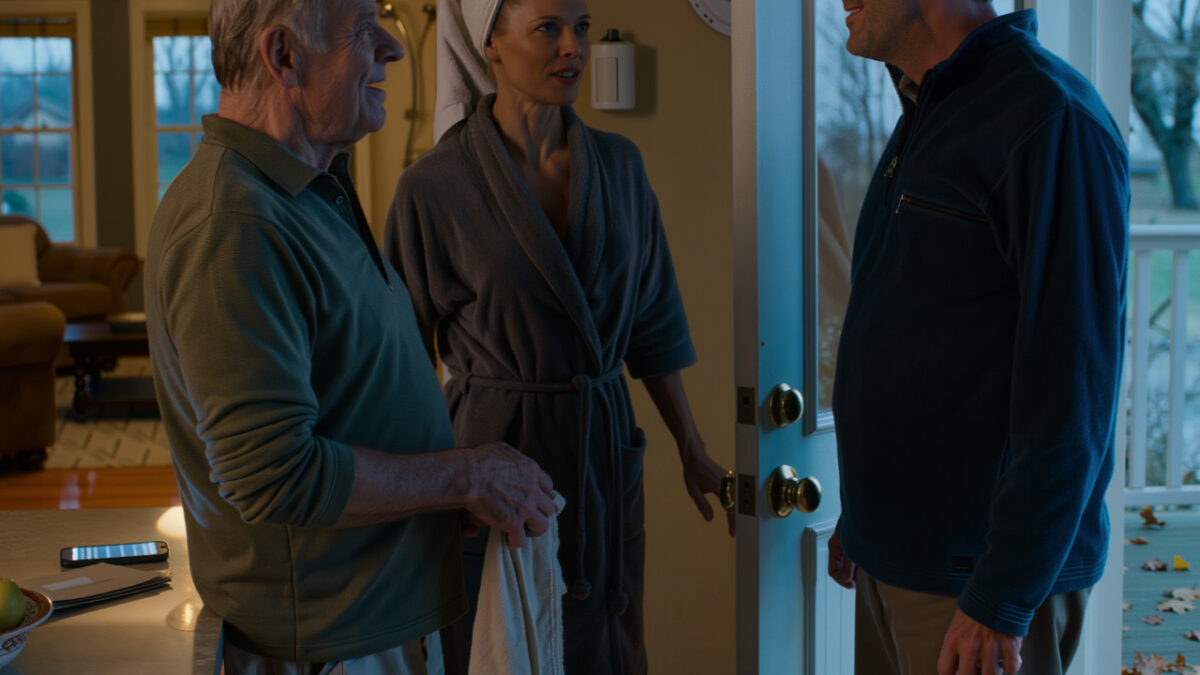
Angela came back into the kitchen a few minutes later in her gray robe, a towel wrapped around her hair, her face scrubbed in pink. She looked like the girl I’d married, and she looked like a stranger, and I couldn’t tell which one frightened me more. She looked at me a beat too long.
“Everything okay?”
she asked. Yeah, I said, and my voice came out steadier than I had any right to expect. Everything’s fine. She nodded, poured herself a glass of water, and carried it toward the living room.
I stood there counting my heartbeats. Somewhere past 300, while the dishwasher sloshed through its first cycle, the doorbell rang. I didn’t move at first. The chime hung in the hallway like a held breath, and from the living room, I heard the couch cushion shift as Angela sat up.
“Are you expecting someone?”
she called. I’ll get it, I said, which wasn’t an answer, and she didn’t push. She was already hunting for the remote, already settling back into an evening I had just set on fire.
Two summers ago, after a run of stolen packages on our street, our son-in-law installed a doorbell camera and made me promise to use it. I never had. Now, I pulled my phone from my back pocket with a hand that didn’t feel like mine and opened the app.
The porch light turned the image of flat bleached yellow. A man stood on the welcome mat with his hands in the pockets of a Navy quarterzip rocking slightly on his heels like someone who’d rehearsed a line in the car. He was my age, maybe a little younger, silver at the temples, a good jaw, reading glasses hooked in his collar.
Nothing about him looked dangerous, and somehow that was worse. If he’d been a younger man with a gym build and a smirk, I think I could have hated him cleanly. Something tugged at me, though.
a faint useless flicker the way a song on a store speaker seems familiar before you can name it. I had seen that face somewhere under different lighting holding a plastic cup. I couldn’t place where and I didn’t have time to try.
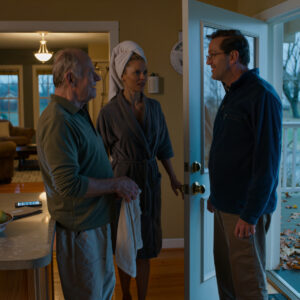
I put the phone away and opened the door. Cold air rolled in around my ankles, smelling of wet leaves and somebody’s fireplace down the block. The man had been smiling when the door swung open.
a soft, nervous, hopeful smile, the kind you wear when you’re about to see someone you’ve been thinking about all day. It was aimed at a spot a few inches to my left where a woman should have been standing.
“Angela,” he said.
“I have never been so aware of my own body, the weight of my shoulders, the doororknob cool and slightly greasy under my palm. I could hear the television in the other room laughing at something.” She’s inside, I said.
Relief crossed his face and he actually took a step forward, one foot over the threshold before his eyes finally landed on me. They moved over my face, my cardigan, the dish towel I realized I was still holding in my left hand. I watched him do the arithmetic.
The smile didn’t drop so much as drain like water leaving a tub. I’m sorry, he said. Who are you? Her husband. He went white. I mean that literally. The color left him from the forehead down, and he pulled his foot back onto the mat as though the floor had turned hot.
His mouth opened and closed once. For a second, I thought he might simply turn around and walk to his car. And I’ll admit a part of me wanted him to because then I could have told myself none of this had happened.
“She texted me,” he said almost to himself. Just now, she said to come over.
“I know, I said that was me. I hadn’t planned to say it. It came out flat and quiet and it landed between us like something dropped from a height.
Daniel looked at me for a long moment. I expected anger or a lie or a puffed up chest. What I got instead was something that looked uncomfortably like shame.
You said you couldn’t forget last night. I continued. So I’m asking what was last night, Mr. Mercer? He flinched at the name. Of course he did. I had no business knowing it.
Nick, who is it? Angela’s voice came from the hall behind me and I heard her slippers on the hardwood. That soft, familiar shuffle I could have picked out of a crowd of a thousand.
She stopped a few feet back. I didn’t turn around. I watched Daniel’s eyes travel past my shoulder and find her. And I watched whatever he saw there confirm everything.
I didn’t need to hear her breathe in. I didn’t need her to say his name. The silence behind me was so complete. It had a texture like a held note.
When I finally looked back, Angela had one hand pressed flat against her robe just below her collarbone, and the color had gone out of her face, too. Two people in my doorway, and the same expression on both. Not guilt exactly.
Something closer to the look of people watching a glass slide off a counter in slow motion.
“Daniel,” she whispered.
“What are you doing here? You told me to come.” His voice cracked on the last word. He swallowed and tried again, quieter, almost gentle, and I couldn’t tell whether the gentleness was for her or for me.
Angela, you told me you were going to tell him. The word tell went through me like a splinter. I turned my head. Tell me what Angela didn’t answer. She looked at the floor at the rug we’d bought on our 15th anniversary at the little frayed corner the dog used to chew.
Her lips moved, but nothing came out. Daniel took a half step back. I should go. This isn’t how I wanted. I’m sorry. I’ll go. You came a long way for that, I said.
I was surprised by my own calm. I could feel it sitting on top of something enormous and ugly, like a lid on a boiling pot. You drove here because you believe my wife invited you into our home.
The least you can do is tell me why. Daniel, please, Angela said. He looked at her for a long time. Something passed over his face that I’d call tenderness if I were feeling charitable and exhaustion if I weren’t.
Then he shook his head slowly.
“No,” he said.
“You said tonight was the night.”
The porch light buzzed overhead. A moth knocked against the bulb over and over, and I stood there between the two of them with a dish towel in my hand, understanding that the message on the counter wasn’t a slip or a careless mistake or a single bad night. It was the visible edge of something with a plan and a date and a place for me in it.
Tonight was the night, which meant my wife had been standing in that shower rehearsing a speech I didn’t know I was supposed to hear. I didn’t want him in my house, and I didn’t want him on my porch either. I wanted him to be a rumor against something I could have heard about secondhand.
“Go home, Daniel,” I said.
“I’m not going to do anything in front of the neighbors, and I’m not going to do anything to you, but I can’t have this conversation with you standing there.”
He nodded. He seemed relieved to be given instructions. He glanced once more past my shoulder and I didn’t turn to see what Angela’s face did with it. Then he stepped back onto the walkway, hands still in the pockets of that Navy quarterzip, and said in a voice so low I almost lost it under the moth and the buzzing light.
Nicholas, I never wanted it to happen this way. Neither did I, I said. I shut the door. The latch clicked an ordinary sound, the sound it had made 10,000 times.
Through the sidelight, I watched his headlight swing across the lawn and slide away down Maple Court. And then it was just the two of us and the television still laughing in the other room. I walked in and switched it off.
The silence that followed was worse. We ended up at the kitchen table, the oak one we’d refinished ourselves the summer before our daughter was born. I took my usual chair.
Angela took hers. Between us sat the fruit bowl and her phone, which neither of us looked at. She had pulled the towel from her hair and it hung in damp honeyccoled strands around her face.
I kept noticing at that stupid haircut.
“Who is he?”
I asked. She told me in pieces. He’d worked with her at the insurance office years ago in the old building on Fulton a few deaths over. They hadn’t spoken in a decade.
Then in February, he’d sent a message on LinkedIn, something harmless, about a retirement party for a woman they both knew, and she’d answered. A few weeks later, they were trading texts. Then phone calls on the deck wrapped in her cardigan.
I sat there and watched all those little rituals I’d stepped around come into focus one by one, like objects in a room when someone finally turns on the lamp. 8 months, she said. Almost.
8 months. I said it back to her slowly. In February, I had the flu and you made me soup. I know. You made me soup, Angela. And then you went out on the deck and called him.
Her eyes filled, but she didn’t wipe them. It started as talking. I swear to you, it did. He was going through his own divorce, and he listened to me in a way that I’m not saying that to hurt you.
I’m trying to tell you how it began. How long have you been lying to me? She looked at her hands. I don’t know when it turned into a lie.
The first time you hit it, I said, and my voice finally cracked on the last word, just a hairline. That’s when. It’s not a mystery. It’s the first time you put the phone face down.
She didn’t argue. That was somehow the most damning thing she could have done. I made myself ask the next one. I’d rather have swallowed glass. Last night, Carol’s. I wasn’t at Carol’s.
I figured that out about 40 minutes ago. She closed her eyes. I met him for dinner in Dublin at that Italian place off the highway because I thought no one we knew would be there.
We sat in the parking lot for a long time afterward. And she stopped and I watched her search for words that wouldn’t make it worse and find none. We crossed a line.
I won’t make you hear the details, but we did. I came home and I stood in the garage for 10 minutes before I came inside and you were asleep on the couch with the TV on. And you looked so so what?
So unsuspecting, she whispered. And I hated myself. I laughed a short ugly sound I didn’t recognize. Not enough to stop. No, she said not enough to stop. I got up and ran the tap and filled a glass and didn’t drink it.
Through the window over the sink, I could see our backyard going black. The swing set long gone. The maple our son had climbed too high at 9 and been stuck in until dusk.
The fireman had come. We’d laughed about it for years. He said you told him you were going to tell me, I said with my back to her. Tonight I was.
Were you going to tell me you were leaving? The silence stretched so long I turned around. Angela sat with her shoulders curved inward, a woman trying to take up less room in her own kitchen.
I didn’t know, she said. Of everything she’d said, that was the sentence that broke something. If she’d said yes, I could have been furious. If she’d said no, I might have hoped.
I didn’t know meant that after 21 years, whether I got to keep my life was something she was still deciding quietly while I rinsed the dishes. It came back to me in a rush uninvited. The cramped apartment on Hudson Street, where the stove never worked.
The night our daughter ran a fever of 104 and the two of us sat on the bathroom floor passing a thermometer back and forth too frightened to speak. Angela at the front window every evening in the lean years watching for my headlights and the way she’d opened the door before I could find my keys.
When had she stopped I couldn’t name the day. That frightened me more than any text message. It meant a marriage could die the way a house settles an inch at a time with no single sound.
I pulled out my chair again and sat down heavily. Is Daniel the reason you’re leaving? No. She said it right away without hesitation, and she looked straight at me when she did.
It was the first honest thing I’d seen in her face all night. Then what is? Angela took a long breath, and her voice when it came was small and steady and worn all the way through.
Because I haven’t been happy for a very long time, Nick. I didn’t say anything right away. When someone you’ve loved for 21 years tells you she hasn’t been happy for a long time, your first instinct is to check the calendar and find the year it started and then check what you were doing that year.
I was doing what I always did. I was at work a long time, I said. Give me a number. I don’t have one. She pulled the towel off her shoulder and folded it in her lap smaller and smaller the way she does with a napkin in a restaurant when she’s nervous.
Maybe 4 years, maybe more. It wasn’t a day, Nick. That’s what makes it so hard to explain. Nothing happened. That’s the whole problem. Nothing happened for years. Then tell me what nothing looked like.
She took a moment. When she spoke, there was no heat in it, which was worse than shouting. She had clearly said all of this to herself in the mirror, in the car, in the shower tonight, and the words had worn smooth.
It looked like you coming home at 7:30 and eating dinner while you read your email. It looked like me telling you about my day and you saying that’s great to the screen.
You’d ask if the car had been serviced, if the property tax was paid, if Emily was coming for Thanksgiving, and I’d answer and then we’d sit in the same room and I’d realize we just had an entire evening with no sentence in it that was about us. I was working, I said.
It sounded as thin out loud as it had in my head. I was keeping the lights on. I know you were. I know what you did for this family, and I never said otherwise.”
Her voice caught. But I didn’t need a provider. I had one. I needed someone to ask me what I was afraid of or what I wanted at 54. And I couldn’t remember the last time either of us had wanted anything that wasn’t for the kids or the house.
I thought about my father, who’d worked 31 years at a tire plant and shown love by changing my oil and never missing a mortgage payment. I’d absorbed it the way you absorb an accent. provide, protect, don’t complain.
I believe that a man who did all three had earned his peace. It had honestly never occurred to me that my wife might be sitting across from me, starving at a full table. Okay, I said.
My throat hurt. Okay, I hear that, and some of it’s true. I’m not going to sit here and pretend I was a mind readader or a saint, but I’ll ask you the question I’d ask anyone.
I leaned forward. You could have told me. I tried when the anniversary trip two years ago in Hawking Hills. I said we felt like roommates and you laughed and said every married couple does after 20 years.
And then you asked if I wanted the last piece of pie. I opened my mouth, closed it. I remembered the trip. I remembered the cabin, the hot tub, the pie.
I did not remember the sentence. It had slid right past me and left no mark. And I understood that this was precisely her point. And I didn’t listen, I said quietly.
Not the way I needed you to. It was fair, and it was the kind of fair that cost you something to admit. I let it sit there for a while.
The dishwasher finished its cycle and clicked into silence. But I wasn’t willing to let it be the whole story, and I don’t think a decent man would have. When I spoke again, my voice was low and even.
Angela, I’ll own what’s mine. I’ll own the pie. I’ll own every night I stared at a screen. But whatever was broken between us, you still had a choice. You could have shouted at me.
You could have booked us a counselor. You could have packed a bag. You picked a stranger on a deck at night and then you picked a lie and you picked it again every single day for 8 months.
She flinched, but she didn’t look away. I know. Do you? I know, she said. And a tear finally slid down and she let it. I’m not asking you to forgive it.
I’m not even saying the marriage caused it. I’m saying it was empty and Daniel walked into the emptiness and I let him. That’s on me. I’d expected excuses. I’d braced for them the way you brace for a wave.
Her refusing to give any was disarming in a way I couldn’t afford to be disarmed. What about him? I asked. Is he a man who does this a lot?
No, she shook her head. His wife left him 2 years ago. He’s been alone in a house for a while just like she stopped herself. He talked about how quiet it was and I recognized it.
That’s the pathetic part. We weren’t swept away, Nick. We were two tired people who finally had someone to say tired things to. But you never filed, never talked to a lawyer.
Never told me you wanted out. I didn’t want to be the person who blew up everything. So, I stayed in the middle with one foot in each life and told myself I’d decide when I was ready.
She gave a wet, humorless laugh. I think that’s what I’m most ashamed of. not even the affair that I let someone else’s silence do my deciding. Then it came to me a memory surfacing in the dark, a folding table, a plastic cup of lukewarm punch.
Last fall, the fundraiser at the Elks Lodge for her old offic’s scholarship fund. A friendly man in a blue blazer had shaken my hand, said something about my daughter’s wedding photos, and moved on. I’d forgotten him before I reached the parking lot.
I met him, I said, didn’t I? At the elks, Angela went very still. Yes. I had shaken his hand and offered him a stuffed mushroom. He must have stood there knowing what he knew and thought, “What a nice, unsuspecting man.”
I rubbed my face with both hands. When I lowered them, I asked the only question that seemed to matter.
“If I hadn’t read that message tonight, when were you going to tell me?”
She looked down at her folded towel.
“Tomorrow.”
I didn’t believe her. I’d like to say I did, but I’ve never been a good liar or a good judge of them. and the evidence of my own marriage argued against my instincts.
Tomorrow was convenient. Tomorrow was what people say. Then the thought arrived cold and specific, and I felt it in my chest before I understood it. Tomorrow was Friday. Tomorrow at 10:00, Angela and I had an appointment at Patricia Lel’s office downtown, the one we’d set up 6 weeks earlier to update our wills and review the paperwork on the house.
Patricia, I said, at 10:00. Angela looked up and I watched her understand where my mind had gone. It wasn’t hard. A wife with a secret, a lawyer’s appointment, a will.
I’ve watched enough television to know how that story is supposed to end. Nick, no. You tell me what I’m supposed to think. You’ve got a man sitting in a parking lot who says, “Tonight was the night and tomorrow morning we’re sitting across a desk from an estate attorney.
I’d like to believe I’m not a fool, but I’ve been wrong about a lot of things in the last hour. It isn’t about Daniel. She pushed back her chair.
Wait here. She went upstairs and I sat listening to her move around our bedroom, a drawer, the closet. The soft thump of something set down on the carpet. I stared at the fruit bowl and thought about the apples going soft in it.
When she came back, she was holding a blue accordion folder, the kind you buy at an office store in August, and she set it on the table between us as carefully as if it might go off. Open it. Inside were bank statements highlighted in yellow.
Years of them. I knew what they were before I finished turning the first page and my stomach dropped for a different reason entirely. Patricia’s office sent that checklist 2 weeks ago.
Angela said, “Asset summary for the update. You said you’d handle it and then you were busy, so I logged into the savings account myself. I hadn’t looked at it in years.
I thought we had about $90,000 in there.” Her voice wobbled. We have 11. I didn’t say anything. I thought something awful. I thought you’d lost it or gambled it or I don’t know what.
So, I started pulling statements and I saw the payments every month for almost 3 years going to Riverside Medical Billing. Then I called them and a very nice woman told me my mother’s account had been paid in full by a Mr. Nicholas Brennan. She pressed her knuckles against her mouth.
$74,000, Nick, for her heart surgery and the rehab after. She told me Medicare covered it. You told me Medicare covered it. There it was the one thing I’d carried so long I’d stopped feeling its weight.
Dolores had been 69 and widowed and proud, the kind of woman who kept a coupon organizer in her purse until the day she died. And she’d lay in that hospital bed in Columbus, believing the bills were handled. They were not.
The first notice arrived at our house by mistake addressed to her and I opened it at the same table at midnight while Angela slept and then I made a decision. Angela was already running herself ragged between work and the hospital sleeping in a vinyl chair.
I thought I can take this one so I did quietly month after month without telling her because I didn’t want her ever to feel she owed me or that her mother was a burden. I wanted her to keep her mother’s dignity intact. And if I’m honest, I was a man who had never learned a better way of saying I love you than paying for things.
Why didn’t you tell me? She asked. Because you’d have felt indebted. I’d have felt married, she said, and her face crumpled. Do you understand that I spent 4 years believing you’d stopped seeing me and the whole time you were carrying this for me and never said a word?
Nick, I found that folder two weeks ago and I cried in the car outside the credit union for an hour because it was the most loving thing anyone has ever done for me and I was already in love with someone else. Her words didn’t land as a weapon, they landed as a verdict on both of us.
That’s why I wanted to see Patricia, she went on, I didn’t want to change anything. I wanted to put it on paper so my brother and sister would know what you’d done. And I wanted to walk in there as someone telling the whole truth, not someone with one foot out the door.
I was going to tell you tomorrow morning before we left the house. I wanted to believe her. Part of me did. Another part stood at a cold distance, arms crossed, and said, “A woman who’s discovered she’s loved is exactly a woman who might tell the truth or one who might need to feel better about herself first.”
I held both.
“It doesn’t erase what happened,” Angela said, anticipating me. I know. I need you to know I’m not saying it does. I know, I said again and meant it. Her phone buzzed against the table and we both jumped.
The screen read Daniel Mercer. She made no move to touch it. It buzzed again, rattling across the wood, and I looked at her and then I reached out and answered it, and I put it to my ear without a word.
Angela. His voice was ragged. Road noise hum behind it. Please, I just Is that you? It’s Nicholas. A long pause, I heard a turn signal ticking. I pulled over, he said, at the speedway on Route 33.
I couldn’t drive. I want you to know something, and I’d like to say it to you directly if you’ll let me. Go ahead. I won’t lie for her, and I won’t ask her to lie for me.
He breathed out shaky. I knew she hadn’t ended things with you. Every time I asked, she’d say soon. I told her last week that I wasn’t going to keep being the reason she hid.
I didn’t come tonight to take anything from you. I came because she told me she was finally going to tell you everything. And I thought I thought I owed her that much to be there when she did.
You got a message from my number. I said, “Yes, I’m not proud of that. I don’t think either of us is proud of much tonight,” Daniel said. And for a second, I almost liked him, and I hated that I did.
He hung up first. I set the phone down and looked at it, and it came to me with a terrible plain clarity that my one reckless thumb press had taken a conversation meant for tomorrow morning with coffee and a folder and some room for grace, and turned it into this.
A kitchen at 11 at night, a stranger on my porch, all of it blown open raw. It wasn’t what she’d planned. It wasn’t what I’d have chosen either. It was just what happened.
I could have thrown the phone. I could have driven to that speedway. I’d read about men who do, and every one of them lost something permanent in the doing.
I sat very still instead, my hands flat on the oak, the same oak we’d sanded together 21 summers ago. I need to know one thing, I said finally, and my voice came out like gravel. Just one, and I need you to think before you answer.
Angela watched me. Do you still want this marriage? She started to cry, then really cry not the quiet leaking from before, but great shuddering breath she tried to swallow.
She didn’t answer. She just sat there with her hands over her face, and the silence she left me with was the loudest thing in that house. I let her cry.
There was nothing in me that wanted to stop it, and nothing that wanted to soften it either. I got up, tore a few sheets from the roll of paper towels and set them in front of her the way you’d hand a stranger a tissue at a funeral. Then I sat back down and waited, and the clock on the stove turned over to 11:52.
When she could finally speak, her voice was raw. I don’t know if I can go back, Nick. It was the honest answer, and I’d asked for honesty, so I made myself take it without flinching.
A wiser man might have said something grand just then. I only had what was true.
“Then don’t promise me forever,” I said.
“I’ve had enough of promises tonight that I can’t tell her real.”
She lowered her hands. Her mascara was gone, her eyes swollen, and she looked 54 and 19 at the same time.
“Here’s what I can live with,” I said. You don’t have to decide tonight. You don’t have to decide this month. But you can’t stay in the middle anymore. That’s the one thing I won’t do.
Be the man you keep in the next room while you make up your mind. So, we separate. Not as a punishment, as a way to find out what’s actually left.
If you want a counselor, I’ll sit in the chair. If you find out you’re certain, you tell me and I’ll call Patricia myself and we’ll do it decently. But whatever we do, we do it with our eyes open.
That’s more than I deserve. This isn’t about deserving. I turned my wedding ring once around my finger, a habit I’d had for 20 years and had never noticed until then.
I can forgive you someday. I think I can. I don’t know when. But forgiveness doesn’t mean pretending nothing happened. If I’m going to forgive you, it’ll be for something real, not something we both agreed to forget.
She nodded slowly. She understood, and I could see it cost her. She left on Saturday, not in a slam doorway. She packed two suitcases while I sat on the porch steps pretending to read the paper and her sister Maryanne pulled up in her Buick and the two of them loaded the trunk without a word.
Angela stopped in front of me before she went. I stood and for a moment neither of us knew what to do with our arms. Then she put her hand flat against my chest briefly as though checking that I was still there and walked to the car.
I took the guest room, not our bed. The first night I lay awake listening to the house, the tick of the furnace, the settling of the stairs, and understood how many of its sounds had been hers. For 2 weeks, I moved through the place like a man in a museum.
I ate cereal for dinner. I called our son and daughter and told them as plainly as I could manage, and I let them be angry at whoever they needed to be angry at. Emily cried.
Our son said nothing for so long that I thought the line had dropped and then said, “Dad, are you okay?” and I had to put the phone down on the counter and breathe. But something odd happened in those two weeks.
Angela and I started talking. Not the old talk, the logistics, the car, and the taxes. We called each other on Sunday afternoons and mostly said difficult things, short and clumsy.
She told me she was frightened I’d hate her. I told her I was frightened, too, that I’d never been the man I thought I was. We stopped checking each other’s faces for the right answer.
We stopped tracking each other’s phones, which I’d started doing in my head without admitting it, and which she had every reason to expect. It was the first time in years that our conversations had no audience and no agenda, and they were awful, and they were the most honest hours I’d spent with her in a decade.
In the second week, she met Daniel at a coffee shop in Westerville. She told me beforehand, which I hadn’t asked her to, and afterward, she told me what was said. She had sat across from him and realized with a kind of vertigo that most of what they’d built was made of escape.
The late night calls, the parking lot, the little language of two people hiding. Take away the hiding and there wasn’t much to stand on. He was kind about it.
She told me over the phone. He said, “I wanted you, Angela, but I didn’t want you to wreck your whole life to get to me.” And I thought that’s the saddest, truest thing anyone said to me all year.
“What are you going to do?”
I asked. I’m not going to move in with him. I’m not going to run from one house into another. She paused. I owe it to myself to stand in my own mess for once, and I owe it to you.
I sat with that for a while because there was a mirror in it I couldn’t look away from. I’d spent my life believing a good husband did four things, worked, paid, protected, kept his word, and I’d done them. God knows I’d done them.
But somewhere along the way, I had stopped being in the room. I’d handed my wife a roof, a secure retirement, and her mother’s hospital bills settled in secret. And I had never once asked her what she was afraid of.
I’d confused being reliable with being present. Those are not the same, and it took a stranger on my porch to teach me the difference. I took my share, and I took it fully.
But I wouldn’t take hers. That was the line I held. Whatever I’d failed to give Angela had chosen what she did with her own hands, and I refused to carry that choice for her.
Somehow, holding both of those at once, my fault and not my fault, steadied me more than anger ever could have. A month after that night, a gray Sunday in late November, we met at a little cafe on High Street, neutral ground with mismatched mugs and a chalkboard menu.
She was already there when I arrived, sitting by the window with her coat on her hair back to its natural brown. and I realized I was relieved. We ordered.
We didn’t talk for a while. Outside, a woman struggled with a stroller and a dog leash at the same time. And we both watched her and both almost smiled.
I don’t know what our marriage is going to become, Angela said at last, turning her cup in a slow circle. I looked at her, my wife of 21 years, and for the first time since the doorbell, I didn’t feel rage or grief. I felt something quieter and harder to name.
Neither do I, I said. But at least we’re finally telling the truth. Three months after that night, on a bright, bitter morning in January, I stood at the kitchen window with my coffee and watched the neighbor’s kid chip ice off his driveway with a snow shovel three sizes too big for him.
I was still living in the same house. Angela and I were still in the legal sense, separated, and we hadn’t filed anything. We were in a strange, unlabeled place between the life we’d had and whatever came next.
and I’d made an uneasy peace with not having a word for it. What I did have was a rhythm. Tuesdays she’d call. Sundays sometimes we’d have coffee. Twice we’d sat in a counselor’s office in Upper Arlington on a couch that was far too soft with a box of tissues placed between us like a referee.
The counselor was a woman named Ruth with short gray hair and a voice like warm bread. And the first time she asked me what I wanted, I couldn’t answer. I’d been asked a thousand questions in my life about what I needed to get done.
Almost never what I wanted. I could talk to Angela now without my chest tightening. That alone felt like a small miracle. We could be in a room together and let a silence sit there without either of us rushing to fill it because the silence was no longer hiding anything.
It was just quiet. I’d forgotten that quiet could be a different thing from the one we’d lived in for years. And I’d had time to look back at that night with a clearer eye the way you look at a house after the smoke is cleared and the walls are still standing scorched but standing.
What I understood was this. The thing that hurt most wasn’t the doorbell. It wasn’t Daniel’s face going white on my porch or the text on the counter or even the word tomorrow.
What hurt most was that for years two intelligent, decent people had sat at one oak table and let a whole marriage go unsaid. Angela had been starving and I’d been exhausted and each of us had assumed the other was fine. We were so polite.
We were so careful not to make a scene that we’d never made a life. And my own part in it, the one I’d typed with my own thumbs, I’d stop being ashamed of that. For weeks, I’d lain awake thinking if I hadn’t answered, none of it would have happened that way.
But I’d come to see it differently. I hadn’t typed, “If that’s true, come over.” Because I wanted a fight. I typed it because for once in my life, I was tired of being the reasonable man.
I wanted the truth to walk through my front door and look me in the face. That’s all. Every other way of finding it out had been close to me by years of good manners.
By spring, Angela and I stopped pretending we were going to go back. We both knew it before either of us said it. It happened in Ruth’s office on a rainy Tuesday when Angela said quietly, “I think I loved you so much for so long that I forgot how to love you out loud.”
And I said, “I think I forgot, too.” And we sat there understanding that sometimes two people can be sorry and honest and still not be able to rebuild what they lost. So, we did the next decent thing.
We hired one lawyer, Patricia Lel, the same woman whose appointment I dreaded. and she turned out to be more humane than either of us deserved. We sold nothing in a hurry.
We split the money fairly and Angela insisted on paying back half of what I’d spent on her mother’s care and I refused and we argued about it for a week and in the end she put it toward a scholarship in Dolores’s name at the community college. It was the best argument we’d had in years.
A year later, the papers were final. We signed them in Patricia’s conference room side by side. And when it was done, Angela reached over and squeezed my hand once.
Not a romantic gesture, just two people who’d survived something together, acknowledging it. We walked out into the parking garage and hugged for a long time, and neither of us said anything clever. We never became enemies.
I’d worried we would. I’d seen it happen to friends, the lawyers, and the slam doors, and the kids stuck in the middle. But we kept showing up for the things that mattered.
Our daughter’s baby shower, our son’s graduation dinner, where Angela and I sat at the same table and passed the roles like two people who’d once shared a life and wouldn’t pretend otherwise. We learned to be kind to each other because of the years we’d had. That I think is the only real revenge on the past to refuse to let it turn you into someone you aren’t.
As for me, I learned how to live in my own house. I painted the guest room and turned it into an office with a good window. I fixed the back fence I’d been ignoring for 6 years.
I started having dinner with my old friend Walt from the plant every other Friday. And I got a dog, a scruffy, ill-mannered beagle mix named Biscuit, who shed on everything and slept across my feet.
I took the trip to Maine that Angela and I had always talked about alone and stood at the edge of a gray cold ocean eating a lobster roll and understood that I was a person who could be happy without being responsible for anyone. It was a strange unfamiliar feeling and it grew on me.
One evening in the fall, more than a year after the night on the porch, I was sitting at the kitchen table with a bowl of soup and a cross word when the doorbell rang. I stopped spoon midair. For 3 or 4 seconds, the old night came back whole.
The cold air, the porch light, the smile draining off a stranger’s face. My pulse jumped. I’d like to say time had healed me completely, but a body remembers what a mind forgives.
I set down the spoon, walked to the door, and opened it. It was my daughter, bundled in a scarf, holding a foil covered plate and wearing a sheepish grin.
“Hi, Dad.”
Emily said, “I was in the neighborhood.” She wasn’t. She lived 40 minutes away. She’d driven out on a week night with a plate of her lasagna because she’d guessed correctly that I was eating soup alone.
I pulled her in and held her, and she smelled like cold air and garlic. And I realized I was smiling so hard that my face hurt. Not every doorbell carries a betrayal.
Some of them carry your people home. That night after she left and the dishes were done and Biscuit was snoring against my ankle, I thought back on it all. And I’ve come to a conclusion I’d like to leave with you.
That night, I thought the doorbell had ended my marriage. Years later, I realized it had only ended the version of my life where I kept pretending everything was fine. If this story stayed with you, I’d really like to hear from you.
Have you ever been in a place where the truth finally came knocking and you had to decide whether to open the door? Leave a comment below and tell me where you’re watching from and what you would have done in my shoes. I read every one of them.
We’ve got plenty more stories like this to share with you every single day. So, please subscribe and hit the bell so you never miss one. Thank you for spending this time with me.
Let’s keep walking this road