I was the new CEO having lunch quietly in the company cafeteria when the sales director walked over and told me, “This table is reserved for Mr. Jennings—go sit somewhere else,” so I picked up my tray without arguing and moved, knowing he had no idea who he had just ordered away or what was about to happen when the afternoon meeting began.
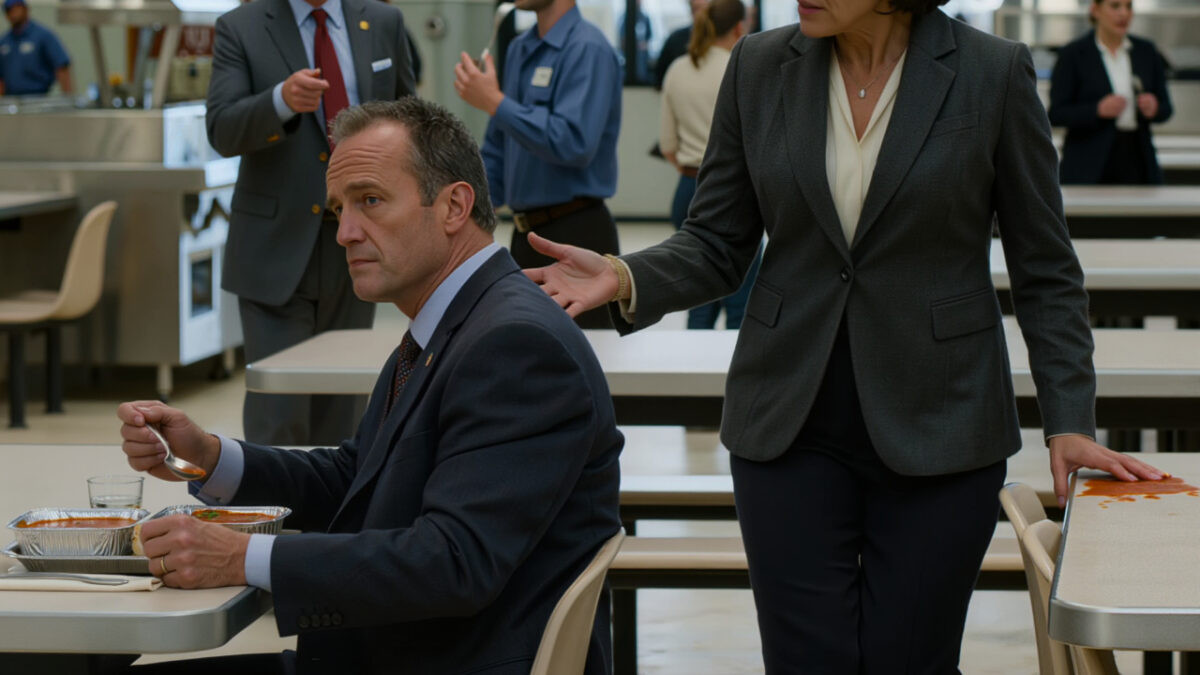
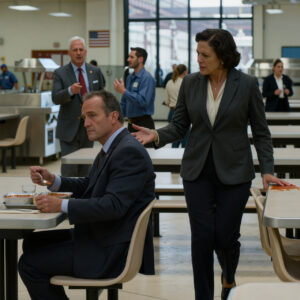
I had been chief executive officer of Apex Industrial Holdings for less than two hours when a woman in a charcoal blazer slammed her open palm directly onto my cafeteria table. The aluminum tray rattled violently. Hot tomato soup splashed over the rim, scalding the back of my hand and soaking my navy cuff.
I did not flinch. I laid my stainless spoon flat against a napkin and met her furious eyes.
“You are the new parachute hire, aren’t you?”
she shouted across the dining hall. Let me make something clear. My husband and I built this enterprise with our bare hands while you were an unknown peddler wandering through small town motel.
Who the hell do you think you are marching in here expecting anyone to take orders from you? The 300 seat dining hall fell silent. Silverware froze in midair. Dishwashers stopped their carts and young receptionists slid down in their chairs.
I pressed a napkin against my reden knuckles and looked past her shoulder. Standing behind her was a tall, silver-haired executive in a gray bespoke suit. His posture was stiff, jaw clenched, eyes shifting nervously.
His name was Paul Jennings. 25 years ago, we had walked the same college campus, trading notes on mechanical engineering and sharing cheap takeout in the library basement. now. He stood behind his wife like a shadow while she attempted to publicly humiliate me on my very first morning.
My name is Ryan Vance. I was 48 years old, 48 hours earlier. I had been an independent sales representative living out of worn carryons, traveling through rust belt corridors to sell hydraulic components.
I had no corporate pedigree and no family trust fund. When my parents died in a highway collision 19 years ago, they left behind heavy obligations and my baby sister, Chloe. I spent my adult years working 70our weeks on dusty highways to ensure Kloe had a safe roof, warm coats, and college savings.
She was 15 now, bright, spirited, and attending a preparatory academy. The unexpected phone call arrived on a rainy Tuesday while I was sitting in an airport tavern in Cleveland. Nursing an amber ale after a stubborn steel client turned down my proposal.
My tie was loose, my shoes scuffed, and my phone buzzed against the bar. The caller identifier read private. I answered in a quiet corridor. A crisp voice introduced herself as Brenda Foster, executive assistant to Oliver Thornton, the legendary 74year-old chairman of Apex Industrial Holdings.
Mr. Thornton requested my presence at corporate headquarters the next morning. Apex Industrial Holdings was a manufacturing giant controlling three production plants, commercial freight fleets, and fabrication facilities across four states. I had pitched small valves to subcontractors.
I had never crossed paths with the billionaire founder of a multi-state conglomerate. Arriving at the 34th floor suite, I found Oliver Thornton seated behind a vast walnut desk. His silver hair was cropped short, his shoulders broad despite his age, his steel eyes possessing penetrating clarity.
Oliver slid a manila folder across the desk. Inside were 12 pages detailing my career, territories managed, sales quotas met, debt settled after my parents died, and notes from independent vendors praising my stubborn honesty. Oliver said his private investigators had tracked me for 6 months.
26 years ago, Oliver founded Apex with three partners, starting in a dilapidated warehouse with four welding rigs. As the enterprise expanded into hundreds of millions in turnover, Oliver rewarded his partners with executive vice presidencies and lucrative stock aotments. But unmonitored power bred systemic rot.
Over the past decade, the partners transformed key departments into private cash thiefs. They installed family members on inflated payrolls, approved non-competitive contracts with dummy vendor entities, and stonewalled anyone demanding transparency. Oliver was 74, battling declining health, and knew his old friends were bleeding the corporation dry.
He needed an outsider with deep operational knowledge, unquestioned integrity, and zero personal debts to the entrenched hierarchy. He offered me the position of group chief executive officer, an annual compensation of $185,000, an executive vehicle, temporary housing, and three months of absolute authority to audit the company. Accepting was stepping onto a minefield.
Entrenched executives possessed deep political roots and decades of institutional leverage. But Oliver looked me in the eyes and said 4,000 working families relied on Apex for their livelihoods and healthcare. If I walked away, parasites would dismantle the company within 3 years.
For Khloe’s future and the honest workers who built those plants, I accepted. Oliver warned me about the three ring leaders. Walter Higgins in finance, Donald Briggs in procurement, and Paul Jennings in sales, whose wife Donna ruled the commercial division through intimidation.
I arrived an hour before sunrise on my start date, skipping any celebratory breakfast to walk the shop floors and observe the loading bays. At noon, Brenda Foster guided me down to the third floor dining hall so I could eat an ordinary meal among the rank and file staff.
I had taken two spoonfuls of soup when Donna Jennings marched across the floor, slammed her hand onto my table, and launched the declaration of war that marked my first two hours as chief executive officer. Donna Jennings stood over me, her chest heaving beneath her charcoal jacket, manicured fingers trembling with indignation.
This corner table has been reserved for Mr. Jennings and senior leadership for 10 years. She snapped loud enough to reach the dishwashing stations. New hires eat in the secondary annex near the loading docks.
Pick up your tray and move over there before I have corporate security escort you off the premises. Nearby line workers lowered their heads, staring at their trays. I set my napkin down, folded my hands calmly across the laminate table, and looked up into her scowling face.
“Mrs. Jennings,” I replied in an even cadence.
“If you have concerns regarding executive appointments, my calendar is open at 4:00. However, this is an employee dining hall established by Oliver Thornton to feed every worker wearing an Apex badge. There are no reserved royal boxes here, and I have no intention of moving.
Her face flushed crimson with a snarl. She reached forward to grab my tray. Before her fingers touched the aluminum lip, a calloused hand clamped firmly around her wrist.
“That is quite enough,” Donna, an authoritative voice cut through the room. I looked up to see a broad shouldered man in dark work trousers and a gray supervisor jacket bearing the badge of Scott Campbell, production line supervisor. His jaw was square, sandy hair dusted with metal shavings, steady blue eyes burning with resolve.
Scott had been my college roommate. We had worked graveyard shifts at a fuel depot to pay semester fees, shared cheap pizza, and promised never to surrender our self-respect for corporate favor. Donna yanked her wrist- free, eyes widening in fury.
Scott Campbell, she hissed. You are an hourly supervisor. How dare you lay hands on an executive director. Mind your production quotas or your termination slip will be signed before shift change.
Scott did not budge. This is an open cafeteria, Donna, he responded evenly. It is not your living room and not a courtroom where you hand out summary judgments. If you wish to register a formal complaint against the chief executive officer, write a memorandum to the board.
Otherwise, let the man finish his soup. Donna glared between the two of us, realization dawning behind her eyes.
“Is that what this is?”
she sneered.
“Our new outsider boss brings in old drinking buddies to climb over our backs and tear down what my husband built.”
She leaned across the table once more.
“Enjoy your soup, Vance. You may hold the title today, but you will not last 90 days in this building.” She pivoted on her 4-in heels, shoes clicking sharply as she stormed out.
Paul Jennings lingered for an awkward heartbeat, avoiding my gaze before scuttling into the corridor after his wife. Scott sat down opposite me, a tired smile breaking through his hardened features.
“2 years, Ryan,” he murmured.
“I read the company announcement this morning, but I had to see it to believe you were crazy enough to step into this snake pit.”
“Ol gave you the polite summary. The reality is far worse. Walter Higgins controls the ledgers. Donald Briggs controls supply and the Jennings family runs sales like a personal slush fund.
They treat anyone who asks questions like an enemy. After lunch, I returned to my 34th floor office and summoned Brenda Foster. I instructed her to bring me 36 months of raw general ledger records, procurement contracts, accounts receivable, aging schedules, and vendor registrations.
Brenda returned rolling a heavy cart stacked with four oversized banker boxes. If I was going to survive the 90 days Donna had allotted me, I needed to master the arithmetic of their corruption. I spent the remainder of the week locked inside my office until past midnight, cross- refferencing ledger entries against freight manifests.
The financial rot was staggering. In procurement, Apex spent roughly $38 million annually on structural materials. Prices were systematically inflated by 20 to 30% above prevailing market rates. Standard beam steel selling on the open market for $650 a ton was invos invoiced to Apex at $850 a ton, siphoning away over $1,600,000 each year.
When I cross-referenced state corporate registries, I discovered the primary steel brokers were Shell entities owned by Roger Briggs, younger brother of executive vice President Donald Briggs. In finance, fraud was even more brazen. Walter Higgins had authorized recurring monthly consulting retainers totaling $520,000 annually to Crestline Advisory Services, an entity registered to an empty suburban apartment.
Walter routed those corporate funds directly into personal brokerage accounts to finance speculative day trading and tech options. In sales, receivables were bleeding. Over $4,200,000 in customer invoice invoices were passed due by more than 18 months.
The largest outstanding debtor was an industrial distributor in Columbus owing $5,600,000 in precision hydraulic actuators owned by Donna Jennings’s first cousin. Apex continued shipping train loads of high-v value inventory every week despite recovering less than $250,000 in total payments. To make matters worse, Donna established an internal compensation rule paying sales representatives full upfront commissions upon signed purchase orders, leaving Apex to absorb 35% default rates.
The first direct skirmish occurred during my second week. Donald Briggs’s procurement manager rushed into my office with an urgent work order, demanding an immediate cash release of $110,000 to replace a catastrophic hydraulic press failure on manufacturing line 4. Instead of approving the expenditure, I brought in an independent master machinist from a neighboring county.
The machinist discovered a loose bleeder valve. He tightened the fitting, replaced two rubber gaskets, and had the press operating at full pressure in 20 minutes for an invoice of $250. Donald’s procurement lieutenant had split the previous $84,000 with a crooked contractor.
The grace period was officially over. I took the forensic inspection report directly to Oliver Thornton’s penthouse residence that evening. The elderly founder sat in his leather armchair, reading the fraudulent maintenance invoices under the glow of a brass lamp.
“For 26 years, I convinced myself their loyalty would protect this enterprise,” Oliver said softly, voice trembling with sorrow and fury.
“I was a fool, Ryan. They stopped being builders long ago. They became vultures, waiting for the carcass to cool. Do whatever you must to cleanse this house. You have my unconditional backing.
The following morning at 8:00, I convened an emergency meeting of the senior executive committee in the main board auditorium. Walter Higgins sat on my left, polishing wire rimmed spectacles. Donald Briggs sat on my right, slouched back with an arrogant smirk.
Paul Jennings sat directly across from me, while Donna Jennings leaned against the rear wall with arms folded defensively. I plugged my laptop into the presentation display and laid down three non-negotiable operational mandates. First, effective immediately, every procurement purchase authorization exceeding $50,000 required the independent written counter signature of the chief executive officer.
Second, an external team of forensic certified public accountants would initiate a comprehensive audit of all vendor contracts executed over the preceding 36 months. Third, effective noon today, equipment purchasing and inventory logistics would be temporarily transferred to the direct oversight of production supervisor Scott Campbell. Are you accusing us of incompetence, Vance?
Donald Briggs roared, slamming his fist against the mahogany table. I have managed procurement for this company for over two decades. You cannot parachute in here and freeze operations because you saw an equipment invoice you do not understand.
Walter Higgins adjusted his glasses and whispered, “Mr. Vance, your arbitrary restrictions will trigger severe operational gridlock.” Paul Jennings attempted to soothe Ryan. Let us be reasonable. We are family here.
Long-standing relationships take precedence over balance sheets. Relationship Capital does not grant license to charge this company 24% above fair market price to enrich family relatives. I fired back voice steady and cutting.
We are bleeding millions while our factory floors cope with defective components. This audit is going forward and anyone who impedes forensic access will face immediate administrative suspension. Donna Jennings threw her notepad onto the carpet, hissed that I would ru this day, and let her husband out the door.
The corrupt triumvirate coordinated their counteroffensive with ruthless precision. Walter Higgins systematically throttled digital access for forensic accountants, claiming central financial servers were undergoing database migrations. Donna Jennings instructed 40 field account executive to halt processing active commercial quotes, purposefully stalling 15 million in new sales pipeline revenue.
Donald Briggs secretly contacted our primary regional steel suppliers, falsely whispering that Apex was facing imminent insolveny and instructed them to withhold raw sheet metal deliveries until cash cleared in advance. Within 48 hours, the main fabrication plant grinded to a near standstill. Scott Campbell walked into my office face dark with exhaustion, clutching stalled production schedules.
If Ross Steel does not arrive by Thursday morning, line three and line five shut down completely, Scott warned. Every hour of factory downtime costs us $60,000 in liquidated contract penalties. Donald is trying to strangle you with your own production lines, but they had underestimated my 22 years of field sales experience.
While Donald had spent 20 years skimming kickbacks from his brother’s dummy corporations, I had spent two decades earning the trust of regional mill managers across three adjoining states. I picked up my telephone, called three independent fabrication mills in Indiana and Pennsylvania, and personally negotiated emergency shipments of certified structural steel at true market rates.
Scott organized independent freight carriers to pick up tonnage directly from rail heads. Within 72 hours, 70 freight flatbeds rolled through the security gates of Apex, unloading fresh structural steel onto our docks. Factory lines roared back to life and Donald supply embargo collapsed.
The desperation of the inner circle rapidly turned to raw personal intimidation. On a rainy Thursday evening, my cell phone rang from an unlisted number. Scott’s voice came through the receiver, hushed and urgent.
Ryan, do not leave headquarters through the executive garage tonight and do not drive your sedan. Why? I asked. A maintenance worker overheard Donald’s lieutenant talking to two local thugs, Scott whispered.
They intend to stage an accident to run you off the highway.
“Take a ride share from the kitchen dock right now.”
I took Scott’s advice, slipping out through the kitchen scullery and boarding an unmarked ride share sedan. Less than a mile from headquarters, a black four-door sedan with dark tinted windows slid out of an alleyway and glued itself to our rear bumper. The driver accelerated and the sedan matched his speed.
My driver, a sharp veteran cab, recognized the pursuit, cut through an unlit service lane behind a strip mall, and breakd behind an apartment complex. Jump out and cut through the breezeway. Brother, the driver muttered.
I threw a $100 note onto his dashboard, sprinted through the dark courtyard, and hailed a yellow city cab on the opposite avenue. I arrived at my rental townhouse, shaken but resolute. The following morning, I hired an independent private security detail, upgraded my life insurance, naming 15-year-old Khloe as sole beneficiary, and established triple redundant off-site cloud archives of all forensic evidence.
Two days later, Donna Jennings organized a walk out of 40 sales representatives, marching them directly into the corridor outside my office, chanting protests and claiming I had slashed their commission compensation in half. I walked out into the corridor without security, closed the door behind me, and looked across the sea of anxious faces.
Under the old policy, 40% of your contracts were uncollectible write-offs, while senior leadership pocketed unearned bonuses and left the company to absorb millions in bad debt. I announced my revised formula guarantees your baseline salary, protects honest closings, and rewards collected cash so that Apex remains financially healthy enough to pay your mortgages and health care next year.
The sales representatives looked at each other, murmuring in realization. One by one, they folded their placards and returned to their desks, leaving Donna standing alone in the empty hallway, consumed by impotent fury. That evening, Brenda Foster tapped gently on my office door, pale and clutching a sign-in sheet.
Mr. Vance, there is a woman downstairs who insists on seeing you immediately. She claims to be your former wife. A cold wave of shock hit me. 10 years earlier, I had been married to Sandra Ellis.
Our marriage unraveled after three turbulent years of financial strain during my early sales career. Sandra had left with a wealthy builder, mailing me finalized divorce decrees. I had not seen her in seven years.
I walked down to the ground floor conference room. Sandra sat clutching a tattered handbag, looking shockingly aged, her frame frail beneath an oversized coat. When she looked up, her dark eyes filled with tears.
“Ryan,” she whispered, “I know I have no right to come here, but I had nowhere else to turn.”
Her former partner had squandered her savings and vanished. Worse, Sandra had been diagnosed with stage three liver cancer, requiring $48,000 for urgent surgery. She wept openly, showing me hospital estimates.
I felt no romance, but I remembered the hopeful girl she had once been. I looked at her with pure human compassion. I will help you, Sandra, I said quietly.
But this will not come from Apex. Every dollar will come from my personal savings account, backed by a formal promisory note witnessed by an independent notary. The next morning, I delivered a certified personal cashier’s check for $48,000 to the hospital, maintaining an absolute division between private charity and corporate funds.
72 hours later, Donna Jennings launched a malicious smear. A regional business tabloid published an anonymous article alleging the new CEO was laundering corporate funds to pay an ex-wife’s medical expenses. Donna circulated links across internal message boards, claiming I was looting company coffers.
Reporters swarmed outside headquarters, thrusting microphones in my face. I walked straight into Oliver Thornton’s office and placed a binder on his desk containing certified personal bank statements, the promisory contract, and hospital receipts proving zero corporate capital had been touched. Oliver studied the records and nodded with relief.
I never doubted your honor, Ryan, but in corporate warfare, truth is a weapon. Make that righteousness undeniable before the world. End this in the boardroom. The moment of reckoning came the following Thursday at the Apex quarterly operating review.
The boardroom was packed with 24 department heads, vice presidents, and trustees. Donna took the podium, presenting glossy slides boasting a 15% expansion in booked sales. As she finished, I stepped up to the podium and took the remote.
Your book numbers look impressive on paper, Donna, I began, voice carrying across the silent room. But payroll is met with collected cash. While booked sales expanded, collected revenue collapsed by 20%.
Of the $4,200,000 due last month, our finance department collected barely $1,200,000. Donna’s smile froze. That is standard collection lag, Vance. She barked. I brought up state registration filings, shipping manifests, and bank transfer logs.
It is not an industry lag. It is systemic wire fraud and a breach of fiduciary duty, I stated coldly. Seven of the 10 largest delinquent accounts traced to a shell distributor registered to your first cousin in Columbus.
Over $5,600,000 in precision actuators were shipped to this single entity with less than $250,000 ever remitted to our treasury. You personally approved every credit override. Donna turned white. I clicked to the next slide.
Mr. Donald Briggs, your brother Roger Briggs operates three dummy supply brokers that invoiced Apex $4,800,000 for subgrade structural steel over 5 years, charging 24% above fair market rates. Those subgrade components caused the boiler line blowout in plant 2 that hospitalized three workers. An incident you buried as operator error.
Donald’s cigar dropped onto the carpet. I turned to Walter Higgins and Mr. Higgins, you authorized $520,000 annually in consulting fees to an empty apartment while diverting corporate reserves into personal margin accounts to finance day trading, losing over $980,000. I placed a titanium flash drive in the center of the mahogany table.
Every wire transfer, email confirmation, and forged inspection certificate is on this drive, I announced. We have notified federal prosecutors and the Department of Labor. You may step down quietly and await indictments or leave in handcuffs before noon.
Stunned silence held the room before a plant manager began clapping. Scott Campbell joined in, followed by every department head until thunderous applause filled the tower. Donna collapsed into her chair, sobbing.
Paul sat paralyzed in disgrace. Donald and Walter stared blankly at the table. The next morning, formal suspensions were issued against all four executives. At 3:00 that afternoon, an untraceable caller hissed over my private line.
Some debts are paid in blood, Vance. Your sister Khloe is 15, right? She attends East View Middle School. A wave of terror struck my heart, replaced by fury. If you touch that child, you will not live to see a courtroom.
I roared. The line went dead. I grabbed my keys, shouted for Scott, and raced across town. We arrived at East View Middle School. As the bell rang, I vaulted from the car and found Chloe walking toward the bus stop.
“Chloe,” I pulled her into a tight embrace.
“What is wrong, Ryan?”
she asked, frightened.
“Get in the car, honey. You are safe now.” I relocated Khloe to a secured residence, guarded around the clock, and handed the complete forensic dossier directly to federal prosecutors.
Within three weeks, federal justice descended with crushing finality. Armed federal agents alongside Internal Revenue Service. Investigators executed search warrants across Apex headquarters and the executives residences. Servers, encrypted hard drives, and financial records were seized.
Donald Briggs was indicted for commercial bribery, mail fraud, and conspiracy. Walter Higgins was arrested at his luxury home for federal wire fraud, money laundering, and unlawful diversion of corporate assets. Paul Jennings was stripped of his titles, ousted from the board, and assessed severe civil penalties for aiding the concealment of corporate embezzlement.
Donna Jennings received the most severe reckoning. Convicted in federal district court of grand corporate embezzlement, wire fraud, f fraud, and falsifying financial books. She was sentenced to 9 years in federal correctional custody without parole.
As marshals cuffed her hands behind her back and led her away, she looked withered and broken, stripped of the arrogance she had displayed in the cafeteria. Watching them fall brought no petty vindictiveness, only profound relief for the thousands of employees whose livelihoods had been held hostage by greed.
Yet the final venom of the corrupt network had not fully drained. One stormy Tuesday evening around 11:00, Scott Campbell and I finished reviewing equipment overhaul plans and walked into the dimly lit executive garage. The concrete chamber was deserted, our footsteps echoing against damp pavement, Scott unlocked his truck and bid me good night, pulling out toward the gate, I walked toward my sedan at the corner bay.
As I reached for the door, rapid footsteps scuffed behind a concrete pillar. I spun around just as a dark figure lunged toward me, raising a heavy iron scaffolding pipe above his head. It was Keith Lson, a former senior procurement buyer dismissed during the initial audit for pocketing illegal kickbacks.
“You destroyed my life, Vance.”
Lson snarled, bringing the iron bar down toward my skull. I threw my left arm up to block the blow. The metal slammed into my shoulder, radiating blinding pain and knocking me to the concrete.
As Larson raised the weapon for a fatal strike, Scott Campbell charged from the side, tackling Larsson with full force, driving him to the floor and disarming the pipe until security officers arrived to secure the premises. Polus hauled Larsson away, charging him with aggravated assault with a deadly weapon and attempted homicide.
Scott helped me up, inspecting my bruised shoulder.
“Are you in one piece, Ryan?”
Scott asked, voice shaking with adrenaline.
“I will live,” I said. You just saved my life, Scott. Scott clapped my shoulder with a grin. That is what brothers do. You bought me 20 years of loyalty back when we were eating cheap noodles.
I am just keeping the ledger balanced. With the criminal elements eradicated, Scott and I rebuilt Apex Industrial Holdings from its foundation. Scott was promoted to executive vice president of operations, establishing an openbook supply chain system and worker-led safety committees.
Marisol Gomez, an honest junior purchasing clerk who had provided early evidence of forged invoices, was appointed director of corporate compliance. Over the next eight months, transparent bidding cut procurement expenditures by 24% while rigorous sales oversight raised receivables collections from 62% to 92%. The company was profitable and clean.
On a personal front, Life offered a bittersweet closing chapter. Sandra Ellis passed away peacefully three months after her surgery, having lived her final days free from financial terror. On a clear Sunday morning, I fulfilled her dying wish, driving to the Atlantic coast to scatter her ashes across the morning tide, grateful that I had possessed the means to offer her dignity when the world had turned its back.
A month later, Oliver Thornton summoned me to his executive penthouse. The elderly chairman looked peaceful and content. He slid an official document across the desk, a binding stock transfer agreement conveying 25% of Apex Industrial Holdings equity into my name.
Oliver looked at me with paternal warmth. You saved 4,000 working families, Ryan, and proved leadership is sacred stewardship. You earned this ownership, and the company is safe in your hands.
One afternoon in autumn, a modest envelope arrived on my desk with a handwritten letter from Hannah Jennings. daughter of Paul and Donna. She wrote that her father was working as an assistant bookkeeper at a rural lumber yard, living in a small rented bungalow, having ceased blaming the world for his downfall.
At Hannah’s request, I met Paul for coffee at a highway diner. Paul looked 10 years older, hair completely silvered. I spent 30 years confusing greed with family loyalty, Ryan, Paul whispered.
I stood by while Donna stole, and I let you take the blame. I am deeply sorry. I looked at my former college peer and nodded. Rebuild your life honestly, Paul.
Be a real father to Hannah. That is the only apology that matters. One full year after the day I first stepped into Apex. I walked down the staircase into the third floor cafeteria.
The dining hall was vibrant, filled with shift workers, technicians, and junior engineers sharing tables and conversation. I carried a bowl of vegetable soup and an iced tea. Walking toward the very corner table where Donna Jennings had once slammed her hand and splashed broth across my knuckles, I sat down and took a spoonful of soup, a young electrical apprentice wearing coveralls approached, hesitating with his tray.
Excuse me, Mr. Vance. Are these seats taken? I smiled warmly. Not at all, son. Have a seat. The table belongs to everyone. The apprentice sat down, and we spent 20 minutes discussing motor maintenance and his weekend plans.
There were no hushed whispers, no anxious glances, and no reserved thrones for corporate royalty. My phone buzzed against the table. A text from Khloe popped onto the screen. Ryan, I took first place on my regional chemistry examination.
You officially owe me an all you can eat barbecue feast this Saturday, plus strawberry ice cream. I smiled, typing back, “Deal, kiddo. You earned the barbecue. We will negotiate the ice cream.”
I looked out through the windows overlooking the manufacturing complex below. Power was not a fortress to hoard. It was a responsibility to hold in trust for the people who trusted you.
I tasted my soup and chuckled softly. It still needed a pinch more salt, but I had the rest of my life to get it