Before my son’s wedding, he handed me a list of twenty-five rules and said, “Follow every one or don’t come,” so I smiled, declined the invitation, booked myself a vacation, and mailed one final gift instead—but when his bride opened it in front of hundreds of guests, the entire room went silent.
I was halfway through my morning coffee when my wife froze at the kitchen sink and said, “Our son just sent us an urgent email.” I opened it expecting a few wedding details. Instead, the first line read, “If you want to attend our wedding, you must follow these 25 rules.”
I laughed thinking it was a joke. 5 minutes later, my wife whispered, “Why would our own son treat us like strangers?” I kept scrolling and each new rule made 38 years of raising him feel completely meaningless.
Before we go any further, I am genuinely grateful you chose to spend your time here with me tonight. Where are you watching from? Drop your city or country in the comments.
I read every single one and it always moves me to see how far these stories travel. A quick note, this story contains fictional elements crafted for reflection and entertainment. Any similarity to actual names or places is coincidental, but everything it asks you to feel is completely intentional.
My name is Eugene Stafford. Most people call me Gene. I am 68 years old and for 38 years, I pressed sawdust into furniture cabinets and porch railings that outlasted the people who commissioned them.
I retired 3 years ago, not because my hands gave out, but because my left knee started arguing with ladders. My wife Dorothy Dot always Dot said it was time. I said I would think about it.
She packed my toolbox into the garage anyway. That was that. We live on Maple Street in Clermont, Florida in a house I painted myself four times over 30 years.
The gutters need replacing. The front step creaks on the left side. I have been meaning to fix it since August. Tonight, none of that matters anymore. It was a regular Monday.
Dot was at the kitchen sink washing the dinner plates, humming something low and tuneless, the way she does when she is content. The radio on the counter played a Conway Twitty song I had heard a thousand times. I was at the kitchen table with my second cup of coffee going cold beside me half-heartedly reading the sports section of the newspaper when Dot called over her shoulder without turning around.
“Gene Kyle sent us an email.”
I looked up from the paper. Kyle was our son. 34 years old working in real estate sales over in the newer part of town, engaged to a woman named Brianna Marsh, and 3 weeks away from what was supposed to be the happiest day of his life.
“What does it say?”
I asked.
“I don’t know. It came to your account.” Dot turned the faucet off and dried her hands on the dish towel hanging from the oven handle.
“He said it was important.”
I picked up my phone from the table and opened the email. Kyle had sent it at 5:47 that afternoon during what I assumed was his lunch break or maybe right after. The subject line read, “Important, please read before responding.”
I almost smiled at that. Kyle had always been formal in writing, even as a teenager sending texts. It was one of the things I had always been quietly proud of.
Then I started reading. The email opened with a short paragraph explaining that he and Brianna wanted the wedding reception to be a smooth, enjoyable experience for everyone involved, and that in order to ensure that they had put together some guidelines for family members attending the event. He called them guidelines.
That word sat wrong in my chest right away, but I kept reading. The first condition said I had to wear a suit that Kyle and Briana would select and purchase for me. I was not to choose my own clothing.
I read it again to make sure I had understood correctly. The second said that Dot needed to visit a salon that Briana would specify no later than 3 days before the wedding. The third told me not to wear my old wristwatch because it would, and I am quoting the email directly here, look out of place among the other guests.
The fourth said Dot should not bring her regular handbag. Briana would loan her something more appropriate. By the time I reached the fifth condition, we were not to wear white, cream, or gold as those colors conflicted with the wedding theme, my coffee had gone completely cold, and my thumb had stopped scrolling on its own.
Something in my chest had tightened up like a bolt turned 1/4 too many. Not anger, not yet. Just a pressure. The kind you feel right before you understand something you have been avoiding understanding for a long time.
I set the phone face down on the table.
“Gene.”
Dot called from the sink. She had gone back to drying the dishes, stacking them in the cabinet the way she always did, methodical and quiet.
“Everything okay?”
“Fine.”
I said.
“Just reading.”
That was not the truth. I had read exactly five of the 25 conditions Kyle had written, and my hands were no longer steady enough to hold the phone comfortably. I reached for my coffee cup, remembered it was cold, and set it back down.
Through the kitchen window, the neighbor’s porch light came on automatically. Ray Kowalski’s house right next door, where Ray had lived for 35 years, the same stretch of time I had known him. His light timer was set for 7:00 every evening without fail.
I had always found that comforting. Tonight, it just reminded me how ordinary this Monday had been until about 4 minutes ago. Dot stacked the last plate and turned around.
She looked at my face and her expression shifted just slightly, the way a woman’s face shifts after four decades of reading the same man. Jean, what is it? I picked the phone back up.
My thumb hovered over the screen. Kyle sent us some rules, I said. For the wedding. Rules? She crossed the kitchen toward me drying her hands again, even though they were already dry.
What kind of rules? I’ve only read five so far. I turned the phone toward her so she could see the screen. There are 25. The dish towel slipped out of Dot’s hands and landed on the floor.
She did not pick it up. She just stared at the phone and I watched the color drain from her face the way water drains from a bathtub, slow at first, then all at once. I had not finished reading the list, but the look on my wife’s face told me I would not need to read it twice to understand what it meant.
Dot picked the dish towel up off the floor, folded it once, and laid it over the back of my chair. Then she said she needed some air and walked out to the back porch. She did not invite me to follow.
I understood that to mean she needed 5 minutes to collect herself before she could look at me without her eyes giving everything away. After 41 years of marriage, we had learned each other’s rhythms, the way you learn the creeks in a house. You stop noticing them consciously, but your body always knows where to step.
I stayed at the table and kept reading. Condition six said we were not to initiate conversation with guests from Briana’s side of the family unless we had been formally introduced by Kyle or Briana first. I read that one three times.
Condition seven said I should not mention my profession in conversation. Kyle had written in his careful formal way that the setting would be a professional and social environment where occupation-based small talk could feel out of place. What he meant was that being a retired carpenter was something he did not want announced in front of Briana’s family.
My chest burned at that one. 38 years of work, of getting up before sunrise and coming home with sawdust in my collar and calluses so thick Dot used to joke she was shaking hands with a piece of sandpaper, and my son was asking me to pretend that had never happened.
Condition eight, do not tell stories about Kyle’s childhood to other guests. Condition nine, do not cry during the ceremony as it might make other guests uncomfortable. I put the phone down for a moment and pressed both palms flat against the kitchen table.
The wood was smooth under my hands, pine, the original table we had bought when Kyle was 3 years old. I had refinished it twice. I breathed in through my nose and out through my mouth, the way the doctor had told me to do when my blood pressure climbed, and then I picked the phone back up.
Condition 10, do not dance or approach the dance floor without explicit permission. Condition 11, limit alcohol consumption to one drink because and here Kyle had a phrase that lodged in my throat like a splinter. He did not want the evening disrupted by uninhibited conversation.
Uninhibited conversation. I had never been drunk at a family event in my life. Not once. Dot did not even keep liquor in the house. Condition 12 said we were to address Briana’s parents as Mr. and Mrs. Marsh at all times, under no circumstances using their first names.
Condition 13, make no comparisons direct or implied between the two families. Condition 14, any gift intended for Kyle and Briana must be submitted to Kyle for review before the event. We were not to present anything directly.
And then condition 15 stopped me cold. You will be seated at table 14 for the duration of the reception. I had attended enough events in my life to know that the tables closest to the kitchen were the ones assigned to guests the hosts felt obligated to invite but preferred not to deal with.
Table 14 near the kitchen door where the servers would be coming and going all night with trays of food, where the noise of the kitchen would make conversation difficult, where no one would take photographs. My son had put us at table 14. I kept reading because stopping felt like surrendering to something I was not ready to name yet.
Condition 16 through 21 covered additional restrictions. No personal photography with the couple. No social media posts of any kind. The monetary gift was expected to be no less than $3,000 to as Kyle phrased it, appropriately reflect the occasion.
And no handmade items were to be presented under any circumstances. Condition 19 hit me like a plank to the sternum. No handmade items. I had spent my entire adult life making things with my hands.
A rocking chair for Dot when her back started troubling her. A toy chest for Kyle when he was four. A bookshelf for our neighbor Marcus Tillman when he and his wife moved in 14 months ago.
My hands were the best thing about me. And my son had just told me to leave them at home. The final condition, number 25, required Dot and me to sign a written commitment stating we would not post, discuss, or share any details about the wedding for a period of 6 months following the date.
I set the phone on the table face down. Outside I could hear Dot on the back porch. She was not crying, or if she was, she was doing it quietly, the way she did everything that hurt her.
After a moment, I stood up, pushed my chair back, and walked out the back door. She was standing at the porch railing with both hands wrapped around it looking out at the backyard. The motion light had clicked on and lit up the old oak tree in the corner, the one Kyle used to climb when he was 9 years old and thought he was invincible.
Her knuckles were white against the railing. Dot. My voice came out rougher than I intended. She turned around. Her eyes were red, but her chin was steady. I read over your shoulder, she said, while you were still at the table.
I saw most of it. Then you know. Yes. She released the railing and pressed one hand against the center of her chest, right over her heart, as though she was trying to hold something in place.
Gene, why would he Her voice cracked on the last word, and she pressed her lips together hard, jaw working, fighting it back. Why would our son write something like that? I did not have an answer.
I wanted one badly. I wanted something reasonable and explainable that would make the email on my phone make sense. But I had read all 25 lines. I had read every careful, formal, bloodless sentence my son had written.
And not one of them sounded like the boy I had raised. Come inside, I said. It’s getting cool. Dot nodded. She walked past me into the kitchen. And as she went by, I heard it, a single quiet sound, half breath and half something else that she swallowed before it could become anything more.
She went straight to the sink, turned the faucet on, and stood there with the water running over her hands, even though there was nothing left to wash. I stood in the doorway between the porch and the kitchen, and looked at the back of her shoulders, and I felt something settle into my bones that was heavier than anger and colder than grief.
I had carried a lot of things in 68 years. I was not sure I had carried anything quite like this before. I was awake before the alarm, which was nothing unusual for a man who spent four decades starting work before the sun had decided what it wanted to do with the day.
What was unusual was sitting at the edge of the bed for 10 minutes without moving, listening to Dot breathe beside me, and trying to remember the last time I had felt this particular kind of hollow. I dressed without turning on the bedroom light, and walked through the dark house to the garage.
The garage smelled the way it always smelled, motor oil, cedar shavings, and the particular dry warmth of old wood. I pulled the cord on the overhead bulb, and the light swung once before settling. My workbench ran the full length of the back wall.
Above it, on pegboard hooks I had installed in 1989, hung every hand tool I owned, organized by size and type. Dot had tried to get me to sell the set twice since I retired. I kept telling her I was not done with them yet.
I was not sure I had ever been more right about anything. I sat on the old stool I kept beside the bench and let the garage be quiet around me. After a while, I started talking, not to anyone in particular, just to the air.
That is what happens when a man gets old enough. He starts having conversations with whatever is in the room. 38 years, I said. 38 years of getting up before Dot, making a pot of coffee strong enough to strip paint, and driving to job sites in the dark.
38 years of coming home with sawdust in my hair and wood stain under my fingernails that the brush could never fully reach. Dot used to hold my hands under the kitchen light and trace the stain lines with her thumb, smiling like they were something to be proud of.
They were something to be proud of. I remembered the year Kyle turned 12 and started coming to job sites with me on Saturdays. He would hand me nails and hold boards steady and ask questions the whole time, not annoying questions, good ones.
Why dovetail joints instead of butt joints? Why oak age is better than pine in humid climates? Why the grain direction matters when you’re cutting with a handsaw versus a power saw?
I had answered every single one because a boy asking good questions deserved a man who took them seriously. Those Saturdays lasted 3 years until Travis Cole came along. I pushed that thought aside.
It was too early in the morning for Travis Cole. Instead, I thought about Kyle’s second year of college when he called me on a Thursday night from his dormitory room. Voice tight and thin telling me he was short on tuition.
His scholarship had not covered a fee he had not anticipated and the deadline was in 4 days. I told him not to worry. I hung up, called Dot into the kitchen, and we sat at that same pine table and figured out where the money was coming from.
We had been putting away $200 every month since Kyle started high school. A separate account Dot had opened at the credit union on Route 27, which she called Kyle’s foundation fund. Not college fund.
Foundation fund. She said a college fund was for 4 years. A foundation was for life. We cleared the tuition balance the next morning. Kyle called that evening to say thank you.
He never asked how we had managed it. I had not expected him to. He was 20 years old and 20-year-olds do not ask where money comes from when they need it.
Then there was the stretch after graduation. 8 months of Kyle sending out resumes and coming up empty living in an apartment across town that cost $1,100 a month he did not have. Dot and I covered it.
Every month $1,100 transferred quietly into his account without announcement or condition. Kyle knew where the money was coming from. He was not stupid, but we never made him say it out loud because a man’s pride is a fragile thing when he is 23 and the world has not opened up the way he planned.
How we did right by him, I said to the garage. The tools on the pegboard did not disagree. What twisted in my chest now was not anger at Kyle for writing 25 conditions.
Anger was too clean an emotion for what I was feeling. What I felt was something more like standing at the top of a staircase in the dark and suddenly realizing that a step you had trusted your entire life was not where you thought it was. I had built things my whole life.
Tables that families ate dinner on for 20 years. Bookshelves that held the books children learn to read from. A front door for the Kowalski house that Ray still bragged about to anyone who asked about the hardware.
Every piece of wood I had ever worked with had a grain, a direction it wanted to go, a strength built into its structure. You could force wood against its grain, but it would always show you eventually where the split was going to come. I had not seen where the split was coming with Kyle.
That bothered me more than the email. I sat in the garage until the sky outside the small high window began to shift from black to the flat gray that comes before sunrise in Florida. Then I heard Dot’s slippers on the kitchen floor and the particular sound of the cabinet where she kept the coffee filters and I knew she was up.
I stood from the stool and as I moved toward the garage door, my hand caught the edge of the old wooden cabinet in the corner. The one I had built from scrap oak the first winter we lived on Maple Street. The impact knocked the cabinet door open and something fell from the top shelf landing on the workbench with a soft flat sound.
I looked down. It was a small notebook. Blue cover faded at the corners, the spine bent from years of being opened and closed. Dot’s handwriting on the front in the particular careful cursive she only used when something mattered.
I had never seen it before in my life. I picked the notebook up off the workbench with both hands, the way you pick up something fragile without meaning to instinctively carefully before your brain has caught up with what your hands already understand. The cover was blue.
Not bright blue, not navy, the particular faded blue of something that had been handled for years, the color rubbed soft at the corners and the spine bent from repeated opening. Dot’s handwriting was on the front in the careful cursive she reserved for things that mattered. She had not written a title.
She had not written her name. She had written one word and that word was Kyle. I sat back down on the stool. The first page had a date at the top.
March 1998 Kyle would have been 8 years old. Dot’s handwriting was smaller than I expected, neat and unhurried. The letters pressed just firmly enough into the page to last.
March 1998 Skipped buying winter coat this year. Set aside $47 for Kyle’s school fund. He needs new cleats for spring soccer. Walt Henderson’s wife told me about a sale at Payless next week.
We’ll check Saturday. I turned the page. June 1998 Jean worked an extra shift Thursday and Friday. Took the difference, $60, and added to Kyle’s fund. Jean doesn’t know I’m keeping track separately.
He would tell me not to bother. He would be wrong. My throat tightened so sharply that I had to set the notebook down on my knee and press my hand over my mouth.
She had been keeping track. For 26 years, my wife had been sitting somewhere in this house at the kitchen table on the back porch. Maybe right here in the garage while I was out on a job writing down every dollar she had set aside for our son.
Every sacrifice itemized in that careful hand. Every coat she had not bought, every dental appointment she had rescheduled, every small pleasure she had folded up and converted into something Kyle could use. I turned pages slowly reading fragments.
September 2001. Sold the pearl earrings my mother left me. Got $110 from the jeweler on Orange Avenue. Added to Kyle’s fund. Don’t tell Gene, he would feel guilty and that’s not the point.
My chest felt like something had reached inside and was squeezing methodically without hurry. November 2003. Gene is working late again. I made soup for dinner and ate alone. It’s fine.
Kyle called from school and sounded happy. That’s the point. June 2006. Sold my mother’s gold chain at the pawn shop on Highway 27. $340. Told Gene I traded it in for a new one.
He believed me. I hate lying to him, but I couldn’t stand watching him take on more work. He already gets up before 5:00 every day. I closed the notebook.
I sat in the garage with it closed on my knee for a long time. Outside the sky through the high window had shifted from dark gray to something closer to pale, the flat early light that comes before the sun commits to rising. I could hear a mockingbird starting up somewhere in the oak tree in the backyard running through its borrowed songs one after another.
After a while, I opened the notebook again and turned to the last written page. Dot had drawn a single line under the final entry and below it she had written in larger letters than usual, as if she had wanted to make sure this part was legible even decades from now.
Total 22 years $47,200. This is not a debt. I am not writing this down so anyone will repay it. I am writing it down because I need to remember that I did right by my son.
That whatever happens, I chose him over and over when he didn’t even know there was a choice being made. If you’re reading this, Jean, I’m sorry I didn’t tell you sooner. You would have tried to stop me.
And I couldn’t let you stop me. I did not cry. I want to be honest about that. My eyes burned the way eyes burn when a man is fighting something that is too large to come out cleanly.
And I pressed the back of my wrist against my mouth so hard I could feel my teeth through my skin. But I did not cry. What I did was sit in the garage until the kitchen light came on, Dot up and moving, starting the coffee.
And then I stood, folded the notebook carefully, and placed it in the breast pocket of my flannel shirt against my chest. Right where my heart was doing things I could not describe. I heard the back door open.
Dot’s voice came through the screen, soft and a little uncertain. Jean, breakfast is ready. You coming in? Be right there, I said. My voice sounded steadier than I had any right to expect.
There is a particular kind of pain that a man carries in his body long after the bone has healed and the doctors have signed off and the physical therapist has shaken your hand and told you that you are as good as you are going to get. It lives in the way you shift your weight getting out of a chair.
In the way you angle yourself on stairs. In the small involuntary hesitation before you stand up from sitting the half second where your brain reminds your body of the lesson it learned the hard way. My left knee reminded me of that lesson every morning.
My left leg reminded me of a different one. I was sitting at the breakfast table Wednesday morning watching Dot pour coffee from the old percolator we had owned since 1987 when she glanced at my leg and said what she had been carefully not saying for 3 months. Does it still hurt the leg?
Some mornings I said. Not bad. Jean. Her voice carried the particular tone she used when she wanted me to stop performing and talk to her like a human being.
I’m not asking for your tough guy answer. I’m asking if it hurts. I looked at my left leg stretched out under the table. The thigh muscle had healed well enough.
The femur was solid. What the fall had done, what the orthopedic surgeon at Orlando Regional had explained to me in the patient language doctors use when they are delivering permanent news, was damage the soft tissue around the knee joint in a way that surgical repair could improve but not fully correct.
I would walk. I would walk without a cane. But the gate would always carry a slight irregularity on the left side more noticeable when I was tired or when the weather turned cold and damp.
It hurts some mornings. I said again. Today is not bad. Dot set the coffee pot down and sat across from me. She wrapped both hands around her mug and looked at me over the rim with an expression I had seen before, the one that meant she was deciding how much of what she was feeling to let out at once.
“He came one time.”
She said.
“One time Jean in five days.”
“No.”
“Uh 25 minutes.”
Her knuckles went white around the mug.
“He sat in that chair beside your bed for 25 minutes, and then he said he had a meeting and he left. And I stayed there every single night because I was not going to let you wake up in that hospital in the dark by yourself.” Dot.
“Briana never came.”
Her voice cracked on the name and she set the mug down hard on the table.
“Not once. Not a card, not a phone call to me, nothing.”
“My husband was in the hospital because he fell off the roof of her house.”
“I fell off the roof of Kyle’s house.”
I said carefully.
“It is her house, too.”
Dot’s eyes were bright and furious tears pushing at the edges.
“She picked out the kitchen tiles. She chose the paint colors. She told you which boards needed replacing on the second floor because she wanted reclaimed oak and not pine because pine was, and I am quoting here, Jean, not the aesthetic she was going for.
And then she couldn’t pick up a phone. I had not heard Dot say that much at once in a long time.” She was not a woman who raised her voice or issued speeches.
She processed things quietly internally and then reported back in measured sentences. Hearing her voice shake and climb like that made my stomach drop the way it had dropped on that rooftop suddenly with no warning. I should have hired someone.
I said. Yes, you should have. Kyle said the estimates were high. Kyle’s estimates were high. She looked at me steadily. So, you got up on that roof yourself at 68 years old, Jean, because that’s what you do.
Because that’s what you have always done. You fill in whatever space Kyle leaves empty and you don’t complain about it and you act like it costs you nothing. I did not have an answer to that because she was not wrong.
The fall itself had happened on a Tuesday afternoon in late August. I was replacing the flashing around the chimney stack on the second floor, a straightforward job, the kind I had done a hundred times. What I had not accounted for was that the new roofing material Kyle and Briana had chosen was a composite shingle with a smoother surface than the traditional asphalt I had worked with for decades.
When I shifted my weight to reach the far edge of the chimney, the right foot went first and the left tried to compensate and the ladder went sideways. The fall was probably 4 seconds. It felt longer.
I woke up on the side yard with the ladder across my legs and a burning in my left thigh so sharp it had its own color. I lay on the grass and looked at the sky, which was the pale washed-out blue of a Florida August afternoon, and I said out loud to nobody, “Well, that is going to be a problem.”
Dot had been inside the house. She heard the ladder hit the ground from the kitchen and she came out the back door running and the sound she made when she saw me on the ground was the sound I am not going to describe here because it lives in a part of my memory that I do not want to put words around.
She called 911. She held my hand until the paramedics arrived. She rode in the ambulance and sat in the hospital waiting room for 6 hours and did not eat anything.
Kyle arrived the following evening. He hugged me at the side of the bed and said he was glad I was okay. And I told him I was fine because that is what I do.
He sat for 25 minutes. He had a meeting. Now I looked across the breakfast table at Dot, who had wiped her eyes with the back of her hand and was breathing carefully through her nose, composing herself the way she always did after allowing herself more feeling than she intended.
The wedding is in 3 weeks, I said. I know when the wedding is, Jean. And I am going. I picked up my coffee cup. I am going and I am going to walk into that room on this leg, and I am not going to apologize for how I walk.
Dot looked at me for a long moment. Then something shifted in her face, the fury cooling into something quieter and deeper, and if I am being honest, more frightening. No, she said softly.
You are not going to apologize for one single thing. The morning after Thanksgiving, I was out in the side yard pulling dead branches off the azalea bushes when I heard Ray Kowalski’s gate latch click open. I did not need to look up to know it was him.
After 35 years living side by side, I could identify Ray by the sound of his footsteps on gravel, the particular rhythm of his walk, heavier on the right, a habit from the hip replacement he had in 2019.
“Happy day after.”
Ray said, stopping at the property line.
“Same to you.”
I straightened up and pressed one hand against the small of my back.
“Betty feed you enough yesterday?”
“Betty fed me enough for three men and then asked why I looked tired.”
He leaned against the fence post with his coffee mug in both hands, a big man gone soft at the middle with a white beard he had grown after retiring from the county roads department and never bothered to trim.
“You got a minute?”
I looked at the azalea bush. It was not going anywhere.
“I got several.”
I said. Ray was quiet for a moment looking down into his mug. That was unusual. Ray was a man who said what he meant inside the first 30 seconds or not at all.
The hesitation told me that whatever he was working up to had been sitting with him for a while.
“I need to tell you some things.”
he said finally.
“Things I probably should have said sooner. I kept thinking it wasn’t my place. But I’ve been thinking about that email you got and I can’t keep sitting on this.”
I crossed to the fence and stood across from him.
“Go ahead.”
“Travis Cole.”
He said the name flat like a fact.
“You remember when he started coming around? Kyle was what 15 14?” I said.
“Maybe 15, somewhere in there. I never liked that boy.” Ray’s jaw tightened.
“Not from the first time I saw him standing outside your gate trying to get Kyle to skip school with him. You were at work. Dot was on a shift.
Kyle snuck out the side door and I watched it happen from my front window and I almost went out there, and I didn’t because I told myself it was your business. My stomach shifted unpleasantly. I didn’t know about that particular time.
There were other times, Ray said. Over the years, I’d see them together and something about that kid always sat wrong with me. The way he talked, always loud, always performing like he needed an audience for everything.
And the things he’d say about you. He paused. About your work, Jean. About being a carpenter. The word landed between us like a stone dropped in still water. What did he say?
My voice came out level. I was proud of that. Ray looked me straight in the eye. He used to tell Kyle that the reason Kyle needed to be different, needed to act different, dress different, talk different, was because of where he came from.
Because of you. He set his coffee mug down on the fence post. He told Kyle that a man whose father worked with his hands his whole life had a choice.
He could either follow that path, or he could leave it behind. And if Kyle wanted what Travis called a real future, he needed to leave it behind. I stood very still.
The mockingbird that had been singing in the oak tree went quiet.
“Kyle never said any of that to me,” I said. No, he wouldn’t have. Ray’s voice was rough. Because he loved you, Jean. Even when he was listening to Travis, he loved you.
He was just also 17 years old and scared. And that boy was in his ear every day telling him who he needed to become. I breathed out slowly. The azalea branches were still in my hand, and I became aware that I had been gripping them tightly enough to feel the bark pressing into my palm.
There’s something else. Ray said. He picked up his mug and looked at the side of my house rather than at me. And I understood that this next part was the part that had cost him the most to carry.
About 6 weeks ago, a Sunday morning, I was working on Betty’s rose bushes right there by the far fence. He nodded toward the corner of his yard closest to Kyle’s old bedroom window. Kyle and Briana pulled up in the driveway.
I don’t think they saw me. I was behind the rose canes. What did you hear? Ray met my eyes again. Briana said, and I’m giving you her exact words because I repeated them to myself about 40 times so I wouldn’t forget.
She said, “Quote, Your parents need to sit at a separate table. I don’t want them next to my parents at the reception. The vibe is completely different. It would be awkward for everyone.”
The azalea branches dropped out of my hand onto the grass. Kyle’s response, Ray continued, his voice tight with something between anger and sorrow, was to say, “Yeah, okay. I’ll figure out the seating.”
I looked at my neighbor. This man who had watched my son grow up, who had given Kyle a $20 bill every birthday until Kyle turned 18, who had stood in my kitchen and drunk my coffee and argued with me about baseball for three and a half decades.
“He didn’t argue.”
I said. It was not a question. He said, “Yeah, okay.” Ray picked up his mug. His hands, I noticed, were not entirely steady.
“I’m sorry, Jean. I should have told you sooner. I kept thinking it would get better. I looked down at the azalea branches on the grass. Then I looked at the side yard and the garage door and the roof of my own house solid and familiar against the November sky.
It’s not your fault, Ray, I said. None of this is your fault. Ray nodded. He did not look convinced. What are you going to do? He asked. I thought about the blue notebook in the breast pocket of my flannel shirt where I had been carrying it since Tuesday morning.
I thought about $47,000 written in careful cursive on the last page. I’m going to build something, I said. Ray had been gone about an hour when Dot came to the back door and said lunch was ready.
I washed my hands at the outdoor spigot, dried them on my jeans, and followed her inside. She had made tomato soup from scratch, the kind she made every Thanksgiving weekend without fail, using the last of the garden tomatoes she had canned in September. She set two bowls on the table, sat down across from me, and picked up her spoon.
For a few minutes, neither of us said anything, which was not unusual. Dot and I had long ago stopped feeling obligated to fill every quiet moment with words. Then she said conversationally, as if she were commenting on the weather, I made that same soup for Kyle last month when he had that bad cold.
I looked up from my bowl. The big pot. She continued stirring slowly. The one with the Dutch oven lid. I drove it over on a Tuesday morning because he had called the night before saying his throat was sore and he had a presentation at work and he was miserable.
She smiled, but it was the small, careful smile she wore when she was telling a story that had a part she had not decided whether to include yet. Breanna answered the door. She was very polite.
She thanked me, took the pot, said Kyle was resting, and she would make sure he ate it.
“Dot, that was good of you.”
I said.
“Marcus Tillman told me something 3 weeks ago.”
Dot said. She set her spoon down and looked at me directly.
“He told me that same Tuesday morning, maybe 20 minutes after I pulled out of Kyle’s driveway. He was walking past their house on his way to the hardware store. He saw Breanna come out the front door with my Dutch oven pot and empty it into the trash can at the side of the house.”
The soup in my bowl had stopped being interesting.
“She She dumped it.”
I said.
“The whole pot.”
Dot’s voice was steady, but her jaw was tight, and I could see the effort that steadiness was costing her.
“Marcus said she rinsed the pot out with the garden hose and set it on the front step. When I came back the next week to pick it up, it was clean as a whistle, and Breanna said Kyle had loved every drop.” She picked her spoon back up and looked at it rather than at me.
“I was so pleased. I told her I would make it again next time he was sick.” I set my own spoon down.
“Dot.”
My voice came out rough.
“I’m not telling you this to make you angry.”
She said quickly.
“I’m telling you because Marcus told me, and I think you should know, and I” She stopped. She pressed her lips together and breathed through her nose.
“I kept thinking maybe Marcus was mistaken. Maybe it was a different pot. Maybe there was a reason.” Her chin trembled just once before she got it back under control.
But I know Marcus Tillman. He’s not a man who makes things up. He moved in 14 months ago, and in 14 months, he has not once given me a reason to doubt him.
Marcus and his wife Jenna had arrived on Maple Street the previous September. A young couple, early 30s, he worked in logistics, and she taught second grade at the elementary school 2 miles away. The first morning after their moving truck left, I had walked over with a bookshelf I had built from leftover oak, nothing fancy, just solid and well-fitted, because I had seen them struggling with boxes and figured they could use a place to put things.
Marcus had shaken my hand with both of his and looked genuinely startled, the way people sometimes look when a stranger does something straightforwardly kind. Since then, they had become the kind of neighbors you actually like, rather than just tolerate. Oh, no, Marcus wouldn’t make that up.
I agreed. No. Dot looked out the kitchen window. He wouldn’t. We sat with that for a moment. There’s the other thing, too. Dot said more quietly now. About going to see their new house.
Do you remember when we went in September, right after they finished the floors? I remember. Briana met us at the door and took us straight out to the back patio.
Said the living room was being repainted, dust everywhere, couldn’t have us sitting in there. Dot turned back from the window and looked at me. I believed her, Jean. I sat on that patio on those metal chairs, and I thought, well, the house is being worked on, that makes sense.
And then Jenna mentioned last month that she had dropped something off at Kyle’s the same week, and Briana had her right in through the front door and straight into the living room to wait. The tomato soup had gone completely cold.
“She walked us around the back of the house.”
I said slowly.
“Like we were delivery people.”
Dot said. Her voice did not rise. She did not slam anything down on the table. She just sat there in the November light with her hands folded around her soup bowl and the quietness of her anger was so much worse than shouting would have been.
“I kept telling myself I was being sensitive.”
“That there were explanations.”
“But there are only so many explanations a person can make up.”
“Before she has to stop and admit what she is actually seeing.”
I reached across the table and put my hand over hers.
“You are not being sensitive.”
I said. She turned her hand over and gripped mine. Her grip was stronger than you might expect from a woman her size. It always had been.
“Jean.”
She said.
“What are we going to do?”
I thought about the blue notebook in my breast pocket. I thought about the garage and the smell of cedar and the oak boards I had been mentally measuring since Tuesday morning.
“I’m already doing it.”
I said. I started on Saturday morning early before Dot was up. The piece of oak I wanted had been sitting on the bottom shelf of the lumber rack since the spring.
A single board 2 in thick quarter sawn with a tight straight grain that I had set aside without a specific purpose in mind. The way a craftsman sometimes holds back a piece of wood because it is too good to use on anything ordinary. I had known for 3 days what it was for.
I lifted it down from the rack and laid it across the workbench and stood looking at it for a full minute before I touched it. Quarter sawn oak is cut at a particular angle to the growth rings, perpendicular or close to it, which produces a surface with a distinctive ray pattern lines that catch light differently depending on how you angle the board.
It is more labor-intensive to produce than plain-sawn lumber, which is why most people do not bother with it anymore. It is also significantly more stable and more beautiful and it lasts considerably longer. I had always preferred it for pieces that were meant to matter.
I picked up my marking gauge and got to work. The box would be 12 in long, 8 in wide, and 5 in deep, large enough to hold the notebook and the photographs I had selected, small enough to carry under one arm. I laid out the pieces on the workbench, checked my measurements three times, and made my cuts on the table saw with the particular focused patience that woodworking requires.
No rushing. No shortcuts. The wood would tell you if you were making a mistake if you bothered to listen. Dot appeared at the garage door around 9:00 with a cup of coffee in each hand.
She looked at the pieces laid out on the bench, looked at me and said nothing for a moment.
“What is it going to be?”
she asked.
“A box,” I said.
“For Kyle and Breanna.”
She was quiet. Then, “Condition 19 says no handmade gifts.”
“I know what condition 19 says.”
She crossed the garage and set one of the coffee cups on the corner of the workbench where I could reach it. She stood beside me and looked at the oak pieces laid out in order sides, bottom, top, the small internal divider I planned to fit on the left side.
“It’s beautiful wood,” she said finally.
“Quarter-sawn oak,” I said.
“Tight grain. It’ll hold up a long time.”
“What are you putting inside it?”
I picked up my coffee.
“Your notebook. The photographs I pulled from the box in the hall closet. And a letter.” Dot’s breath caught a small sound, barely there.
“Gene, my notebook is “I know what it is,” I said.
“That’s why it belongs in there.”
She put both hands around her own coffee cup and looked at the workbench rather than at me. Her shoulders had gone very still, the way they go when she is processing something too large to respond to immediately.
“She’ll read it,” Dot said quietly.
“In front of everyone?”
“Yes,” I said.
“She will.”
Another silence. The mockingbird was going again outside. It had been particularly vocal all week, cycling through its repertoire of borrowed calls with the relentless enthusiasm of a creature that had never been told to keep it down.
“Okay,” Dot said. Just that.
“Okay.”
I spent the rest of Saturday fitting the joints. I was using hand-cut dovetails for the corners, interlocking wedge-shaped cuts that required precise work, but produced a joint so strong it would outlast any glue or nail. The process was slow and required absolute concentration, which suited me fine.
Concentration meant I was not thinking about Kyle’s email. I was thinking about the angle of the chisel and the direction of the grain and whether the fit was tight enough to satisfy me. It was.
Sunday. I glued up the box, clamped it, and let it cure for 6 hours. In the afternoon, I fitted the lid, hung it on small brass hinges I had kept in a hardware jar since approximately 2003 and installed a simple brass clasp on the front.
Then, I sanded the entire exterior through four grits of sandpaper, starting coarse and finishing fine, until the surface was smooth enough that you could run your palm across it and feel nothing but the wood itself. In the evening, I took my smallest carving gouge and carved the inscription into the lid by hand.
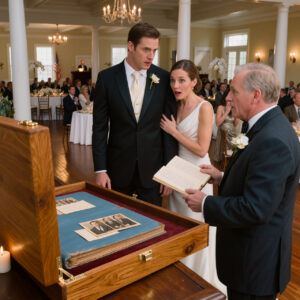
Kyle and Briana December 14th, 2024. The letters were clean and even pressed into the grain with a confidence I did not entirely feel in the rest of my body. When I finished, I blew the dust from the carved letters and held the box under the work light, turning it slowly.
It was the best piece I had made in years. I lined the interior with a square of dark red velvet I had cut from an old jewelry box Dot kept in the bedroom. She said she had no use for the box anymore and I could have the fabric.
I placed the blue notebook on the right side and the envelope of photographs on the left. Then I took a small piece of not paper from the workbench drawer and wrote seven lines in my plainest handwriting. Kyle, I am not coming to your wedding to cause trouble.
I am not coming to embarrass you or to make a scene. I am coming because I am your father and I have been your father for 34 years and that is not a thing a man stops being because he received an email with 25 conditions. Inside this box is something your mother made for you over 22 years.
She never showed it to me. I found it by accident. I think you should know what it says. I folded the note and placed it on top of the notebook.
Then I closed the lid, latched the clasp, and set the box on the corner of the workbench. Dot appeared in the doorway. She looked at the box. Her hand came up slowly and covered her mouth.
“Oh, Jean.”
She said. Her voice broke clean in half on my name.
“It’s just a box.”
I said. But my own throat had gone tight, and I had to look at the workbench instead of her face. Before I tell you what Jean put inside that box, and what he asked Marcus to do with it, type box in the comments, so I know you are still with me.
Every single comment means the world. Heads up, what follows contains some fictional elements woven in for depth and storytelling. If that is not your preference, no hard feelings, you are always free to step away.
Ray Kowalski showed up at my back door Monday morning with his second cup of coffee, and the expression of a man who had been thinking hard since before sunrise. I let him in without asking what he wanted, because after 35 years, that formality had stopped being necessary. He stopped in the kitchen doorway when he saw the oak box sitting on the table.
“Is that it?”
He said.
“That’s it.”
He walked over and stood in front of it without touching it, the way you stand in front of something in a museum that you respect too much to handle. He looked at the dovetail corners. He looked at the carved inscription on the lid.
He looked at the brass hinges.
“Jean.”
He said, “That is a beautiful piece of work.”
“Thank you.”
He pulled out a chair and sat down across from the box like it was a person at the table. Walk me through the plan. I poured him a cup of coffee from the pot on the counter and sat down.
Dot and I drive to Savannah Friday. Check into the motel. The wedding is Saturday afternoon at 4:00 at a place called the Grand Magnolia Ballroom. We arrive at the time Kyle specified, sit at table 14 as instructed, and we don’t bother anyone.
Ray wrapped his hands around the coffee cup. And the box? Marcus Tillman was invited to the wedding. Kyle worked with his brother-in-law on a property deal last year and the family stayed in touch.
I’m going to ask Marcus to carry the box in as his gift contribution and place it on the gift table. Ray nodded slowly. Kyle won’t know it’s from you until they open it.
He’ll see the inscription on the lid when they bring it up, I said. But by then, it’ll already be in the room. And inside is Dorothy’s notebook. What? And the photographs.
And the note. Ray drank his coffee and looked at the box for a long moment. Then he looked at me with the direct uncomplicated gaze of a man who had been my friend since Gerald Ford was president.
Betty and I want to come, he said. I had not expected that. Ray. I did don’t argue with me. He set his cup down firmly. I have known that boy since he was in diapers.
I have watched what has been happening in this family for the last 3 years and I have kept my mouth shut when I should have spoken and I am done keeping my mouth shut. Betty feels the same. Kyle didn’t invite you.
Me, Kyle didn’t invite half the people who deserve to be there. Ray’s jaw set hard. We’ll sit at your table. Table 14 near the kitchen. Betty says the food is always better near the kitchen anyway.
Something loosened in my chest that I had not realized was wound tight. You do that. We’re already doing it. He said. Betty bought a dress on Saturday. That afternoon, I called Kyle.
He picked up on the third ring with the slightly clipped tone he used when he was between tasks at work and did not want to be interrupted. Hey Dad. What’s up?
I’m calling to let you know that your mother and I will be at the wedding Saturday. I said. We’ll arrive at 3:30 as you requested, sit at table 14, and follow the other guidelines in your email.
A brief pause. Okay. Good. Another pause, slightly longer. Did you and Mom have a chance to look at the suit I sent the link for? We’ll be dressed appropriately.
I said. Dad, I sent a specific link. Kyle. I kept my voice even and warm the way I had learned to keep it during 38 years of dealing with clients who were difficult but whose money I needed.
We will be dressed appropriately. You don’t need to worry about that. He was quiet for a moment. Okay. He said finally. Just it matters to Breanna that everything looks cohesive.
I understand. I paused. Is there anything else you need from us before Saturday? No. A beat. Thanks for calling, Dad. Of course. I waited a moment. Kyle. Yeah. The word I wanted to say was not a short one and it was not a simple one and this was not the phone call in which to say it.
I knew that. So instead I said the only thing that was both true and manageable.
“We’ll see you Saturday.”
After I hung up, I sat at the kitchen table with the phone in my hand and the oak box in front of me and the blue notebook sealed inside it. And I thought about a boy who used to follow me to job sites on Saturday mornings and ask good questions about wood grain and joint angles.
And why things that were built right lasted longer than things that were built fast. Marcus Tillman knocked on the front door that evening. I had called him earlier and asked if he could stop by.
He came in, saw the box on the table and listened while I explained what I needed. When I finished, he was quiet for a moment looking at the inscription on the lid. Then he looked up.
His eyes were bright in a way that made him look younger than 30.
“Archie Tutter, chew Jean.”
He said he had picked up the habit of calling me that somewhere in the last year. And I had never corrected him because I did not want to.
“I’ll put it right where it needs to be. You have my word.” We left Maple Street at 6:00 in the morning before the sun had cleared the tree line.
Dot had been up since 4:30. I heard her moving through the house in the dark, the particular soft sounds of a woman who had spent a lifetime being careful not to wake anyone. The coffee was made when I came downstairs.
Our two bags were already by the front door, packed the night before with the quiet efficiency she brought to everything she did not want to talk about too much. I loaded the bags into the trunk of the Buick, checked the tire pressure the way I always did before a long drive and stood in the driveway for a moment looking at the house.
Maple Street was still and gray in the early December morning. The oak tree in Ray’s yard dropping the last of its leaves onto the sidewalk. Ray’s porch light was on.
It was always on. I found that steadying in a way I could not have explained to anyone. Dot came out the front door with both travel mugs. She handed me the one with the chipped handle, which was mine, and got into the passenger seat without ceremony.
I got in, adjusted the mirror, and backed out of the driveway. For the first hour we did not say much. The interstate was thin with traffic this early on a Friday.
Mostly trucks running overnight loads south to Miami or north toward Atlanta. I kept the speed at 65 and let the miles come. Dot held her coffee mug in both hands and watched the highway through the windshield with the particular alert stillness of a woman thinking through something she was not ready to say out loud yet.
It was somewhere around Gainesville that she spoke.
“Do you think he’ll look at us?”
she asked.
“At the wedding? Do you think Kyle will actually look at us when we walk in?” My hands stayed easy on the wheel.
“I don’t know.”
“I keep thinking about that.”
She turned her coffee mug slowly in her hands.
“Not about the box. Not about the notebook. Not about any of it. I just keep thinking about whether my son will look at me when I walk into the room.”
My chest tightened.
“He’ll look at you, Dot.”
“He looked right past me at Thanksgiving last year.”
She said not with bitterness, just with the flat accuracy of a woman reporting a fact she had verified too many times to dispute.
“We sat at his table for 3 hours, and he talked to Gerald Marsh about golf for 45 minutes. And he talked to Travis about some property deal, and he asked me once if I wanted more sweet potato casserole. I remember once She set her coffee mug in the cup holder and folded her hands in her lap.
I made that casserole from scratch. Same recipe my mother used. I have made it every Thanksgiving of Kyle’s life. Her voice was not breaking. That was almost worse, the steadiness of it, the careful control.
He asked me once if I wanted more. Then he turned back to Gerald Marsh. I reached over and put my hand over her folded hands. She turned her palm up and held on.
We stopped once outside of Lake City at a gas station with a Waffle House attached. I filled the tank while Dot went inside. She came back with two bacon and egg biscuits wrapped in foil and a fresh cup of coffee for each of us.
And we ate in the parking lot with the engine running and the heat on low. The biscuits were exactly what a Waffle House biscuit always was, too large, slightly greasy, and completely satisfying in the uncomplicated way of food that makes no promises about being good for you.
“Shop better than the hotel restaurant would have been.”
Dot said.
“Better than most things.”
I agreed. She smiled at that, a small, real smile, the kind that reached her eyes. I had not seen that smile in 2 weeks. And the sight of it did something complicated to my rib cage.
We reached Savannah at 11:15. The city came up slowly the way southern cities do. Spanish moss in the oaks lining the highway approaches the particular low golden light of a December morning in coastal Georgia.
I had always liked Savannah. It was a city that took its time, which suited me. The motel was a clean plain place on the western edge of the city.
Two stories, exterior corridors, a vending machine by the ice maker that Dot immediately identified as having Cheer Wine, which she had not seen since her cousin’s wedding in North Carolina in 1987. She bought two cans and carried them back to the room with the gravity of a woman transporting something irreplaceable.
Our room was on the ground floor facing the parking lot. Through the window past the row of cars, I could see the upper stories of the Hilton where Gerald and Susan Marsh would be staying. Kyle had mentioned it in passing two months ago.
His in-laws were coming in from Charlotte and he had booked them somewhere nice downtown. I stood at the window and looked at the Hilton for a moment. Then I pulled the curtain closed and sat down on the edge of the bed.
Dot set her Cheer Wine on the nightstand and sat beside me. We were quiet together in the dim room, the muffled sound of the interstate coming through the wall.
“Get some rest,” I said.
“Big day tomorrow.”
She leaned her head against my shoulder. Just that. No words. I put my arm around her and we sat there on the edge of that motel bed in Savannah, Georgia, two old people about to walk into something neither of us fully knew how to prepare for.
After a while, she said very quietly, “I’m glad you’re the one I married, Jean.” I pressed my lips against the top of her head.
“Me too, Dot,” I said.
“Me too.”
We dressed in the motel room. I wore the navy suit I had bought at J.C. Penney four years ago for my brother-in-law’s funeral. Not because I had nothing else, but because it was honest.
It was a good suit. It fit well. It was not the suit Kyle had sent a link for which had run $240 at a store in Atlanta that Briana apparently preferred.
I had looked at that link once and closed it. If I was going to walk into that room on this leg, I was going to do it in something I had chosen myself. Dot wore a pale blue dress that she had owned for years and loved without apology.
She stood at the bathroom mirror doing something careful with her hair. And when she came out, her eyes were bright and her chin was level and she looked, it seemed to me, like exactly who she was, a 65-year-old woman who had spent four decades being underestimated by people who did not know any better.
“You look beautiful,” I told her. She patted my arm and handed me my coat.
“Don’t get sentimental before we even get there.”
Ray and Betty met us in the parking lot at 3:15. Betty was wearing a deep burgundy dress and had done something with her silver hair that made her look 10 years younger. Ray had on his good suit, the charcoal one he wore to his daughter’s college graduation in 2017.
He looked at me steadily when we shook hands and that steadiness went into me like something solid. We drove to the Grand Magnolia Ballroom in two cars. The venue was in the historic district, a restored building with white columns and iron railings on Abercorn Street.
The kind of place that charged by the hour for graciousness. A valet in a red jacket took the cars. I noticed the parking area held several vehicles with Charlotte license plates.
The Marsh contingent had arrived in force. The front entrance had a reception table staffed by two young women in matching black dresses who checked names against a tablet. When I gave them mine, the one on the left ran her finger down the screen and said with practiced brightness, “Mr. and Mrs. Stafford, you’re at table 14, straight through the main doors and to your left.”
I thanked her. Dot took my arm. We walked through the main doors together. The Grand Magnolias Ballroom was everything Kyle and Briana had apparently spent eight months and a significant sum of money making it.
White orchids climbed arrangements on every table. Candles in tall hurricane glasses lined the center of the room. A monogram in gold script, K and B interlocked, glowed on a screen behind the raised platform at the far end.
The ceiling was coffered plaster painted ivory with chandeliers hung at intervals that caught the candlelight and distributed it in a way that made everything look warmer and more expensive than it possibly could have been. There were perhaps 200 guests already seated or moving between tables. The sound was the particular murmur of well-dressed people who did not know each other well enough yet to be loud.
And then I heard it. A laugh. Low, quickly covered. I did not turn my head immediately. I had learned in 68 years that the worst thing you can do when someone laughs at you is let them see that you heard it.
Instead, I kept walking, my left leg doing what my left leg did now, and I let the laugh happen behind me in whatever corner it had come from. But Dot’s grip on my arm tightened by exactly 1 degree. She had heard it, too.
I allowed myself one glance toward the front tables as we passed. Gerald Marsh was seated at table one. Of course, he was a broad man in a dinner jacket, silver-haired and comfortable in the way of people who have been comfortable for so long they have stopped noticing it.
He had said something to Susan beside him and his hand was lifted in front of his mouth and the expression on his face was the expression of a man who had just made a quiet joke at someone else’s expense. At a table three rows back, Travis Cole sat in a suit that was shiny in the wrong places.
He caught my eye for 1 second, then leaned toward the man next to him, Kyle, who was standing near that table greeting guests, and said something close to Kyle’s ear. Kyle’s mouth twitched. He brought his hand up and pressed his knuckles against his lips and he turned his head slightly to the side, the way people do when they are trying to contain a laugh they know they should not have.
Dot made a sound that was not quite a word. Very small. Very controlled. Like something she had caught before it could become what it wanted to be. Don’t. I said quietly.
Not to her. To myself, really. To the part of me that wanted to stop walking and say something that could not be unsaid. We found table 14 along the left wall as promised.
Close enough to the kitchen door that the sound of rolling carts and stacked plates came through clearly. Ray pulled out a chair for Betty. I held Dot’s chair. We sat down four people at a table meant for eight in a room full of people who had been sorted by someone’s calculation of their worth.
I looked at the tablecloth. White linen, same as every other table in the room. The candle in the hurricane glass was the same size as the ones at table one.
That detail, for some reason, struck me as almost funny.
“View’s not bad.”
Ray said.
“You can see the whole room from here.”
Betty agreed. I looked across the ballroom toward the gift table near the platform. The oak box sat there near the end of the row, the carved inscription on its lid catching the candlelight.
Marcus Tillman, seated at table nine with Jenna, caught my eye and gave a single small nod. The box was in the room. Whatever happened next was going to happen.
The ceremony began at 4:00 exactly. A string quartet positioned near the platform started with something classical that I did not know the name of, but recognized as the kind of music chosen to signal that what was happening was serious and expensive. The guests settled.
The murmur of conversation dropped away in layers, table by table, until the room was the particular quiet of several hundred people agreeing simultaneously to pay attention. The officiant, a man in his 50s with the measured voice of someone accustomed to performing in large spaces, took his position on the platform and welcomed the guests with the standard language of wedding ceremonies, the words about love and commitment and the significance of witnesses.
I had heard versions of this speech four or five times over the years at the weddings of friends and relatives. It had never before felt quite so much like it was being said in a different language than the one I spoke. The groomsmen came first, filing in from the side door in matching charcoal suits.
Travis Cole was among them, and he moved with the particular looseness of a man who had convinced himself that being in this room on this occasion was a measure of his own importance. He took his position near the front without glancing toward table 14. Then Kyle walked out.
I had not seen my son in his wedding suit before this moment. He was tall. He had gotten that from my side with the straight posture he had always carried.
And in the black suit with the ivory tie Briana had apparently selected, he looked like the kind of man that people assume is successful without asking for evidence. He was 34 years old and he was handsome. And he was someone I had spent 34 years loving without condition.
And standing there at the front of that ballroom, he looked almost completely like a stranger. My throat tightened around something I was not going to name in this room. Kyle took his position at the front.
His eyes moved across the assembled guests with the practiced survey of a man who had been told exactly where everyone would be sitting. When his gaze reached the left wall, it found table 14. It found me.
For 2 seconds we looked at each other across the length of the Grand Magnolia Ballroom. Then he looked away. Dot’s hand found mine under the table. Her fingers were cold.
I held them. The bridesmaids came next. Then the flower girl, a small child of about six, who scattered petals with the intense concentration of someone performing surgery. And then the music shifted to the processional and every head in the room turned toward the back doors.
Briana came in on her father’s arm. She was, I will say this honestly, a beautiful bride. The dress was simple and well-fitted, the kind that required a particular confidence to wear.
Gerald Marsh walked beside her with the expression of a man who was entirely aware that every eye in the room was on him by proximity and did not mind this at all. He delivered her to the front with a kiss on the cheek and took his seat at table one where Susan reached over and gripped his arm.
The ceremony itself was not long. The officiant spoke about partnership and building a life together. Kyle and Briana had written their own vows, which they read from small cards.
Briana’s were polished and assured. Kyle’s were genuine in a way that surprised me. He spoke about wanting to be the kind of man who showed up, who was present, who did not leave when things became difficult.
I sat at table 14 and listened to my son say those words and felt something press against the inside of my sternum that had no clean name. Ray beside me exhaled slowly through his nose. Betty reached over and put her hand briefly on top of Dot’s.
When the rings were exchanged and the officiant pronounced them married and Kyle kissed his wife, the room responded with the warm collective sound of people genuinely moved or performing being genuinely moved at a wedding. It is sometimes difficult to tell the difference. I clapped with the rest of them.
Dot clapped beside me, her eyes bright. Then the couple turned to face their guests and Kyle’s eyes swept the room again with that same surveying look. And this time when he reached table 14, he did not stop.
His gaze moved past us and continued around the room as if table 14 contained nothing worth pausing on. The music swelled. The couple began their recessional walk. As they passed our table close enough that I could see the small pearl buttons on Briana’s sleeve, she turned her head toward the room to acknowledge the applause and her eyes moved across the left wall with the mechanical pleasantness of a smile that had been prepared in advance.
She did not look at Dot. She did not look at me. She looked through us the way you look through a window at something more interesting on the other side.
Dot’s hand had gone very still in mine. The room broke into the general movement of guests rising, stretching, gravitating toward the bar. Servers appeared with trays of champagne. The MC, a man in his 40s, with a practiced ease took the microphone and announced that dinner would be served shortly and that before dinner the couple would be honored by a special gift presentation from their families, which had been personally arranged by the bride.
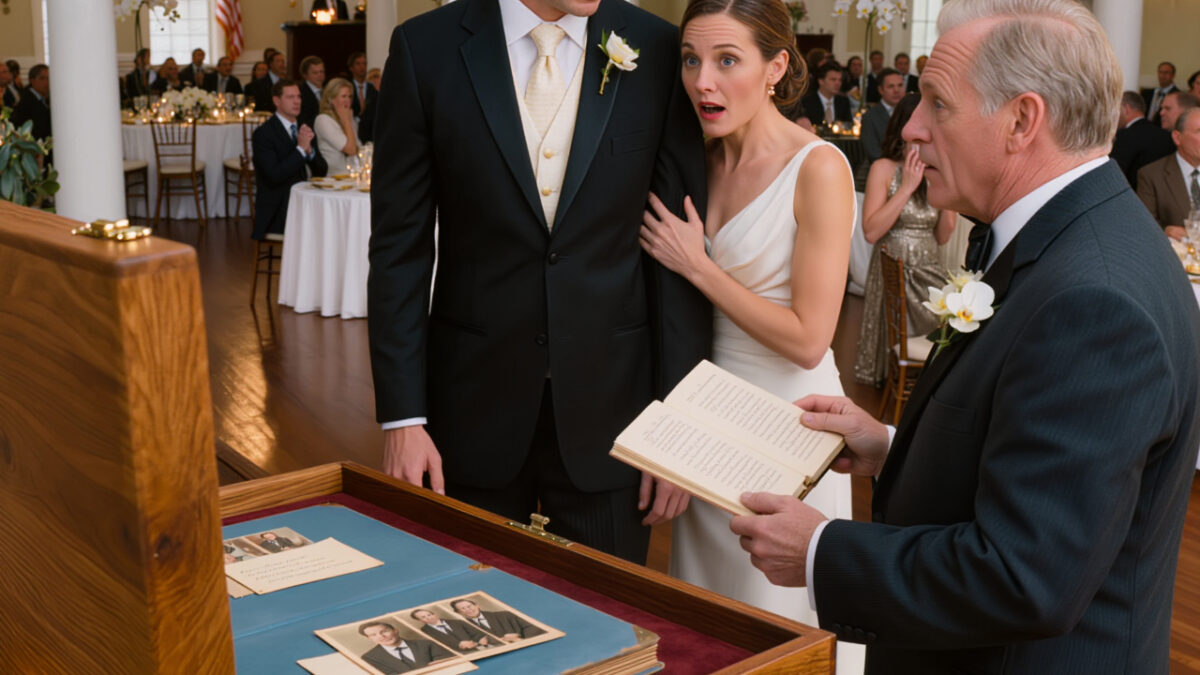
And was he said with a smile going to be memorable. I looked at the gift table. The oak box sat at the end of the row exactly where Marcus had placed it, the carved lid catching the light from the nearest chandelier.
My left hand, the one that was not holding Dot’s, rested on my knee. I pressed it flat against my thigh, against the leg that had healed as well as it was going to heal, and waited for what was coming. Dinner had been cleared and the champagne had made its second round by the time the MC took the microphone again.
“Ladies and gentlemen,” he said with the practiced warmth of a man who had done this many times, “Before we open the dance floor, Kyle and Briana have arranged something very special. This is the family gift presentation, a tradition they have created for this evening to honor the people who helped build the foundation of this marriage.”
Applause moved through the room. Briana, seated now at the head table on the platform, smiled at the room with the composure of a woman who had planned this moment down to the minute. Kyle sat beside her with his hand on the back of her chair, looking relaxed in the way that people look relaxed when they believe they are in complete control of what is about to happen.
From table 14, I watched the gift table. A server and one of the venue’s event coordinators had begun organizing the items there, and I could see the oak box at the end of the row. It was the largest single item on the table, and the carved inscription on the lid caught the candlelight in a way that made the letters visible from where I was sitting.
Kyle had not noticed it yet. The presentation began with gifts from Briana’s side. Daniel’s parents, a couple from Charlotte who had arrived that morning, presented a check in an embossed envelope that Gerald Marsh announced to the room with evident satisfaction.
Two of Briana’s cousins brought framed photographs. An aunt on the Marsh side gave a set of monogrammed crystal glasses that were carried to the platform with both hands. Each gift produced applause.
Each applause produced a photograph. The MC narrated with the cheerful efficiency of someone being paid by the hour. Then the server lifted the oak box. I felt Ray shift in the seat beside me.
Under the table, Dot pressed her knee against mine. The server carried the box to the platform and set it on the table in front of Kyle and Briana. Kyle looked at it for the first time at close range, and I watched the moment he understood what it was.
The quarter-sawn oak, the hand-cut dovetails at the corners, the brass hinges and clasp, the carved inscription on the lid. His jaw tightened by exactly 1 degree. Briana looked at the box and then looked at Kyle with a question in her eyes.
Kyle said something to her quietly and whatever it was made her expression go careful and flat in the way of someone deciding how to respond to something unexpected in public. The MC leaned toward the box and read the card that Marcus had attached. This gift comes from Jean and Dorothy Stafford.
He straightened and smiled at the room. From the groom’s parents. Applause. Polite, scattered, appropriate. Kyle put his hands on the clasp. Aidan, maybe we open this one privately. Breanna said, her voice pitched low using the MC’s first name with the familiarity of someone who had briefed him three times in the past week.
But Kyle had already lifted the lid. On top was my note, the folded piece of notepaper with seven lines in my plainest handwriting. Kyle picked it up, unfolded it, and read it.
I could not see his face from table 14. I could see his shoulders and I watched them change as he read a barely perceptible shift, a slight drop, like something had let go of a tension he had been holding since he walked into the room. He set the note down without reading it aloud.
Then he lifted the blue notebook out of the box. He held it for a moment, turning it over in his hands. The faded blue cover. Dot’s handwriting on the front.
One word, Kyle. What is that? Breanna asked. Her voice was still controlled, still quiet. But there was an edge in it now, the edge of a woman who has organized something carefully and is watching an element she did not account for enter the room.
It’s my mother’s, Kyle said. Gerald Marsh had risen from his seat at table one. He was a man who operated on instinct in social situations. 40 years of business dinners had trained him to move toward the center of any room where something interesting was happening.
He stepped onto the platform without being invited the way men like Gerald Marsh moved through the world as if the invitation were implied by their presence. He reached out and took the notebook from Kyle’s hands with the casual authority of a man who had never been told no at a party.
May I? He said already opening it. Kyle did not answer. I am not sure he could have. Gerald Marsh opened the notebook to the first page. He read the date.
He read the first entry. And then because Gerald Marsh was a man who had spent his career presenting information to rooms full of people, he read it out loud without fully deciding. To the words simply came out of him the way words come out of people who are accustomed to filling silence.
March 1998, he said. His voice carried without effort to the nearest tables. Skipped buying winter coat this year. Set aside $47 for Kyle’s school fund. The table nearest the platform went quiet.
Gerald Marsh turned the page. June 1998. Jean worked an extra shift Thursday and Friday. Took the difference, $60, added to Kyle’s fund. Jean doesn’t know I’m keeping track separately.
He would tell me not to bother. He would be wrong. Susan Marsh, still at table one, pressed both hands flat against the tablecloth in front of her. Gerald turned another page.
His voice had changed slightly. The presentation quality had dropped out of it, replaced by something more careful, more private, the voice of a man reading something he had not expected to be moved by. June 2006 Sold my mother’s gold chain at the pawn shop on Highway 27.
$340. Told Jean I traded it in for a new one. He believed me. The table behind Gerald went quiet, too. The quiet was spreading outward from the platform in a slow ring table by table, the way a stone dropped in still water sends its circles to every edge.
Briana’s hand closed around Kyle’s arm. Kyle. She said, her voice dropping to something urgent and compressed. Tell him to stop. Kyle did not tell him to stop. Gerald Marsh turned to the last written page and went very still.
Gerald Marsh read the final page without looking up from the notebook. The ballroom had gone quiet enough that I could hear the candles in the hurricane glasses, not quite a sound, more of an absence of sound, the particular hush of 200 people deciding simultaneously to hold still.
Then Gerald read the last entry aloud in a voice that had lost all its dinner party ease and become simply the voice of a man who had been handed something he was not prepared for. Total 22 years $47,200. He paused.
His chest rose and fell once. This is not a debt. I am not writing this down so anyone will repay it. I am writing it down because I need to remember that I did right by my son.
That whatever happens, I chose him over and over when he didn’t even know there was a choice being made. He stopped reading. The room did not react immediately. It absorbed the way rooms absorb things that are too large for an immediate response.
Then Susan Marsh made a sound from table one, not a word, just a sound, the kind that escapes before a person can decide whether to let it. And she pressed her fingers hard over her mouth, her shoulders pulling inward. Gerald closed the notebook.
He stood on that platform with the blue notebook in both hands, and he looked at Kyle. And the look on his face was not the look of a man who was angry or performing. It was the look of a man who had just recalculated something fundamental and found the original figure to be entirely wrong.
Kyle’s face had gone the color of the ivory tablecloths. Briana stepped forward. This is a private family matter, she said to the room, her voice recovering its authority, her chin lifting.
This is not something that was intended to be Excuse me. The voice came from the left side of the room, table 14. Ray Kowalski pushed his chair back and stood up.
He was a large man, and the act of him standing drew every eye in the room without effort. He did not reach for a microphone. He did not need one.
Ray had spent 30 years working road construction crews, directing equipment and traffic over engine noise. He knew how to make himself heard. My name is Ray Kowalski, he said in the carrying voice of a man making a plain statement.
I have lived next door to Jean and Dorothy Stafford for 35 years. I want to say something if nobody objects. Nobody objected. I watched Jean Stafford work extra shifts for years so his son could go to college without debt.
Ray said, “I saw Dorothy sell jewelry she had inherited from her mother to cover tuition she never told her husband about. I watched Jean climb onto the roof of Kyle’s house this past August alone at 68 years old because the estimates from contractors were too high and Jean was not the kind of man who said no to his son.”
Ray’s voice did not waver. It did not rise. It simply continued steady as a load-bearing wall. That fall broke something in his leg that did not fully heal. He walks into this room tonight with that injury.
And I watched two people laugh when he came through that door. The room turned. Not all at once, not dramatically, but the heads at the nearest tables rotated toward the front, toward Gerald Marsh with the slow collective movement of people putting information together.
Gerald Marsh set the notebook down on the gift table. His hand stayed on it for a moment as if he was not sure what to do with a hand that had just been holding something like that.
“I’m not saying this to embarrass anyone.”
Ray continued.
“I’m saying it because that man sitting at table 14 has been quiet for a long time. Too long.” He looked directly at Kyle.
“And the people who benefited from his quiet ought to know what it cost him.”
Ray sat down. The room rearranged itself in the silence that followed the particular rearranging that happens when people in a social situation have been given a piece of information that makes the arrangements of the room look different than they did 5 minutes ago. Marcus Tillman stood up from table nine.
He was younger than anyone else who had spoken and And spoke with the directness of a man who had made a decision on the drive over and was not going to unmake it. My wife and I moved to Maple Street 14 months ago, Marcus said. The first morning after our moving truck left, Jean Stafford knocked on our door with a bookshelf he had built because he thought we might need it.
Just because. He looked at Breanna. A few weeks later, my wife saw something from our window. She saw you take a pot of soup that Dorothy had cooked and driven over when Kyle was sick and she watched you empty it into the trash can at the side of your house.
Then she watched you rinse the pot out with the garden hose. He held Breanna’s gaze without aggression, just with the steady clarity of a witness. My wife is a second grade teacher.
She does not exaggerate and she does not lie. Breanna’s face had gone very still. The composure was still there, but it had stopped being natural. It had become the kind of composure that requires active maintenance, the way you hold a door shut against wind.
That is completely she started. I was there, Jenna Tillman said from beside Marcus. She did not stand. She simply said the four words clearly and they were enough. Breanna turned to Kyle.
Her eyes were bright and urgent. Kyle, say something. Kyle was looking at the blue notebook still sitting on the gift table where Gerald had set it. He was looking at it the way you look at something you have known your entire life without seeing it.
The sudden recognition that an ordinary object has been doing extraordinary work without your knowledge. He did not say something. The silence after Jenna’s four words lasted perhaps 3 seconds.
Then Betty Kowalski stood up. Betty was 68 years old and 5 ft 3 in tall. And she had the particular stillness of a woman who had spent decades being underestimated and had long since stopped minding.
She did not raise her voice. She did not need to. The room was quiet enough that she could have whispered and been heard at the back wall. She was not looking at Kyle or at Briana.
She was looking at Travis Cole. Travis was seated at a guest table two rows back from the platform. And he had been growing progressively smaller in his chair since Ray stood up.
The shiny suit that had looked like confidence 2 hours ago now looked like a costume. His champagne glass had been empty for a while and he had not flagged down a server to refill it because flagging down a server would have required movement and movement would have drawn attention.
Betty looked at him the way she looked at things in her garden that did not belong there. I know you. She said. Travis looked up. His smile came out reflexively, the automatic charm of a man accustomed to talking his way through things.
Ma’am, I think you might have me confused with I do not have you confused with anyone. Betty said with the tranquil certainty of a woman who had been remembering faces since before Travis Cole was born. You are the boy who used to stand outside Gene Stafford’s front gate when Kyle was 14 years old trying to talk him into skipping school.
I watched you from my front porch more times than I can count. And I recognize your face the way I recognize every face that grew up on that street. Travis’s smile lost its footing.
You told Kyle for years that where he came from was something to leave behind. Betty continued. You told him that his father’s work was something to be ashamed of.
I know this because Ray heard it and Ray told me and things Ray tells me stay told. She tilted her head slightly. How many times did Jean Stafford feed you at that kitchen table when you were a boy?
How many Saturday mornings did you show up at that house and leave with a full stomach and then spend the afternoon telling his son he was better than his family. The table around Travis had developed the particular stillness of people trying very hard not to be noticed. Travis opened his mouth.
Nothing useful came out. You don’t have to answer. Betty said pleasantly and sat back down. The room had reached a temperature I could feel from table 14. Not quite anger, something more precise than anger.
The temperature of people who have sorted out what they think about something and are no longer withholding the verdict. Susan Marsh stood up from table one. She was a composed woman who had been composed all evening and the composure held now but it had changed quality.
It was no longer the composure of a woman enjoying herself. It was the composure of a woman who had made a decision and was carrying it with both hands. She walked to the platform.
She picked up the blue notebook from the gift table where Gerald had left it. She opened it to the last page and read the final entry to herself moving her lips slightly the way people do when they want to make absolutely certain they have read something correctly. Then she looked at her daughter.
Briana. Her voice was not loud. It did not need to be. Did you know about the notebook? Breanna’s jaw tightened. Mother, this is not the time. I am asking you a question at your wedding, Susan said.
I would like an answer. Did you know that Dorothy Stafford had been setting money aside for Kyle for 22 years? That has nothing to do with Did you know Susan continued with the patient persistence of a woman who had asked Breanna to answer questions since she was 4 years old and had learned to wait that Jean Stafford fell off the roof of your house and walks with a permanent injury because of it.
The composure on Breanna’s face cracked. Not completely. She was too controlled for a complete crack, but at the edges where the maintenance had gotten expensive. He offered to do that himself, Breanna said.
Nobody asked him. Kyle asked him, Ray said from table 14. He was still seated. He did not need to stand to be heard anymore. I heard that phone call through the fence.
Gerald Marsh, standing to the side of the platform with his hands in his jacket pockets and the expression of a man doing difficult arithmetic, turned to look at his son-in-law. Kyle. His voice was different now than it had been all evening.
The bonhomie had gone out of it entirely. Leaving something straighter and less comfortable. Tell me something honestly. When you put your parents at table 14, what was your thinking?
Kyle had not moved from his position in front of the gift table. He was still looking at the blue notebook in his mother’s hands. The wedding suit that had looked so right 3 hours ago now seemed to belong to a slightly different person than the one standing in it.
His throat moved.
“Suck it, Zeda.”
“It was the table that made sense for the space.”
he said. The words came out rehearsed, and he heard it, too. I could tell by the way his expression shifted after he said them, the slight flinching recognition of a man who has just heard himself say something he does not fully believe.
Gerald looked at him for a long moment.
“Is that what you want to stand behind tonight?”
“It made sense for the space.”
Kyle looked at his father-in-law. Then he looked at his mother who was holding the notebook, the way she had carried things her whole life, carefully, with both hands, as if whatever was inside deserved that much. Then across the length of the ballroom, he looked at table 14.
He looked at me. I did not look away. I did not say anything. I just held his gaze from that table by the kitchen door, in the navy suit I had chosen myself, with my left leg aching the way it always ached at the end of a long day, and I let my son look at his father and see whatever it was he needed to see.
Whatever he found there, I could not tell you. His face did something complicated that I did not have a name for. Then Breanna stepped forward, and the room shifted again.
Breanna walked to the center of the platform with the particular deliberateness of a woman who has decided that the only way out of a situation is through it. She had stopped trying to look composed. The composure was gone now, not shattered, not dramatic, but simply absent the way a mask goes absent when a person has run out of the energy required to hold it in place.
What was underneath was something harder and more honest than anything she had shown the room all evening.
“I want to say something.”
She announced to the room rather than to any individual in it. Nobody stopped her.
“Jean and Dorothy Stafford are good people.”
She said. The words came out clipped and forceful, the cadence of someone making a legal argument.
“Nobody in this room is disputing that. But there is a context that has not been mentioned tonight. And I think it is important.” Gerald Marsh crossed his arms. Susan watched her daughter with an expression I could not fully read from table 14, something between dread and the particular attention of a mother who knows her child is about to say something that cannot be unsaid.
“Jean has a pension.”
Breanna said.
“Dorothy has a retirement account. They own their home. They are financially stable in a way that Kyle and I are not. We are building from zero. We have a mortgage, we have student loans, we have business expenses, and we are doing it without a foundation underneath us.”
Her voice had found a rhythm now, the rhythm of someone who has rehearsed this argument internally many times.
“If the people who love Kyle wanted to support him the way the notebook says they did, then the support worked. He is here. He is successful. He is happy.
The sacrifice accomplished what it was supposed to accomplish.” The room received this in a silence that had changed texture from the silence of 5 minutes ago. Then Breanna said the thing.
“They could afford it.”
She said.
“Jean and Dorothy could absorb those costs in a way that Kyle and I simply cannot. That is not ingratitude. That is math. The words landed in the ballroom the way certain things land, not with a crash, but with a settling, a final weight coming to rest on a surface that would now have to hold it permanently.
Susan Marsh closed her eyes. Gerald uncrossed his arms and put both hands in his pockets and looked at the floor. Ray made a sound beside me at table 14, low and involuntary.
The sound a man makes when he has heard something confirm exactly what he feared. Dot’s hand found my wrist under the table. Her grip was so tight I could feel her pulse against my skin, fast and hard, the pulse of a woman holding herself together by main force.
I looked at my wife’s profile, the line of her jaw, the set of her mouth, the brightness in her eyes that was not tears yet, but was close. And I thought about a woman sitting alone at a kitchen table in 1998, writing down $47 in a blue notebook while her husband worked an extra shift he did not know was funding the same account.
I thought about a gold chain that went to a pawn shop on Highway 27 and never came back. I thought about a woman sleeping in a hospital chair for five nights because she would not let her husband wake up in the dark alone. I thought about the word afford.
I pushed my chair back and stood up. It was not a dramatic movement. I did not knock anything over. I simply stood the way a man stands when he has been sitting long enough and it is time to be vertical again.
My left leg registered the familiar protest and I let it register without responding to it. The room noticed. Heads turned toward table 14. I did not look at Briana.
I did not look at Kyle. I looked at Dot, who was still seated, still holding my wrist. Her eyes coming up to find mine with a question in them.
“Dot.”
I said.
“Let’s go home.”
She held my gaze for 1 second. Then she released my wrist, placed both palms on the table, and stood up beside me with the unhurried dignity of a woman who has nothing to prove to this room or any other. Ray and Betty rose simultaneously, without a word, without a signal.
They simply stood because that is what you do when you have been someone’s neighbor for 35 years and you have come to a place like this together. I picked up Dot’s small evening bag from the back of her chair and handed it to her. She took it.
I offered her my arm. She took that, too. I turned toward Gerald Marsh, who was still standing near the platform with his hands in his pockets and an expression that had aged 10 years in the last 20 minutes.
I nodded to him. Not warmly, not coldly. Simply the nod of one man acknowledging another.
“Thank you for reading The Notebook.”
I said. He opened his mouth. Then he closed it. Then he nodded back. We walked toward the exit. The room did not part for us dramatically. People shifted in their chairs, turned their heads, created space in the natural way of crowds responding to movement.
The walk from table 14 to the main doors of the Grand Magnolia Ballroom was perhaps 40 feet. My left leg did what it did. I did not hurry, and I did not slow down.
Ray’s hand landed on my shoulder. As we reached the door, one firm brief pressure there, and then gone, the kind of contact that does not require explanation between men who have known each other since Gerald Ford was president. Behind us, I heard Briana’s voice start again, higher now, less controlled.
Kyle, say something. Tell them. And then the main doors closed behind us, and her voice was gone. And there was only the cool December air of Savannah, and the quiet of Abercorn Street, and Dot’s arm in mine.
She did not speak until we reached the car. Then she stopped beside the passenger door and turned to face me, and her eyes were wet now. Finally, the tears she had been holding since the moment Gerald Marsh laughed in that doorway.
And she pressed both hands flat against my chest, over the breast pocket where I had carried her notebook for 2 weeks. And she said in a voice so low I had to lean in to hear it. You kept it safe, Jean.
I covered her hands with mine. You kept it safe. I said, “For 22 years.” We got back to Maple Street at 11:47 at night. I know the exact time because I looked at the dashboard clock when I pulled into the driveway.
The way I always check the clock when I come home from somewhere difficult, as if knowing the precise moment of return gives the return more weight. The house was dark. The oak tree in Ray’s yard was still the December air, finally cold enough to have an edge to it, even in Florida.
Ray’s porch light was on. It was always on. I had found that steadying every day for 35 years, and I found it steadying now, and I was grateful for the kind of comfort that does not require explanation.
Ray and Betty were sitting in the two wooden chairs on our front porch. Ray had his coat on and his hands around a thermos. Betty had a blanket across her knees and two mugs set on the small table between the chairs.
They had driven back separately, arrived before us and simply sat down to wait. There was no particular expression on either of their faces. Not pity, not satisfaction, not the careful brightness of people who want you to know they are there for you.
Just two old people sitting on a porch in the dark because their friends were coming home and they did not want the porch to be empty. Dot looked at them through the windshield and pressed her fingers over her mouth.
“Oh,” she said. Just that one word. We got out of the car. Betty poured the tea without being asked. She had brought the thermos from their kitchen chamomile, the kind Dot kept in the cabinet, and we sat on the porch, all four of us, and drank tea in the December night and did not say very much because there was nothing that needed saying that the sitting together did not already say better.
After a while, Ray looked over at me and said, “You okay?”
“Getting there,” I said. He nodded. That was enough. They stayed until 1:00 in the morning. When they left, Betty hugged Dot for a long time and did not say anything at all, which was exactly right.
Ray shook my hand and held it for an extra second. Then they walked back across the property line and their porch light went on inside and ours went off and Dot and I went to bed. In the weeks that followed, the pieces settled the way pieces always settle, not neatly, not without cost, but with the particular gravity of things finding their true level.
Gerald Marsh called on a Tuesday, 3 days after the wedding. He asked for me specifically. He was not a man who apologized easily. I could hear the structure of the sentence before he found the words for it.
But he said that he had laughed when I walked into that room and that he was sorry for it. He said he had read the notebook twice since Saturday night and that he understood now that he had been looking at the wrong things. I told him I accepted his apology.
I meant it. Kyle called on a Wednesday. He was quiet for a long time before he spoke. And when he did, his voice had a texture I had not heard in it for years.
Something younger and less certain and more real than the voice he had been using at dinners and phone calls for the past 3 years. He said he had not known about the notebook. He said he had not known about his mother’s jewelry or the extra shifts or what the fall from the roof had done to my leg permanently.
“I should have known,” he said.
“I should have asked.”
“Yes,” I said.
“You should have.”
We did not resolve everything on that call. We did not pretend to. But it was the first conversation in a long time that felt like it was being conducted between the actual people involved rather than the versions of ourselves we had each decided to present.
Briana did not call. Travis Cole did not call either, which was a relief I had not anticipated feeling as clearly as I did. Marcus Tillman brought over a pot of chili on a Friday evening.
He and Jenna stood on the porch and did not come in, just handed it over and said they were glad we were home. Jenna said she hoped the drive back had been all right. I told her it had been fine.
She smiled the way young people smile when they are genuinely relieved without any performance in it. The chili was excellent. By March, the azaleas on the side yard were starting to come back.
I had pruned them in January and fed them in February and they were responding the way good plants respond to being taken care of, not dramatically, not overnight, but steadily putting out new growth along the branches in the particular pale green of early spring. One evening in March, I went out to the garage after dinner.
I had a piece of white oak that had been sitting on the lumber rack for 2 months. Wider than the quarter-sawn board I had used for Kyle’s box, with a figure in the grain that caught the light differently depending on the angle. I had been thinking about what to do with it since January and I had finally decided.
I lifted it down from the rack and laid it across the workbench. Dot appeared at the garage door right on schedule with her cup of tea.
“What are you making?”
she asked.
“Just a bookshelf,” I said.
“For Marcus and Jenna. They mentioned they needed another one.” She looked at the white oak board.
“That’s beautiful wood.”
“Figured oak,” I said.
“The grain pattern comes from the medullary rays, the way the light catches the cells when the wood is cut at the right angle. I ran my hand along the surface. Takes longer to find a board with this kind of figure.
Worth it, though.” Dot came and stood beside me at the bench and looked at the board the way she had looked at the quarter-sawn oak in November with the quiet appreciation of a woman who had spent 40 years watching a man love his work.
“Gene,” she said.
“Yeah.”
“I’m glad we went. I picked up my marking gauge. My left leg was comfortable tonight. The cold had lifted and the joint was cooperative the way it sometimes was on warm spring evenings in Florida.
Me, too. I said. I set the gauge to my measurement, pressed it against the edge of the board, and drew the first line. The garage smelled like sawdust and wood oil and the particular dry warmth that had been the smell of my working life for 38 years.
Outside through the small high window, the March sky was going from pale blue to the deeper blue of early evening. Ray’s porch light would come on at 7:00. It always did.
My name is Eugene Stafford. I am 68 years old. I built things for 38 years and I am still building things. And I have a wife who kept a blue notebook for 22 years without telling me and neighbors who sit on porches in December without being asked and a son who is learning slowly what it means to look at the people in front of him and actually see them.
That is not everything. But tonight in this garage with this piece of figured oak on the bench and Dot standing beside me with her tea, it is enough. People have asked me what I would have done differently.
Honestly, I would have spoken sooner. I waited too long, swallowed too much, and called it patience when it was really fear. Fear of being the difficult one. Fear of cracking something that was already broken long before I touched it.
Do not make that mistake. The people who love you quietly, who write things down in blue notebooks, and never show you they deserve to be seen before a ballroom full of strangers sees them first. I am not a man who talks about faith easily.
But I will say this, once I believe God put Ray and Betty on that street 35 years ago for a reason. And I believe he put Marcus and Jenna there 14 months ago for a reason, too. Some things are not coincidence.
Some things are just grace arriving in the form of neighbors who show up with thermoses and chili pots, and no explanation needed. If this story found you tonight, maybe it found you for a reason, as well. These grand pastries are not just entertainment.
They are mirrors. And this revenge story did not end with punishment. It ended with a piece of figured oak on a workbench, and a woman standing beside me saying she was glad we went.
That is the only revenge worth having. The kind that gives you your life back. If something in this story sat with you, leave a comment below. Share it with someone who needs to hear it, and subscribe, so you never miss what comes next.
Thank you for staying until the very end. It means more than you know. The grand pastries and revenge story content on this channel contains fictional elements created for reflection and education.
If this type of storytelling is not for you, we respect that completely. Feel free to explore other content that better suits you. We will always be here for those who choose to stay.